Bernard Cornwell - Stonehenge
Здесь есть возможность читать онлайн «Bernard Cornwell - Stonehenge» — ознакомительный отрывок электронной книги совершенно бесплатно, а после прочтения отрывка купить полную версию. В некоторых случаях можно слушать аудио, скачать через торрент в формате fb2 и присутствует краткое содержание. Жанр: Старинная литература, на русском языке. Описание произведения, (предисловие) а так же отзывы посетителей доступны на портале библиотеки ЛибКат.
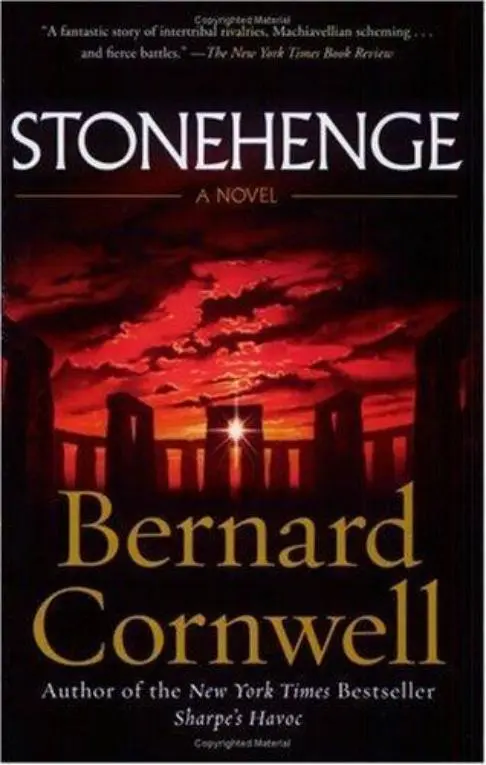
- Название:Stonehenge
- Автор:
- Жанр:
- Год:неизвестен
- ISBN:нет данных
- Рейтинг книги:3 / 5. Голосов: 1
-
Избранное:Добавить в избранное
- Отзывы:
-
Ваша оценка:
Stonehenge: краткое содержание, описание и аннотация
Предлагаем к чтению аннотацию, описание, краткое содержание или предисловие (зависит от того, что написал сам автор книги «Stonehenge»). Если вы не нашли необходимую информацию о книге — напишите в комментариях, мы постараемся отыскать её.
Stonehenge — читать онлайн ознакомительный отрывок
Ниже представлен текст книги, разбитый по страницам. Система сохранения места последней прочитанной страницы, позволяет с удобством читать онлайн бесплатно книгу «Stonehenge», без необходимости каждый раз заново искать на чём Вы остановились. Поставьте закладку, и сможете в любой момент перейти на страницу, на которой закончили чтение.
Интервал:
Закладка:
When the tide turned Saban did not detect it, but Lewydd was satisfied and his eight paddlers gave a shout and drove the boat out to sea. They went well away from the coast before turning east and now the wind was behind them and so Lewydd ordered a sail raised. The sail was made of two ox hides that were hung on a short spar suspended at the top of a stubby mast, and once the wind caught the leather it seemed to Saban that the boat flew, though still the waves came faster. The great seas would heap up behind and Saban feared the boat must be overwhelmed, but then the stern would lift and the paddlers would redouble their efforts and for a heart-stopping moment the wave would carry the boat forward in a great seething surge before the crest passed under the hull and the boat would lurch back and the sail would crack like a whip. The other crews raced them, driving their paddles hard so that the spray flicked up in the sun. They chanted as they worked, rivalling each other in music as well as in speed, though sometimes the chanting paused as men used sea-shells to scoop water from their boats.
Late in the morning the seven boats turned into the land. The tide, Lewydd explained, was turning, and though it was possible for paddles and sail to drive them against that current, their progress would be small and the effort great, so the boats sought shelter in a small bay. They did not go ashore, but rather anchored with a great stone through which a hole had been chipped and to which a long line of twisted strips of hide was attached. The seven boats rested through the afternoon. Most of the crews slept, but Saban stayed awake and saw men with spears and bows appear on the cliffs of the small cove. The men stared down at the boats, but made no attempt to interfere.
The crews woke towards evening and made a meal of dried fish and water and then the stones were hauled up from the sea's bed, the sails were hoisted and the paddles were plunged into the sea again. Slaol set in a blaze of red that was broken by streaky clouds and all the heaving sea behind flickered with the taint of blood until the last colour drained away and the grey gave way to black and they were sailing in the night. There was no moon at first, and the land was dark, but the sky had never seemed to hold so many stars. Lewydd showed Saban how he was following a star in the group that the Outfolk called the Mooncalf and the people of Ratharryn knew as the Stag. The star moved across the sky, but Lewydd, like all fishermen, knew its motion, just as he recognised the dark outlines of the low hills on the northern bank which, to Saban, were mere blurs. Later, when Saban woke from a half-sleep, he saw that there was land on both sides because the great sea was narrowing. A near full moon had risen and Saban could see the other boats stretched on either side with Lahanna's light flashing rhythmically from their paddles.
He slept again, not waking until the dawn. The paddlers were driving their boats towards the blaze of the rising sun. Great sheets of gleaming mud lay on either side, and folk walked on the mud's ripples and stared at the boats. 'They're hunting shellfish,' Lewydd said, then lifted his spear because a dozen boats had come from the southern shore. 'Show them your bow,' Lewydd said, and Saban dutifully held up the weapon. All the men in Sarmennyn's boats now brandished spears or bows and the stranger's boats sheered away. 'Probably just fishermen,' Lewydd said.
The sea narrowed between the wide muddy flats on which intricate fish traps, woven from hundreds of small branches, made dark patterns. Saban, looking over the side, saw the sea-bed writhing. 'Eels,' Lewydd said, 'just eels. Good eating!' But there was no time to fish, for the tide was again turning and the paddlers were chanting hard as they drove the boat towards the mouth of a river which slid into the sea between glistening banks. Lewydd said it was the River Sul, the same name that was used in Ratharryn. Birds rose from the mudbanks, protesting at the boats' intrusion, and the sky was filled with white wings and raucous cries.
They waited for the tide to turn again, then let it carry them far up Sul's river. That night they slept ashore and next morning, freed now of the tide's influence, they paddled the boats upstream, gliding beneath vast trees that sometimes arched overhead to make a green tunnel. This is all Drewenna's land,' Lewydd said.
'You've been here before?'
'When I hunted your young men on their ordeals,' Lewydd answered with a grin.
'Maybe I saw you,' Saban said, 'but you didn't see me.'
'Or maybe we did see you,' Lewydd said, 'and decided a little runt like you wasn't worth keeping.' He laughed, then lowered his spear shaft over the side to test the river's depth. 'This is the way we shall bring the stones,' he said.
'Only three days' journey?' Saban asked, pleased that the voyage had been so swift.
'The stones will take much longer,' Lewydd warned him. 'Their weight will make the boats slow, and we shall have to wait for good weather. Six days, seven? And more to bring the stones upriver. We shall be fortunate to make one voyage a year.'
'Only one?'
'If we are not to starve,' Lewydd said, meaning that the paddlers could not abandon their fishing or farming for too long. 'Perhaps, in a good year, we might make two voyages.' He poled with his spear shaft, not to test the depth but to push the boat forward. The seven craft were driving against the river's strong current now and most of the crews had abandoned their paddles and were standing and using their spears as Lewydd was doing. Every now and then, through the trees, they could see fields of wheat and barley, or pastures with cows. Pigs rooted on the river bank where herons nested high in the trees. Kingfishers whipped bright from either bank. 'And from here to Ratharryn?' Lewydd asked. 'I don't know how long that will take.' He explained how they could follow the Sul until it was too shallow for the boats to float any more, and there the stones and the boats would have to be hauled onto the bank and dragged on sledges to another river, perhaps a day's journey away. That river flowed into the Mai and once on that river the boats could be turned upstream until they came to Ratharryn.
'More sledges?' Saban asked.
'Ratharryn's folk will build them. Or Drewenna's,' Lewydd said, which was why the new chieftain of Drewenna had called this meeting of the tribes. The stones must pass through his land and their passage would require his help and doubtless Stakis wanted a rich reward for letting the boulders go safely past his spearmen.
The river was narrowing beneath the green trees and each of the boats now carried a leafy branch in its bows to show that the men of Sarmennyn came in peace, yet even so the few folk who saw them hid or ran away. 'Have you been to Sul?' Saban asked Lewydd.
'Never,' Lewydd said, 'though we sometimes raided close to it.' He explained that Sul's settlement was too large and too well guarded and so Sarmennyn's raiders always skirted the place.
The settlement was famous, for it was the home of a goddess, Sul, who welled hot water up from the ground and so had given her name to the river which curled around the cleft in the rocks where her marvellous spring bubbled. Drewenna ruled the settlement and guarded it fiercely, for Sul attracted scores of people seeking healing and those supplicants had to bring gifts if they were to gain access to the waters. Saban had heard many stories of Sul; his mother had told him how a monster had once lived there, a massive beast, larger than an aurochs, with a skin hard as bone and a great horn reaching from its forehead and massive hoofs heavier than stones. Anyone trying to reach the hot water had to pass the monster, and no one ever could, not even the great hero Yassana, who was the son of Slaol and from whose loins all Ratharryn's people had sprung, but then Sul had sung a lullaby and the monster had laid its heavy head in her lap and she had poured a liquid in its ear and the monster had turned to stone, trapping her. The monster and the goddess were still there, and at night, Saban's mother had said, you could hear her sad lullaby coming from the rocks where the hot water flowed.
Читать дальшеИнтервал:
Закладка:
Похожие книги на «Stonehenge»
Представляем Вашему вниманию похожие книги на «Stonehenge» списком для выбора. Мы отобрали схожую по названию и смыслу литературу в надежде предоставить читателям больше вариантов отыскать новые, интересные, ещё непрочитанные произведения.









Обсуждение, отзывы о книге «Stonehenge» и просто собственные мнения читателей. Оставьте ваши комментарии, напишите, что Вы думаете о произведении, его смысле или главных героях. Укажите что конкретно понравилось, а что нет, и почему Вы так считаете.