Bernard Cornwell - Stonehenge
Здесь есть возможность читать онлайн «Bernard Cornwell - Stonehenge» — ознакомительный отрывок электронной книги совершенно бесплатно, а после прочтения отрывка купить полную версию. В некоторых случаях можно слушать аудио, скачать через торрент в формате fb2 и присутствует краткое содержание. Жанр: Старинная литература, на русском языке. Описание произведения, (предисловие) а так же отзывы посетителей доступны на портале библиотеки ЛибКат.
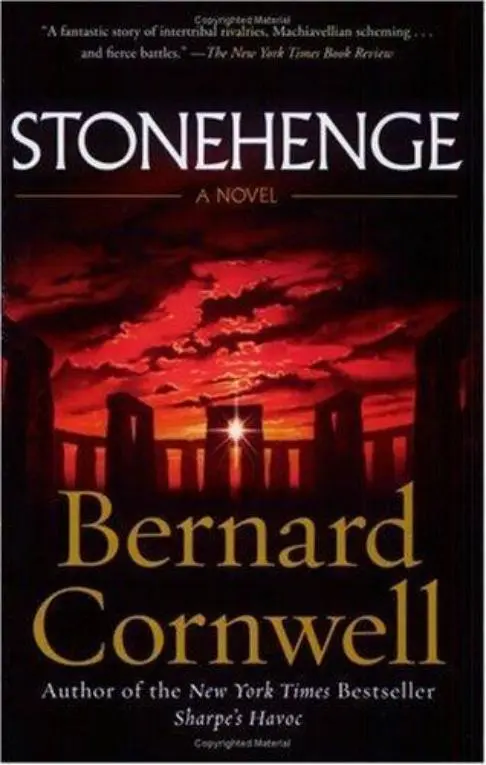
- Название:Stonehenge
- Автор:
- Жанр:
- Год:неизвестен
- ISBN:нет данных
- Рейтинг книги:3 / 5. Голосов: 1
-
Избранное:Добавить в избранное
- Отзывы:
-
Ваша оценка:
Stonehenge: краткое содержание, описание и аннотация
Предлагаем к чтению аннотацию, описание, краткое содержание или предисловие (зависит от того, что написал сам автор книги «Stonehenge»). Если вы не нашли необходимую информацию о книге — напишите в комментариях, мы постараемся отыскать её.
Stonehenge — читать онлайн ознакомительный отрывок
Ниже представлен текст книги, разбитый по страницам. Система сохранения места последней прочитанной страницы, позволяет с удобством читать онлайн бесплатно книгу «Stonehenge», без необходимости каждый раз заново искать на чём Вы остановились. Поставьте закладку, и сможете в любой момент перейти на страницу, на которой закончили чтение.
Интервал:
Закладка:
Professor North also suggests that celestial events were not observed from the inside of the monument looking out, but rather from the outside looking in. No doubt both means of viewing were possible; anyone wanting the best view of the midsummer sunrise would wish to be in the centre of the monument, but at midwinter sunset the observer would want to stand outside the shrine and look through its centre. That main axis, the line stretching from the avenue through the monument, seems to be the major astronomical feature which marks the summer rising and the winter setting of the sun. The four Station Stones, of which two remain, were aligned on major lunar events, but they form a rectangle and its two shorter sides are parallel with the monument's main solar axis.
Which raises the question of why such an elaborate monument was necessary. After all, if marking the observed extremes of the sun and moon were all that was required, then it could have been done with just four or five stones. But the same is true of more recent religions. God, we are assured, can be worshipped as efficaciously about a kitchen table as in a church, but that is not a compelling argument for the demolition of Salisbury Cathedral. And cathedrals do have something to tell us about Stonehenge. If, four thousand years from now, archaeologists were to discover the remains of a cathedral they might deduce all kinds of things from the ruins of the building, but their first, and most obvious, conclusion would be that it faces the rising sun from which they would assume, reasonably enough, that Christianity worshipped a sun god. In truth the east-west alignment of most Christian churches has nothing to do with the sun. Nevertheless a theory would be propounded that Christianity was a solar religion (while the incidence of crucifixes would surely persuade our future archaeologists that Christians conducted horrific human sacrifices), and what might never be suspected are the vast range of other activities — weddings, coronations, funerals, masses, worship services, concerts — that went on within the building. So it is with Stonehenge. We can see the solar and lunar alignments clearly enough (and must hope that, unlike our notional future archaeologists, we are not entirely wrong about them), but we cannot see the other activities that happened at the stones.
Stonehenge, then, must have been a cultic centre used for a range of spiritual activities, but which was, nevertheless, aligned on significant solar events, which events must have been important to whatever religion was practised. But Stonehenge did not spring out of nowhere. The monument that we see is merely the last stage of a very long process that took hundreds of years, and remnants of that process are scattered throughout Britain. Most henges are circular enclosures formed by banks and ditches. That is a simple enough concept, suggesting the reservation of a sacred space, but it was complicated by the addition of wooden posts within the circles that were almost certainly used for the observation of celestial phenomena. Over time those circles of wooden posts became ever more common until, all across Britain, there were numerous timber henges: veritable forests of posts that were clustered in concentric rings within their earthen banks. There was one such timber temple at Stonehenge itself, another just to the north at what is now known as Woodhenge, at least two more at nearby Durrington Walls and a fourth, Coneybury Henge (the 'Death Place'), just a mile to the south-east of Stonehenge.
Later still some of the wooden posts were replaced by stones, and those stone circles are what we see today. They range from the north of Scotland to the west of Wales and to the south of England. Some are double circles, some have avenues approaching them, others have 'coves' like those at Avebury; no two are alike, yet two of them, separated by a mere twenty miles, though utterly dissimilar to each other, stand out for their complexity: Avebury and Stonehenge. It is no surprise, then, to learn that these monuments are the culmination of the tradition of temple building in southern Britain (in the north and west new temples were to be made for another thousand years), and that tradition is simple enough to understand. Neolithic man largely built his temples as circles, and used them to observe celestial events that were closely related to his religious beliefs. The difference between, say, the Rollright Stones in Oxfordshire and Stonehenge in Wiltshire is obvious, one is simple and the other is exquisitely engineered and awe-inspiring, yet at heart they are both the same thing.
Why were they built as circles? The easy answer is to say that they came at the end of a long tradition of circle building, though that begs the question. Sometimes neolithic man preferred to erect rows of stone, such as those at Carnac in France or the smaller rows on Dartmoor. He sometimes built mysterious earthworks that trailed for miles across the countryside (the Stonehenge Cursus, just to the north of the monument, is an example of this), yet overwhelmingly he decided on a circular shrine, and the commonest suggestion is that the circle reflected the heavens, the horizon or the nature of existence. Yet it seems unlikely that so powerful a tradition rests solely on metaphor; it is surely more probable that the metaphor reinforced a practicality, which could have been that the earliest worshippers of the 'henge' religions wanted to observe celestial phenomena that occurred all across the sky. John North suggests that they began with the long barrows, those strange mounded graves that can still be seen throughout Britain, and that the barrows' builders used the spine of the mound as an artificial horizon across which they sighted stars, planets, the sun and the moon. Timber poles fixed their sightings. But a barrow is really only useful for such observations from either side of its long axis, while a circular bank, a henge, can be conveniently used for every quadrant of the sky and the interior of the henge provides a useful place for positioning sighting poles, so the tradition of circular temples began. When the builders erected Avebury and Stonehenge, then, they were working within a tradition, only they were taking that tradition to new heights of achievement. They undoubtedly wished to impress. God may be adequately worshipped from a kitchen table, but a person entering a cathedral is more likely to be filled with awe and wonder, for the builders did something marvellous that transcends the quotidian; just so with Stonehenge and Avebury. They are temples designed to echo the awesome mystery of the unknown. Neolithic man could effectively mark the position of the midwinter sunset with two short timber posts, but the posts would not have the same effect as approaching Stonehenge along its processional way and seeing the looming blackness of the lintelled boulders on the horizon. Then would come that heart-chilling moment when the land was smothered in the long shadow cast by the stones, and in the centre of that shadow was a last ray of the sun lancing down towards the Heel Stone. That shadow, andthat livid shaft of light, was what the builders of Stonehenge achieved.
But just as a cathedral (the word comes from the Latin for a 'throne') is not made solely for the occasional enthronement of a bishop, nor was Stonehenge constructed just for the supreme moments of the solar year. It must have had many rites, many of them descended with the thousand-year tradition of henge building. We do not know what those rites were, but we can guess, for humankind's demands of the gods do not change much. There would be rituals for death (funerals), for sex (weddings), for giving thanks (harvest festivals), for petitioning (prayer meetings), for rites of passage (baptism, first communion or confirmation), for celebrating secular power (coronations or great state occasions), as well as the regular services which still punctuate the ritual year. Doubtless some of these activities were more prominent then than now, healing rituals, for instance, or those ceremonies related to the agricultural year. The best discussion I have found of what may have lain behind those rituals is in Aubrey Burl's book Prehistoric Avebury, for that monument was also built to encompass all the religious needs of a community. Stonehenge performed the same function, but, unlike Avebury, it also accentuates the midwinter sunset, and that suggests the temple was preoccupied with death: the death of the old year and the hopes of revival with the new year.
Читать дальшеИнтервал:
Закладка:
Похожие книги на «Stonehenge»
Представляем Вашему вниманию похожие книги на «Stonehenge» списком для выбора. Мы отобрали схожую по названию и смыслу литературу в надежде предоставить читателям больше вариантов отыскать новые, интересные, ещё непрочитанные произведения.









Обсуждение, отзывы о книге «Stonehenge» и просто собственные мнения читателей. Оставьте ваши комментарии, напишите, что Вы думаете о произведении, его смысле или главных героях. Укажите что конкретно понравилось, а что нет, и почему Вы так считаете.