W.E.B. Griffin - Retreat, Hell!
Здесь есть возможность читать онлайн «W.E.B. Griffin - Retreat, Hell!» весь текст электронной книги совершенно бесплатно (целиком полную версию без сокращений). В некоторых случаях можно слушать аудио, скачать через торрент в формате fb2 и присутствует краткое содержание. Год выпуска: 0101, Жанр: Старинная литература, на английском языке. Описание произведения, (предисловие) а так же отзывы посетителей доступны на портале библиотеки ЛибКат.
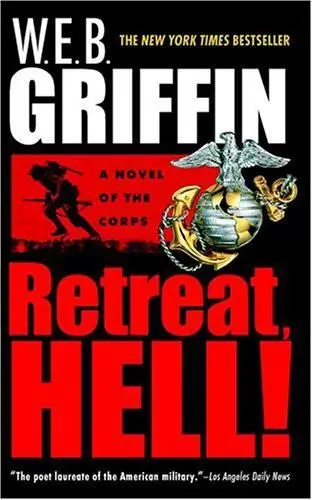
- Название:Retreat, Hell!
- Автор:
- Жанр:
- Год:0101
- ISBN:нет данных
- Рейтинг книги:3 / 5. Голосов: 1
-
Избранное:Добавить в избранное
- Отзывы:
-
Ваша оценка:
Retreat, Hell!: краткое содержание, описание и аннотация
Предлагаем к чтению аннотацию, описание, краткое содержание или предисловие (зависит от того, что написал сам автор книги «Retreat, Hell!»). Если вы не нашли необходимую информацию о книге — напишите в комментариях, мы постараемся отыскать её.
Megaseller Griffin (Honor Bound; Brotherhood of War; Men at War) musters another solid entry in his series chronicling the history of the U.S. Marines, now engaged in the Korean War. Gen. Douglas MacArthur, nicknamed El Supremo by his subordinates, is taken by surprise when the North Korean Army surges south across the 38th parallel. After early losses, he rallies his troops and stems the tide, but not for long. Intertwining stories of literally an army of characters reveal how MacArthur and his sycophantic staff overlook the entire Red Chinese Army, which is massed behind the Yalu River and about to enter the war. Brig. Gen. Fleming Pickering attempts to mediate the ongoing battles between feisty, give-'em-hell Harry Truman and the haughty MacArthur, while worrying about his pilot son, Malcolm "Pick" Pickering, who has been shot down behind enemy lines. The introduction of the Sikorsky H-19A helicopter into the war by Maj. Kenneth "Killer" McCoy and sidekick Master Gunner Ernie Zimmerman details the invention of tactics that will become commonplace in Vietnam. Readers looking for guts and glory military action will be disappointed, as barely a shot is fired in anger, but fans of Griffin's work understand that the pleasures are in the construction of a complex, big-picture history of war down to its smallest details: "There were two men in the rear seat, both of them wearing fur-collared zippered leather jackets officially known as Jacket, Flyers, Intermediate Type G-1." Veterans of the series will enjoy finding old comrades caught up in fresh adventures, while new-guy readers can easily enter here and pick up the ongoing story.
Retreat, Hell! — читать онлайн бесплатно полную книгу (весь текст) целиком
Ниже представлен текст книги, разбитый по страницам. Система сохранения места последней прочитанной страницы, позволяет с удобством читать онлайн бесплатно книгу «Retreat, Hell!», без необходимости каждый раз заново искать на чём Вы остановились. Поставьте закладку, и сможете в любой момент перейти на страницу, на которой закончили чтение.
Интервал:
Закладка:
"Sure. You're going with them?"
"Yeah. I want to show Colonel Vandenburg what we have at Socho-Ri, and the sooner we can put the L-19 to work conducting our own search for Pickering, the better."
The hangar door screeched open wide enough to admit a tanker trailer.
[SIX]
8O23d Transportation Company (Depot, Forward)
Inchon, South Korea
142S 8 October 195O
Captain Francis P. MacNamara, Transportation Corps, was not at all surprised when he got a "heads-up" call that the X Corps Transportation Officer, Colonel T. Howard Kennedy, would be in the Inchon area and would pay the Eighty-Twenty-Three a visit.
MacNamara had been expecting such a "visit." He would not have been surprised if he had gotten an official call announcing a formal inspection of the unit. Certainly, the status of readiness of the Eighty-Twenty-Three would be of interest to the staff officers of X Corps, and so far there had been no contact of any sort.
He was, of course, a little nervous. He knew that the purpose of an inspection—by whatever name—was to find fault with whatever was being inspected.
But he was ready. There had been very little "business" for the Eighty-Twenty-Three since he'd started to set up shop. There had been that interesting business of issuing vehicles to the CIA a week before, and he had exchanged twenty-seven of his vehicles for damaged vehicles. But that had not at all taxed the capabilities of the Eighty-Twenty-Three. He felt sure he could conduct one hundred vehicle exchanges a day easily, and more if pressed.
But the lack of business had permitted getting the Eighty-Twenty-Three into very good shape. Not only had his shops repaired all but seven of the exchanged vehicles and returned them to the Ready for Exchange lines, but there had been time to establish creature comforts for his men.
The squad tents in which they were housed now had wooden floors, doors, and electric lights. A section of the garage building had been converted to a mess hall, with picnic-table-type seating for the lower ranks, and chairs and tables for First Three Graders and officers.
He was serving three hot meals a day, and had set up two shower points, one for the men and a second for the noncoms and officers, which they shared on a simple schedule. Similarly, he had set up three latrines, one outside under canvas, and two—by repairing existing facilities—in the main building, one for the officers and another for the noncoms.
He had even established a unit laundry. He'd had to bend regulations a little to do this. Koreans were performing this service, in exchange for the garbage from the mess and five jerry cans of gasoline daily. Inasmuch as this service was provided outside the depot area, he didn't think it would come to the attention of anyone visiting the Eighty-Twenty-Three. If it did, he was prepared to argue that it was a question of troop morale. Men whose uniforms quickly became grease- and oil-stained, and who took a great deal of comfort in knowing that after their shower they could put on fresh clothing, were obviously going to be happier than those who had to either wash their clothing themselves or go to one of the X Corps shower points outside the depot and exchange them.
Not to mention, of course, that his laundry service returned uniforms that were even pressed. In the case of the officers, starched and pressed. The uniforms available for exchange were those that had simply been washed and dried in the enormous machines of the shower point.
Immediately after the "heads-up" call, Captain MacNamara had sent his runner to announce an officer's call, and when his four lieutenants came to the CP, he told them what was going to happen.
He said that when he walked through the shop and around the depot perimeter, as he planned to do in thirty minutes, he didn't want to see anyone unshaved or in a dirty uniform. He said, as they knew, he didn't insist that steel helmets and web gear be worn while the men were working, but he expected to see both near those working. Those on perimeter guard he expected to see looking alert and with their weapons as clean as possible, and they better be wearing their helmets and web gear.
And thirty minutes later he took a quick tour of the Eighty-Twenty-Three, and found only a few things—he insisted that a large poster of a nearly naked redhead be removed from the wall of one of the work bays, for example—that needed correction. Then he started a second tour of the Eighty-Twenty-Three, this time a slow one.
He thought it would look better if Colonel T Howard Kennedy found him keeping a personal supervisory eye on things, rather than sitting in the CP, drinking coffee, and reading Stars and Stripes.
From what MacNamara had heard—and, for that matter, seen—the war was just about over. The linkup with Eighth Army advancing from the south had been made, and he'd heard that the UN had given permission to MacArthur to chase the North Koreans back across the 38th Parallel and destroy what was left of their army.
There were a lot of implications to be drawn from that, and MacNamara had been around the Army long enough to make them.
Many of the troops here would be withdrawn, either—at first, at least—to Japan or all the way back to the States. That didn't mean they would take all their wheeled vehicles with them. For one thing, that would take a lot of shipping, and for another, it didn't make a lot of sense to haul vehicles that had been used hard in the war and needed Third and Fourth Echelon maintenance all the way back to the States when that maintenance could be performed a lot cheaper in Japan.
And MacNamara believed that it was unlikely the Army was going to allow itself to be caught again with its pants down, logistically speaking. From what he'd seen and heard, there had been almost nothing in the depots in Japan when the war started, and that had hurt bad.
It seemed very likely to MacNamara that what would happen, once the war was over in a couple of weeks, was that the Army would restock the depots in Japan with the vehicles that had come from the States. There would be ordnance depots in Japan like the Anniston Depot in Alabama, with stocks of rebuilt-to-specification vehicles ready for immediate issue.
And there was certainly a role to play in that for units like the Eighty-Twenty-Three generally, and, if he played his cards right, for Captain Francis P. MacNamara specifically.
He didn't want to get too enthusiastic about it, only to be later kicked in the balls, but it seemed possible, even likely, that he could stay on active duty long enough to get his promotion to major. He was eligible.
If that happened, that meant he would be retired as a major when he had his twenty years in, even if he got RIF'd again back to master sergeant.
But it was also possible, if less likely, that he could stay on active duty, particularly if he was right about the Army setting up an Anniston-type depot in Japan when the war was over, and go all the way to twenty years and retirement as a major.
Hell, maybe even make lieutenant colonel before he retired.
All it would take for this to happen would be for the brass to notice that he had done a hell of a good job with the Eighty-Twenty-Three and was just the man they needed for what was going to happen after the war.
Colonel Kennedy arrived fifteen minutes into Captain MacNamara's second tour of the depot.
MacNamara saw him arrive—in a three-jeep convoy—but pretended not to see him until the "visiting party" had parked their jeeps and walked down to him between two rows of Ready for Exchange vehicles.
Then he hurriedly walked to them, saluted, and announced, "Good morning, sir. Captain MacNamara, Francis P., commanding."
Читать дальшеИнтервал:
Закладка:
Похожие книги на «Retreat, Hell!»
Представляем Вашему вниманию похожие книги на «Retreat, Hell!» списком для выбора. Мы отобрали схожую по названию и смыслу литературу в надежде предоставить читателям больше вариантов отыскать новые, интересные, ещё непрочитанные произведения.








Обсуждение, отзывы о книге «Retreat, Hell!» и просто собственные мнения читателей. Оставьте ваши комментарии, напишите, что Вы думаете о произведении, его смысле или главных героях. Укажите что конкретно понравилось, а что нет, и почему Вы так считаете.