W.E.B. Griffin - Retreat, Hell!
Здесь есть возможность читать онлайн «W.E.B. Griffin - Retreat, Hell!» весь текст электронной книги совершенно бесплатно (целиком полную версию без сокращений). В некоторых случаях можно слушать аудио, скачать через торрент в формате fb2 и присутствует краткое содержание. Год выпуска: 0101, Жанр: Старинная литература, на английском языке. Описание произведения, (предисловие) а так же отзывы посетителей доступны на портале библиотеки ЛибКат.
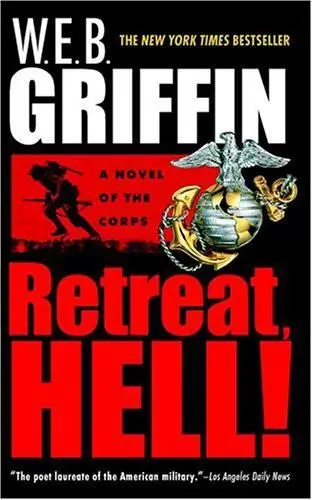
- Название:Retreat, Hell!
- Автор:
- Жанр:
- Год:0101
- ISBN:нет данных
- Рейтинг книги:3 / 5. Голосов: 1
-
Избранное:Добавить в избранное
- Отзывы:
-
Ваша оценка:
Retreat, Hell!: краткое содержание, описание и аннотация
Предлагаем к чтению аннотацию, описание, краткое содержание или предисловие (зависит от того, что написал сам автор книги «Retreat, Hell!»). Если вы не нашли необходимую информацию о книге — напишите в комментариях, мы постараемся отыскать её.
Megaseller Griffin (Honor Bound; Brotherhood of War; Men at War) musters another solid entry in his series chronicling the history of the U.S. Marines, now engaged in the Korean War. Gen. Douglas MacArthur, nicknamed El Supremo by his subordinates, is taken by surprise when the North Korean Army surges south across the 38th parallel. After early losses, he rallies his troops and stems the tide, but not for long. Intertwining stories of literally an army of characters reveal how MacArthur and his sycophantic staff overlook the entire Red Chinese Army, which is massed behind the Yalu River and about to enter the war. Brig. Gen. Fleming Pickering attempts to mediate the ongoing battles between feisty, give-'em-hell Harry Truman and the haughty MacArthur, while worrying about his pilot son, Malcolm "Pick" Pickering, who has been shot down behind enemy lines. The introduction of the Sikorsky H-19A helicopter into the war by Maj. Kenneth "Killer" McCoy and sidekick Master Gunner Ernie Zimmerman details the invention of tactics that will become commonplace in Vietnam. Readers looking for guts and glory military action will be disappointed, as barely a shot is fired in anger, but fans of Griffin's work understand that the pleasures are in the construction of a complex, big-picture history of war down to its smallest details: "There were two men in the rear seat, both of them wearing fur-collared zippered leather jackets officially known as Jacket, Flyers, Intermediate Type G-1." Veterans of the series will enjoy finding old comrades caught up in fresh adventures, while new-guy readers can easily enter here and pick up the ongoing story.
Retreat, Hell! — читать онлайн бесплатно полную книгу (весь текст) целиком
Ниже представлен текст книги, разбитый по страницам. Система сохранения места последней прочитанной страницы, позволяет с удобством читать онлайн бесплатно книгу «Retreat, Hell!», без необходимости каждый раз заново искать на чём Вы остановились. Поставьте закладку, и сможете в любой момент перейти на страницу, на которой закончили чтение.
Интервал:
Закладка:
"But you need one more than they do, eh?"
"Yes, sir. I think it's a question of deciding priorities. I think getting General Dean back qualifies."
"Yeah, so do I. Not to mention getting young Pickering back," Howe said. "Has McCoy told you about him?"
"No, sir."
"Okay. Major Pickering, General Pickering's son, was shot down about two months ago, and has been evading capture ever since. ..."
"You know that, sir? That he's alive and hasn't been captured?"
"McCoy thinks he's alive," Howe said.
"Where is he?" Vandenburg said, turning to McCoy.
"The last sighting was east of Wonju," McCoy said.
"You sighted him?"
"We sighted where he had stamped out a signal ... his initials and an arrow on the ground, not him. I figure we missed him by no more than a couple of hours."
"You couldn't pick him up with a chopper?"
"We didn't have the choppers then, and we couldn't take one away from the 1st MarDiv—they're using them to transport wounded."
" 'Couldn't take one' from the Marines—or anyone else who has one—is past tense, Ken," Howe said. "The rules have changed."
"Sir?"
"This is absolutely not for dissemination," Howe said. "I think the reason the President called General Pickering to Washington is to give him the CIA. He asked me what kind of a director I thought he'd make, and I told him I couldn't think of anyone better qualified to take it over and straighten it out. So what we have is a changed priority with regard to Major Pickering. We can't afford to have the son of the Director on the CIA in enemy hands." He paused. "That, too, Ken, is in the nature of an order."
"Aye, aye, sir."
"Okay, Colonel," Howe went on. "You lay your hands on these airplanes you need, and I will do my damnedest to see that no one takes them away from you."
"Sir, may I offer a suggestion about how that might be done?" Vandenburg asked.
"Shoot."
"I notice the general doesn't have an aide-de-camp."
"I don't need one," Howe said simply, then chuckled and added: "I shine my own shoes."
"Sir, I respectfully suggest that you do need an aide-de-camp," Vandenburg said. "A fairly senior one. And I volunteer for the duty."
"Where are you going with that idea?"
"I don't think any general here, from MacArthur on down, would try to take an airplane away from the aide-de-camp of—What's your official title, sir?"
"We're the Presidential Mission to the Supreme Command, United Nations Command," Master Sergeant Rogers said. "His official title is Chief of Mission. Boss, I think the colonel's had a fine idea."
Howe thought it over for ten seconds.
"Okay," he said. "Do it. Type up something appropriate, Charley, naming the colonel my deputy. Somehow, he doesn't look like an aide-de-camp."
"Even better, sir," Vandenburg said.
"Yes, sir," Rogers said. "And we get to use the airplanes, too, right?"
"Of course," Vandenburg said.
"You're a ... I was about to say 'devious man,' Colonel," Howe said admiringly. "But I think the word I'm looking for is 'ruthless.' I can see where you and The Killer are going to get along just fine."
[FOUR]
USAF Airfield K-l
Pusan, South Korea
0945 8 October I9SO
The breakout—and advance northward—from the Pusan Perimeter of the Eighth Army had done little or nothing to reduce the pressure on what had once been the only operational airfield in South Korea.
It had become, however, more of a passenger and freight terminal than a base for the fighters and light bombers it had been when the Pusan Perimeter needed fighting aircraft to keep from being pushed into the sea.
When the USAF C-47 from Seoul arrived at the port city, it had to take its place at the end of a long line of aircraft making their approaches to the field. Many of the aircraft ahead of them were four-engine C-54 transports bearing the insignia of the Military Air Transport Command, and there were four essentially identical aircraft wearing the insignia of the civilian airlines from which they had been chartered.
The warplanes were not entirely gone. The stack also held a dozen or more warplanes, USAF P-51 Mustang fighters, A-20 and A-26 attack bombers, and several Corsairs from the Marine Corps and Navy.
And when, after more than a half hour in the stack, the Gooney Bird from Seoul finally touched down and taxied to the tarmac in front of base operations, there was even a Lockheed Constellation of Trans-Global Airways sitting there taking on enough fuel to get it to Japan, where it would be topped off. The glistening, sleek, triple-tailed aircraft looked out of place among the others.
When the Gooney Bird shut down its engines and the door opened, sixteen people, ranging in rank from PFC to full colonel, got off and most of them walked into base operations to see about getting themselves some ground transportation.
Four of the passengers—a lieutenant colonel, a major, a captain, and a lieutenant, the latter three wearing the wings of Army aviators—did not go into base operations but started walking across the field to a hangar before which sat a small fleet of Army aircraft.
When they got close to the hangar, they saw a small group of officers and men standing around an L-20 DeHavilland Beaver, watching as a corporal put the final touches to the insignia of the Eighth United States Army he had painted on the door. The aircraft looked as if it was not only just about brand new but also freshly polished.
The senior of the officers was a major, also an Army aviator. He saluted the lieutenant colonel and smiled at his brother aviators.
"Good morning, sir," he said. "This came off the ship at 2100 last night," he went on, indicating the Beaver. "And as soon as that paint dries, it's going to Eighth Army Forward. How's that for efficiency?"
"Commendable," the lieutenant colonel said, then spoke to the soldier with the paintbrush: "Son, have you got some paint thinner in your kit?" "Yes, sir," the corporal said, visibly confused.
"Then how about taking that off the door?" the lieutenant colonel said. "I don't want that insignia on there."
"Sir?" the major asked incredulously.
"I said I don't want that insignia on the door," the lieutenant colonel explained, reasonably, "and asked the corporal to start taking it off."
"Sir, this aircraft is assigned to Eighth Army Forward," the major said.
"It was assigned to Eighth Army Forward," the lieutenant colonel said. "Now I'm taking it."
"Sir, you . . . you can't do that," the major said.
"Yes I can. And I will also require two L-19s."
"Sir, I can't just give you this airplane," the major said, "or any aircraft, for that matter, without authority from United Nations Command."
"You are the officer in charge?" the lieutenant colonel asked.
"No, sir. I'm the deputy."
"Well, then, son, if you have problems with this, why don't you ask the officer in charge to come talk to me?"
"Yes, sir. I'll do that, sir."
"And in the meantime, Corporal, you start getting that insignia off the doors," the lieutenant colonel said.
The major walked quickly—almost trotted—to a Quonset hut set up beside a hangar and returned in less than two minutes, followed by a portly lieutenant colonel wearing pilot's wings and the insignia of an aide-de-camp to a three-star general, and another lieutenant colonel, also a pilot, whose collar carried the insignia of the Transportation Corps.
"Colonel," the portly lieutenant colonel said, "this is some sort of joke, right?"
"What's a joke?"
"About you taking this airplane."
"I wasn't joking about that."
"This airplane belongs to General Walker," the portly lieutenant colonel said. "Do you understand that?"
Читать дальшеИнтервал:
Закладка:
Похожие книги на «Retreat, Hell!»
Представляем Вашему вниманию похожие книги на «Retreat, Hell!» списком для выбора. Мы отобрали схожую по названию и смыслу литературу в надежде предоставить читателям больше вариантов отыскать новые, интересные, ещё непрочитанные произведения.






Обсуждение, отзывы о книге «Retreat, Hell!» и просто собственные мнения читателей. Оставьте ваши комментарии, напишите, что Вы думаете о произведении, его смысле или главных героях. Укажите что конкретно понравилось, а что нет, и почему Вы так считаете.