W.E.B. Griffin - Retreat, Hell!
Здесь есть возможность читать онлайн «W.E.B. Griffin - Retreat, Hell!» весь текст электронной книги совершенно бесплатно (целиком полную версию без сокращений). В некоторых случаях можно слушать аудио, скачать через торрент в формате fb2 и присутствует краткое содержание. Год выпуска: 0101, Жанр: Старинная литература, на английском языке. Описание произведения, (предисловие) а так же отзывы посетителей доступны на портале библиотеки ЛибКат.
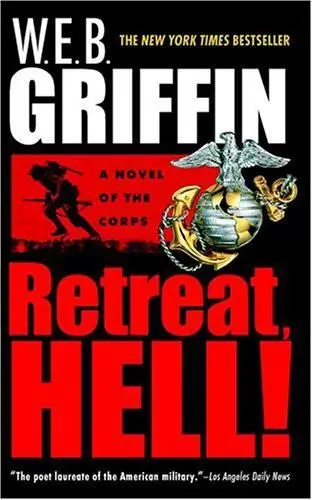
- Название:Retreat, Hell!
- Автор:
- Жанр:
- Год:0101
- ISBN:нет данных
- Рейтинг книги:3 / 5. Голосов: 1
-
Избранное:Добавить в избранное
- Отзывы:
-
Ваша оценка:
Retreat, Hell!: краткое содержание, описание и аннотация
Предлагаем к чтению аннотацию, описание, краткое содержание или предисловие (зависит от того, что написал сам автор книги «Retreat, Hell!»). Если вы не нашли необходимую информацию о книге — напишите в комментариях, мы постараемся отыскать её.
Megaseller Griffin (Honor Bound; Brotherhood of War; Men at War) musters another solid entry in his series chronicling the history of the U.S. Marines, now engaged in the Korean War. Gen. Douglas MacArthur, nicknamed El Supremo by his subordinates, is taken by surprise when the North Korean Army surges south across the 38th parallel. After early losses, he rallies his troops and stems the tide, but not for long. Intertwining stories of literally an army of characters reveal how MacArthur and his sycophantic staff overlook the entire Red Chinese Army, which is massed behind the Yalu River and about to enter the war. Brig. Gen. Fleming Pickering attempts to mediate the ongoing battles between feisty, give-'em-hell Harry Truman and the haughty MacArthur, while worrying about his pilot son, Malcolm "Pick" Pickering, who has been shot down behind enemy lines. The introduction of the Sikorsky H-19A helicopter into the war by Maj. Kenneth "Killer" McCoy and sidekick Master Gunner Ernie Zimmerman details the invention of tactics that will become commonplace in Vietnam. Readers looking for guts and glory military action will be disappointed, as barely a shot is fired in anger, but fans of Griffin's work understand that the pleasures are in the construction of a complex, big-picture history of war down to its smallest details: "There were two men in the rear seat, both of them wearing fur-collared zippered leather jackets officially known as Jacket, Flyers, Intermediate Type G-1." Veterans of the series will enjoy finding old comrades caught up in fresh adventures, while new-guy readers can easily enter here and pick up the ongoing story.
Retreat, Hell! — читать онлайн бесплатно полную книгу (весь текст) целиком
Ниже представлен текст книги, разбитый по страницам. Система сохранения места последней прочитанной страницы, позволяет с удобством читать онлайн бесплатно книгу «Retreat, Hell!», без необходимости каждый раз заново искать на чём Вы остановились. Поставьте закладку, и сможете в любой момент перейти на страницу, на которой закончили чтение.
Интервал:
Закладка:
A moment later, Corporal Meredith bellowed, "Sergeant Doheny, I think you better come down here!"
Doheny ran quickly down the ditch, pushing the safety off on his M-1 Garand as he did. When he was beside the funny-looking vehicle, he came out of the ditch, holding the Garand like a hunter expecting to flush a bird.
A not-at-all-friendly voice called to him from the vehicle.
"Doheny, tell that moron to get that fucking light out of my eyes, or I'll stick it up his ass!"
"Who is that?" Doheny called back.
"Gunner Zimmerman! Are you blind as well as deaf?"
I knew I knew that fucking voice!
Staff Sergeant Doheny and Master Gunner Zimmerman had been professionally associated at one time or another at the USMC Recruit Training Facility, Parris Island; Camp Lejeune; and Camp Pendleton.
Doheny was more than a little in awe of Master Gunner Zimmerman. He was a Marine's Marine: tough, competent, and fair. And—although Zimmerman had never said anything about it himself—Doheny knew that during War Two Zimmerman had been a Marine Raider.
"Turn those fucking flashlights off," Sergeant Doheny ordered. They were out immediately.
"Jesus, Mr. Zimmerman, what the fuck are you doing out here?" Doheny inquired.
"Major McCoy," Gunner Zimmerman said, "this is Staff Sergeant Doheny. He's not too bad a Marine—when he's sober."
Sergeant Doheny saluted.
"Sorry, sir," he said. "I didn't see any insignia. . . ."
"How are you tonight, Sergeant?" McCoy replied, returning the salute.
"Can't complain, sir. Sir, with respect, what the fuck is this vehicle?"
"We took it away from the prisoner in the backseat, Sergeant," McCoy said. "As best as I can tell, it's a Chinese copy of a Russian vehicle the Russians copied after a German jeep."
"I'll be damned," Doheny said, and then stepped close to the vehicle and looked in the backseat. There was enough reflected light from the headlights for him to be able to see a hatless North Korean officer tightly trussed up and then tied to the backseat.
"What happened to the truck?" Zimmerman asked.
"No fucking idea. I had it drug into the road so anyone coming down the road would have to stop.'
"Good thinking, Sergeant," McCoy said. "How do we get around it?"
"Sir, if you're careful, you can get around it in a jeep," Doheny said. "I done that. I don't know about in this."
"Well, we'll try. What's between here and Seoul, Sergeant?"
"There's a checkpoint at the pontoon bridge over the Han River, sir. And that's about it. So far as action is concerned, we've got it pretty well cleaned out, but there's action north and east."
He pointed. There were flashes of dull light, and booming noises. It could have been a distant thunderstorm. It was, in fact, artillery.
"You got a landline to the checkpoint?" Zimmerman said. "I would really hate to get this close only to get blown away because somebody thought if it's riding around in a gook vehicle, it's probably a gook."
Sergeant Doheny sensed that the explanation was a shot at the major.
"No problem, sir," he said. "Anything else I can do for you?"
The major turned around and said something to the North Korean officer, who, after a moment, responded. Then the major turned to Sergeant Doheny.
"The colonel needs to relieve himself, and so do I. Can your people untie him, and watch him?"
"Yes, sir. We're about fifty yards the other side of the truck."
"Okay. We'll do that next. And then . . . have you got any sandbags?"
"Yes, sir."
"I'll need a couple of them, please."
"Yes, sir. Sandbags?"
"Empty ones."
"1 got stacks of them, sir."
"I think two will be enough, thank you."
[THREE]
The House
Seoul, South Korea
2O45 28 September 195O
The sound of the cannon fire and the muzzle flashes lighting the sky had grown progressively louder and brighter as they approached the center of Seoul. There was obviously fighting, heavy fighting, on the outskirts of the city.
They were stopped three times inside the city, twice by Army military policemen and once by a Marine patrol, but the American flag on the hood and Zimmerman's gruff declaration that they were "transporting a prisoner"—and, of course, the prisoner himself, with two sandbags over his head—was enough to satisfy the MPs and a Marine sergeant. They were not asked for either orders or identification.
The city was in ruins. The North Koreans had defended it block by block, and there was smell of burned wood and rotting flesh. The streets were full of debris, and their progress was slow.
But finally McCoy turned the Russian jeep off a narrow street, stopped before a wrought-iron fence in a brick wall, and blew the horn.
Immediately—startling them—floodlights mounted on the brick wall glowed red for an instant, then bathed them in a harsh white light.
Master Gunner Zimmerman bellowed the Korean equivalent of "Turn those fucking lights off!"
The lights died and the gate swung open. As McCoy drove though it, he saw that an air-cooled .30-caliber Browning machine gun was trained on them.
The building inside the wall looked European rather than Asiatic. It was of brick-and-stone construction, three stories tall. It had been built in 1925 for Hamburg Shipping, G.m.b.H., which had used it to house their man in Seoul. It was purchased from them in 1946 by Korean Textile Services, Ltd., a wholly owned subsidiary of Far East Fur & Textiles, Ltd., of Hong Kong, which, it was alleged, was owned several steps distant by the United States Central Intelligence Agency. It was known as "The House."
A Korean in U.S. Army fatigues came out of the front door as McCoy pulled the Russian jeep up in front of the veranda beside three jeeps and a three-quarter-ton ambulance. The overpainted Red Cross markings on the sides of the ambulance body were still visible.
The Korean—he was at least six feet tall and weighed about 200 pounds, enormous for a Korean—came down the stairs, slinging his Thompson submachine gun over his shoulder as he did.
He said nothing.
In Korean, McCoy ordered, "Take the colonel in the house. Put him in one of the basement rooms. Once he's there, put a guard on him, untie him, take the sandbags off his head, and give him something to eat. I want him alive and unhurt."
The enormous Korean nodded his understanding. "The others?" he asked in English.
"They'll be here early tomorrow morning, all of them," McCoy said. Then he asked, "Is he here?"
"In the library," the Korean replied, again in English.
McCoy nodded, and he and Zimmerman got out of the Russian jeep and walked into the house.
The library was the first door on the right off the foyer. McCoy pushed open the door and walked in.
The first time McCoy had been in the room, the bookshelves lining three walls had been full. Now they were bare. The Inmun Gun had stripped the house of everything reasonably portable as soon as they had taken over the building.
"It's not amazing how little is left," Dunston had philosophized, "but how much."
Dunston, a plump, comfortable-appearing thirty-year-old whose Army identification card said that William R. Dunston was a major of the Army's Transportation Corps, sat at a heavy carved wooden table. A Coleman gasoline lantern on the table glowed white, and Dunston was using it to read Stars and Stripes, the Army newspaper.
Dunston was not actually a major, or even in the Army, despite his uniform and identity card. He was in fact a civilian employed by the Central Intelligence Agency, and before having been run out of Seoul by the advancing North Korean Army had been the Seoul CIA station chief. After the landings at Inchon, Dunston had flown back into the city as soon as enough of the runway at Kimpo Airfield had been cleared to take an Army observation aircraft.
Читать дальшеИнтервал:
Закладка:
Похожие книги на «Retreat, Hell!»
Представляем Вашему вниманию похожие книги на «Retreat, Hell!» списком для выбора. Мы отобрали схожую по названию и смыслу литературу в надежде предоставить читателям больше вариантов отыскать новые, интересные, ещё непрочитанные произведения.




Обсуждение, отзывы о книге «Retreat, Hell!» и просто собственные мнения читателей. Оставьте ваши комментарии, напишите, что Вы думаете о произведении, его смысле или главных героях. Укажите что конкретно понравилось, а что нет, и почему Вы так считаете.