W.E.B. Griffin - Retreat, Hell!
Здесь есть возможность читать онлайн «W.E.B. Griffin - Retreat, Hell!» весь текст электронной книги совершенно бесплатно (целиком полную версию без сокращений). В некоторых случаях можно слушать аудио, скачать через торрент в формате fb2 и присутствует краткое содержание. Год выпуска: 0101, Жанр: Старинная литература, на английском языке. Описание произведения, (предисловие) а так же отзывы посетителей доступны на портале библиотеки ЛибКат.
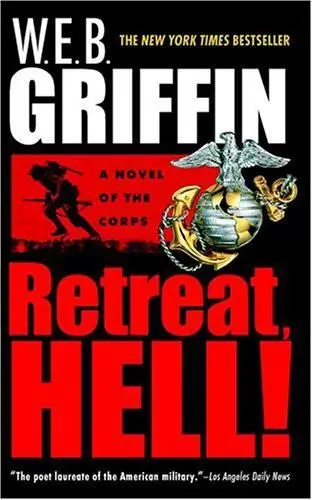
- Название:Retreat, Hell!
- Автор:
- Жанр:
- Год:0101
- ISBN:нет данных
- Рейтинг книги:3 / 5. Голосов: 1
-
Избранное:Добавить в избранное
- Отзывы:
-
Ваша оценка:
Retreat, Hell!: краткое содержание, описание и аннотация
Предлагаем к чтению аннотацию, описание, краткое содержание или предисловие (зависит от того, что написал сам автор книги «Retreat, Hell!»). Если вы не нашли необходимую информацию о книге — напишите в комментариях, мы постараемся отыскать её.
Megaseller Griffin (Honor Bound; Brotherhood of War; Men at War) musters another solid entry in his series chronicling the history of the U.S. Marines, now engaged in the Korean War. Gen. Douglas MacArthur, nicknamed El Supremo by his subordinates, is taken by surprise when the North Korean Army surges south across the 38th parallel. After early losses, he rallies his troops and stems the tide, but not for long. Intertwining stories of literally an army of characters reveal how MacArthur and his sycophantic staff overlook the entire Red Chinese Army, which is massed behind the Yalu River and about to enter the war. Brig. Gen. Fleming Pickering attempts to mediate the ongoing battles between feisty, give-'em-hell Harry Truman and the haughty MacArthur, while worrying about his pilot son, Malcolm "Pick" Pickering, who has been shot down behind enemy lines. The introduction of the Sikorsky H-19A helicopter into the war by Maj. Kenneth "Killer" McCoy and sidekick Master Gunner Ernie Zimmerman details the invention of tactics that will become commonplace in Vietnam. Readers looking for guts and glory military action will be disappointed, as barely a shot is fired in anger, but fans of Griffin's work understand that the pleasures are in the construction of a complex, big-picture history of war down to its smallest details: "There were two men in the rear seat, both of them wearing fur-collared zippered leather jackets officially known as Jacket, Flyers, Intermediate Type G-1." Veterans of the series will enjoy finding old comrades caught up in fresh adventures, while new-guy readers can easily enter here and pick up the ongoing story.
Retreat, Hell! — читать онлайн бесплатно полную книгу (весь текст) целиком
Ниже представлен текст книги, разбитый по страницам. Система сохранения места последней прочитанной страницы, позволяет с удобством читать онлайн бесплатно книгу «Retreat, Hell!», без необходимости каждый раз заново искать на чём Вы остановились. Поставьте закладку, и сможете в любой момент перейти на страницу, на которой закончили чтение.
Интервал:
Закладка:
McCoy looked at him for a moment, then ducked through the narrow sandbagged opening into the CP without replying.
A slight, very young corporal was sitting on a folding metal chair by the radio and an EE-8 field telephone.
"Corporal," McCoy said, "see if you get through to G-2 at Division on the landline."
The corporal looked to Captain Allen for guidance. Allen nodded. The corporal cranked the generator handle on the side of the leather-cased EE-8.
"Patch me through to Regiment," he ordered after a moment, and then, a moment after that, he ordered, "Patch me through to Division."
McCoy walked to him and took the handset from him.
"Wolf Two, please," he said.
Twenty miles away, in a small village called Anyang, seven miles or so south of Seoul, in what had been built to be the waiting room of the railway station, Technical Sergeant Richard Ward picked up the handset of one of three EE-8 field telephones on the shelf of his small, folding wooden field desk.
"Wolf Two, Sergeant Ward, sir."
"Trojan Horse Six for the colonel, Sergeant," McCoy said.
"Hold one," Ward said, and extended the handset to Lieutenant Colonel Charles Lemuleson, a short, thin forty-year-old in too large fatigues, who was the intelligence officer of the 7th Division.
"For you, Colonel," Ward said, and added, "Trojan Horse Six."
Colonel Lemuleson turned from the map board leaning against the wall.
"Good!" he said. "I was getting worried."
He took the handset, pressed the butterfly switch, and said, "Wolf Two."
"Trojan Horse Six, sir. Good evening, sir."
Captain Allen handed Major McCoy a china mug of steaming coffee. McCoy smiled his thanks.
"Welcome home," Colonel Lemuleson's voice came somewhat metallically over the landline. "You're all right? Where are you?"
"At a roadblock south of Suwon, sir. We just came through."
"And apparently nobody shot at you. I was concerned about that."
"Yes, sir, that was a concern."
"I've got a message for you. Ready?"
"Yes, sir."
" 'Kimpo oh nine hundred twenty-nine September. Acknowledge. Confirm. Signature Hart, Capt., USMCR, for Admiral Dewey' Got it?"
"Yes, sir. Thank you."
"Got that just after you left," Colonel Lemuleson said. "It was in the clear. Couldn't get you on the radio."
"It was in the clear" meant that the message had not been encrypted, which meant further that someone had decided there wasn't time to go through the encryption process. And that it wasn't encrypted explained "Admiral Dewey." Captain George S. Hart, USMCR, aide-de-camp (and bodyguard) to Brigadier General Fleming Pickering, USMCR, Assistant Director for Asia of the Central Intelligence Agency, did not want to use Pickering's name in a non-encrypted message.
"The radio in the jeep went out before we were out of Seoul, sir," McCoy said. "Can you take a reply, sir?"
"Shoot."
"Acknowledge and confirm Kimpo oh nine hundred twenty-nine September. All well. Fresh eggs but no ham. Signature, McCoy."
Lieutenant Colonel Lemuleson said, "Got it," read it back for confirmation, and then asked, "Are you going to explain the ham and eggs business, McCoy? And who the hell is Admiral Dewey?"
"I better not, sir. But if memory serves, Admiral Dewey won the battle of Manila Bay in the Spanish-American War."
Lemuleson chuckled. "I knew I'd heard the name someplace. Anything else I can do for you, McCoy?"
"Yes, sir, there is. Sir, if I'm to be at Kimpo at 0900, I'd like to go there tonight—"
"That may be risky, McCoy," Lemuleson said. "I don't want to get a report in the morning that somebody shot first before asking any questions."
"Yes, sir. But I don't think I have much choice. Making things more difficult is that we picked up some prisoners. What I'd like to do is send four of them to you with one of my sergeants. You could give him that envelope—"
"It's under a thermite grenade in my safe," Lemuleson interrupted.
"—and he could bring it to us in Seoul at first light."
"And if you need some identification tonight?"
"I'll have to take that chance, sir."
"Your call, McCoy," Lemuleson said. "Done."
"May I have that phone, please, Major?" Major Masters asked. It was more of an order.
McCoy considered the request for a moment, then said, "Hold one, sir, please. Major Masters wants to talk to you."
"What the hell is he doing there?" Lemuleson said.
McCoy handed the handset to Masters.
"Masters, sir. These people have five prisoners, one of them a lieutenant colonel, and Major McCoy refuses to turn them over to me."
He looked triumphantly at McCoy.
McCoy and the others could hear one side of the ensuing conversation.
"Trying to stay on the top of the situation sir," Major Masters said, and then, "Yes, sir."
And then, "Yes, sir."
And then, "Yes, sir."
And then, "Yes, sir, I'll do that, sir."
Then he handed the handset back to McCoy.
"The colonel wants to speak to you, Major," he said.
"Yes, sir?" McCoy said.
"Sorry about that, McCoy. He doesn't know what's going on, and for obvious reasons—God save us all from well-meaning idiots—I didn't want to tell him."
"I understand, sir. No problem."
"I told him to do whatever you tell him to do, and to ask no questions."
"Thank you, sir."
"If you need anything else, give a call.”
"Thank you very much, sir," McCoy said, and handed the handset to the corporal.
"Major, would you be willing to lead my Marines—the jeep and the weapons carrier—to Division?" McCoy asked.
"Certainly," Major Masters said. "Anything I can do to be of service. . . ."
[TWO]
Seoul, South Korea
1935 28 September 195O
Staff Sergeant John J. Doheny, USMC, thought it highly unlikely that "fleeing remnants" of the North Korean Army would drive boldly up Korean National Route 1 with their headlights blazing, but it never hurt to be careful.
"Heads up!" Doheny ordered when the headlights first illuminated, then stopped at the wrecked and burned General motors 6x6 truck he had ordered dragged into the middle of the road as sort of a prebarrier to his roadblock fifty yards up the road.
"Halt, who goes there?" a voice in the darkness called to the lights.
That was Corporal Daniel Meredith, USMCR, whom Doheny had stationed with three other Marines, one of them armed with a BAR, in the ditches on either side of the burned truck barrier.
On one hand, Doheny thought, that sounded a little silly, as if they were at Parris Island or someplace, waiting for a drill instructor to inspect the guard post and demand a recitation of the Ten General Orders, instead of here, in the middle of a war.
On the other hand, he couldn't think of any other challenge that could be made that did the job as well. What else could Meredith shout? "Hi, there! Mind stopping there a moment, and telling me who you are?" or maybe, "Pardon me, sir, are you a friendly or a fucking gook Communist?"
"Marines!" a deep voice called back.
The beam of one flashlight and then another appeared, one from each side of the road. If his orders had been followed—and Sergeant Doheny had no reason to think they hadn't—PFC Miller, the big hillbilly with the BAR, now had it trained on the vehicle on the road from his position nowhere near the flashlights, waiting for orders to fire from Meredith.
Sergeant Doheny could now see enough to know there was something really strange down there. There were three men in a strange-looking jeep. The two in the front had their hands over their heads. The one in the back just sat there.
There was an American flag draped over the hood of the vehicle.
As Doheny got to his feet, he saw Meredith come onto the road from behind the vehicle, holding his carbine at the ready.
Читать дальшеИнтервал:
Закладка:
Похожие книги на «Retreat, Hell!»
Представляем Вашему вниманию похожие книги на «Retreat, Hell!» списком для выбора. Мы отобрали схожую по названию и смыслу литературу в надежде предоставить читателям больше вариантов отыскать новые, интересные, ещё непрочитанные произведения.



Обсуждение, отзывы о книге «Retreat, Hell!» и просто собственные мнения читателей. Оставьте ваши комментарии, напишите, что Вы думаете о произведении, его смысле или главных героях. Укажите что конкретно понравилось, а что нет, и почему Вы так считаете.