Philippa Gregory - The Kingmaker's Daughter
Здесь есть возможность читать онлайн «Philippa Gregory - The Kingmaker's Daughter» весь текст электронной книги совершенно бесплатно (целиком полную версию без сокращений). В некоторых случаях можно слушать аудио, скачать через торрент в формате fb2 и присутствует краткое содержание. Жанр: Старинная литература, на английском языке. Описание произведения, (предисловие) а так же отзывы посетителей доступны на портале библиотеки ЛибКат.
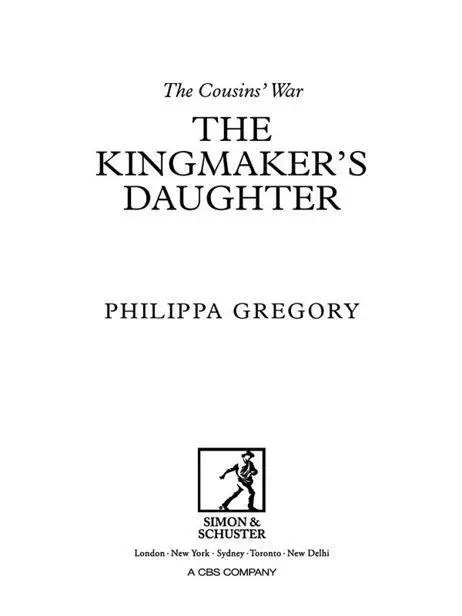
- Название:The Kingmaker's Daughter
- Автор:
- Жанр:
- Год:неизвестен
- ISBN:нет данных
- Рейтинг книги:4 / 5. Голосов: 1
-
Избранное:Добавить в избранное
- Отзывы:
-
Ваша оценка:
The Kingmaker's Daughter: краткое содержание, описание и аннотация
Предлагаем к чтению аннотацию, описание, краткое содержание или предисловие (зависит от того, что написал сам автор книги «The Kingmaker's Daughter»). Если вы не нашли необходимую информацию о книге — напишите в комментариях, мы постараемся отыскать её.
The Kingmaker's Daughter — читать онлайн бесплатно полную книгу (весь текст) целиком
Ниже представлен текст книги, разбитый по страницам. Система сохранения места последней прочитанной страницы, позволяет с удобством читать онлайн бесплатно книгу «The Kingmaker's Daughter», без необходимости каждый раз заново искать на чём Вы остановились. Поставьте закладку, и сможете в любой момент перейти на страницу, на которой закончили чтение.
Интервал:
Закладка:
Richard, my husband, is always at his brother’s side. He is one of the inner circle: comrades who fled with Edward from England and returned in triumph. He, William Hastings, and Anthony Woodville the queen’s brother are the king’s friends and blood brothers – together for life; they will never forget the wild ride when they thought that my father would catch them, they will never forget the voyage when they looked anxiously back over the stern of their little fishing boat for the lights of my father’s ships following them. When they speak of riding through the dark lanes, desperate to find Lynn and not knowing whether there would be a boat there that they could hire or steal, when they roar with laughter remembering that their pockets were empty and the king had to give the boatman his furred gown by way of payment, and then they had to walk penniless in their riding boots to the nearest town, George shuffles his feet and looks around, and hopes that the conversation will take another turn. For George was the enemy that night, though they are all supposed to be friends now. I think that the men who thundered along the night roads in darkness, pulling up in a sweat of fear to listen for hoofbeats coming behind them, will never forget that George was their enemy that night, and that he sold his own brother and his own family, and betrayed his house in the hopes of putting himself on the throne. For all their smiling friendship now, for all the appearance of having forgotten old battles, they know that they were the hunted that night, and that if George had caught them he would have killed them. They know that this is the way of this world: you have to kill or be killed, even if it is your brother, or your king, or your friend.
For me, every time they speak of this time, I remember that it was my father who was their enemy, and their comradeship was forged in fear of him, their good guardian and mentor who suddenly, overnight, became their deadly enemy. They had to win back the throne from him – he had utterly defeated them and thrown them out of the kingdom. Sometimes, when I think of his triumph and then his defeat, I feel as alien in this court as my first mother-in-law, Margaret of Anjou, their prisoner in the Tower of London.
I know for sure that the queen never forgets her enemies. Indeed, I suspect that she thinks of us as her enemies now. Under instruction from her husband she greets me and Isabel with cool civility, and she offers us places in her household. But her little smile when she sees the two of us seated in stony silence, or when Edward calls George to bear witness to a battle and then breaks off realising that this was one where George was on the other side – those moments show me that this is a queen who does not forget her enemies, and will never forgive them.
I am allowed to decline a place in the queen’s household as Richard tells me that we will live in the North for much of the time. At last, my share of the inheritance has been given to him. George takes the other half, and all Richard wants is to take up the great northern lands that he has won and rule them himself. He wants to take my father’s place in the North and befriend the Neville affinity. They will be predisposed to him because of my name, and the love they had for my father. If he treats the northerners well, openly and honestly as they like to be treated, he will be as grand as a king in the North of England and we will make a palace at Sheriff Hutton, and at Middleham Castle, our houses in Yorkshire. I have brought him the beautiful Barnard Castle in Durham too, and he says that we will live behind the mighty walls that look down to the River Tees and up to the Pennine hills. The city of York – which has always loved the house that shares its name – will be our capital city. We will bring grandeur and wealth to the North of England, to a people who are ready to love Richard because he is of the House of York, and who love me already, for I am a Neville.
Edward encourages this. He needs someone to keep the North at peace, and to defend England’s borders against the Scots, and there is no-one he trusts more than his youngest brother.
But I have another reason to refuse to stay at court, a reason even better than this. I curtsey to the queen and say: ‘Your Grace must excuse me. I am . . .’
She nods coolly. ‘Of course, I know.’
‘You do?’ At once I think that she has foreseen this conversation with her witch’s gaze, and I cannot restrain my shiver.
‘Lady Anne, I am no fool,’ she says simply. ‘I have had seven babies myself, I can see when a woman cannot eat her breakfast but still grows fatter. I was wondering when you were going to tell us all. Have you told your husband?’
I find I am still breathless with the fear that she knows everything. ‘Yes.’
‘And was he very pleased?’
‘Yes, Your Grace.’
‘He will be hoping for a boy, an earl for such a great inheritance,’ she says with satisfaction. ‘It is a blessing for you both.’
‘If it is a girl I hope you will be godmother?’ I have to ask her; she is the queen and my sister-in-law, and she has to assent. I don’t feel any warmth or love for her and I don’t think for one moment this means she will really bless me or my baby. But I am surprised by the kindness in her face as she nods. ‘I shall be pleased.’
I turn so that her ladies can hear me. My sister, her head bent down to her sewing, is among them. Isabel is trying to look as if she has heard none of this conversation; but I have to believe that she is yearning to speak to me. I can’t believe that Isabel would be indifferent to me, pregnant with my first child. ‘If I have a girl I am going to call her Elizabeth Isabel,’ I say clearly, pitching my voice for her ears.
My sister’s head is turned away; she is looking out of the window at the swirling snow outside, pretending to be indifferent. But when she hears her own name, she looks around. ‘Elizabeth Isabel?’ she repeats. It is the first time she has spoken to me since she scolded me when I came to court as a runaway bride.
‘Yes,’ I say boldly.
She half-rises from her seat, and then sits down again. ‘You will call a daughter: Isabel?’
‘Yes.’
I see her flush and at last she gets up from her seat and comes towards me, away from the queen and her ladies. ‘You would name her for me?’
‘Yes,’ I say simply. ‘You will be her aunt, and I hope you will love her and care for her. And . . .’ I hesitate – of course Isabel of all the people in the world knows that I am bound to be afraid of childbirth. ‘If anything should ever happen to me, then I hope you will raise her as your own child, and . . . and tell her about our father, Iz . . . and about everything that happened. About us . . . and how things went wrong . . .’
Isabel’s face twists for a moment trying to hold back her tears, and then she opens her arms and we cling to each other, crying and laughing at the same time. ‘Oh Iz,’ I whisper. ‘I have hated being at war with you.’
‘I am sorry, I am so sorry, Annie. I should not have acted as I did – I didn’t know what to do – and everything happened so fast. We had to get the fortune . . . and George said . . . and then you ran away . . .’
‘I’m sorry too,’ I say. ‘I know you couldn’t go against your husband. I understand better now.’
She nods, she doesn’t want to say anything about George. A wife owes obedience to her husband, she promises it on her wedding day before God; and husbands exact their full due, supported by the priest and by the world. Isabel is as much George’s possession as if she was his servant or his horse. I too have promised fealty to Richard as if he were a lord and I was indeed a kitchen maid. A woman must obey her husband as a serf obeys his lord – it is the way of the world and the law of God. Even if she thinks he is wrong. Even if she knows he is wrong.
Читать дальшеИнтервал:
Закладка:
Похожие книги на «The Kingmaker's Daughter»
Представляем Вашему вниманию похожие книги на «The Kingmaker's Daughter» списком для выбора. Мы отобрали схожую по названию и смыслу литературу в надежде предоставить читателям больше вариантов отыскать новые, интересные, ещё непрочитанные произведения.


Обсуждение, отзывы о книге «The Kingmaker's Daughter» и просто собственные мнения читателей. Оставьте ваши комментарии, напишите, что Вы думаете о произведении, его смысле или главных героях. Укажите что конкретно понравилось, а что нет, и почему Вы так считаете.