Philippa Gregory - The Kingmaker's Daughter
Здесь есть возможность читать онлайн «Philippa Gregory - The Kingmaker's Daughter» весь текст электронной книги совершенно бесплатно (целиком полную версию без сокращений). В некоторых случаях можно слушать аудио, скачать через торрент в формате fb2 и присутствует краткое содержание. Жанр: Старинная литература, на английском языке. Описание произведения, (предисловие) а так же отзывы посетителей доступны на портале библиотеки ЛибКат.
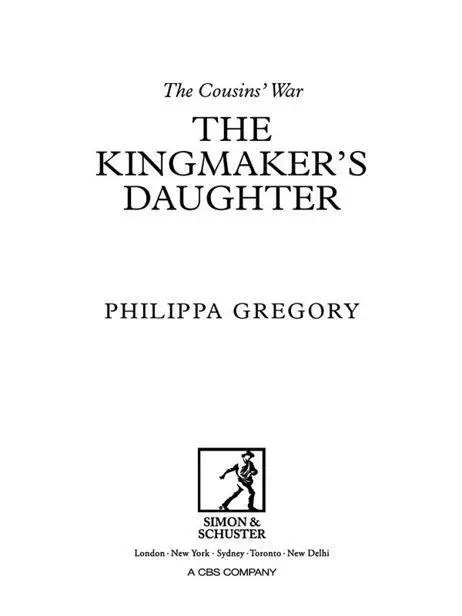
- Название:The Kingmaker's Daughter
- Автор:
- Жанр:
- Год:неизвестен
- ISBN:нет данных
- Рейтинг книги:4 / 5. Голосов: 1
-
Избранное:Добавить в избранное
- Отзывы:
-
Ваша оценка:
The Kingmaker's Daughter: краткое содержание, описание и аннотация
Предлагаем к чтению аннотацию, описание, краткое содержание или предисловие (зависит от того, что написал сам автор книги «The Kingmaker's Daughter»). Если вы не нашли необходимую информацию о книге — напишите в комментариях, мы постараемся отыскать её.
The Kingmaker's Daughter — читать онлайн бесплатно полную книгу (весь текст) целиком
Ниже представлен текст книги, разбитый по страницам. Система сохранения места последней прочитанной страницы, позволяет с удобством читать онлайн бесплатно книгу «The Kingmaker's Daughter», без необходимости каждый раз заново искать на чём Вы остановились. Поставьте закладку, и сможете в любой момент перейти на страницу, на которой закончили чтение.
Интервал:
Закладка:
‘There’s a little chapel,’ Richard volunteers. ‘It’s not a forgotten battle. He’s not forgotten. Edward and I pay for masses to be said for his soul.’
‘Do you?’ I say. ‘I didn’t know.’ I can hardly speak, I am so torn by guilt that I should be married into the house which my father named as his enemy.
‘I loved him too, you know,’ Richard says quietly. ‘He raised me, like he raised all of his wards, as if we were more to him than boys for whom he would get a fee. He was a good guardian to all of us. Edward and I thought of him as our leader, as our older brother. We couldn’t have done without him.’
I nod. I don’t say that my father only turned against Edward because of the queen, because of her grasping family and her wicked advice. If Edward had not married her . . . if Edward had never met her . . . if Edward had not been enchanted by her and her mother and their potent brew of sensuality and spells . . . but this is just to open a lifetime of regret. ‘He loved you,’ is all I say. ‘And Edward.’
Richard shakes his head, knowing as I do where the fault lay, where it still lies: with Edward’s wife: ‘It’s a tragedy,’ he says.
I nod, and we ride on to Fotheringhay in silence.
FOTHERINGHAY CASTLE, NORTHAMPTONSHIRE, AUTUMN 1472
The castle, Richard’s birthplace and his family’s house, is in disrepair, and has been ever since the wars started and the Yorks could only spend money fortifying the castles that they needed as bases for rebellion against the sleeping king and the bad queen. Richard frowns as he looks at the outer wall that is bowing dangerously over the moat, and scrutinises the roof of the castle where the rooks are making bundles of twiggy nests on the leads.
The duchess greets me warmly, though I am the third secret bride in her family. ‘But I always wanted Richard to marry you,’ she assured me. ‘I must have discussed it with your mother a dozen times. That was why I was so pleased that Richard was made your father’s ward, I wanted you to know each other. I always hoped you would be my daughter-in-law.’
She welcomes us into the smaller hall of the castle, a wood-panelled room with a great fire built at either end, and three huge tables laid for dinner: one for the menservants, one for the women servants and one table for the nobility. The duchess, Richard and I and a few of her kinswomen take the top table and oversee the hall. ‘We live very simply,’ she says, though she has hundreds of servants and a dozen guests. ‘We don’t try to compete with Her and Her court. Burgundian fashions,’ she says darkly. ‘And every sort of extravagance.’
‘My brother the king sends you his good wishes,’ Richard says formally. He kneels to his mother and she puts her hand on his head in blessing. ‘And how is George?’ she asks at once, naming her favourite. Richard winks at me. The overt favouritism of the duchess was an open joke in the family until the moment when it led her to favour George’s claim to the throne. That was too far, even for the indulgent affection of the king.
‘He is well, though we are still trying to settle the inheritance of our wives,’ Richard says.
‘A bad business.’ She shakes her head. ‘A good estate should never be broken up. You should make an agreement with him, Richard. You are the younger son after all. You should give way to your brother George.’
This favouritism is less amusing. ‘I follow my own counsel,’ Richard says stiffly. ‘George and I will agree to share the Warwick fortune. I would be a poor husband to Anne if I let her inheritance be thrown away.’
‘Better to be a poor husband than a poor brother,’ she says smartly. ‘Look at your brother Edward, under the cat’s-paw and betraying his family every moment of the day.’
‘Edward has been a good friend to me in this,’ Richard reminds her. ‘And he has always been a good brother to me.’
‘It’s not his judgement I fear,’ she says darkly. ‘It’s Hers. You wait till your ambitions run counter to hers and then see whose advice Edward will take. She will be his ruin.’
‘Indeed, I pray not,’ Richard says. ‘Shall we dine, Lady Mother?’

Her theme, the ruination of the family by the scheming of Elizabeth Woodville, is a constant one throughout our visit, and though Richard silences her as frequently and as politely as he can, it is impossible to deny the many cases she cites. It is apparent to everyone that the queen gets her way and Edward allows her to put her friends and family into places that belong to other men, she exploits her royal fees more than any queen has done before, and favours her brothers and sisters. Richard will not hear a word said against his brother the king; but at Fotheringhay nobody loves Elizabeth Woodville and the radiant young woman that I first saw on the great night of her triumph is quite forgotten in the picture of the grasping ill-wisher that the duchess describes.
‘She should never have been crowned queen,’ she whispers to me one day when we are sitting in her solar, carefully embroidering the cuffs of a shirt which the duchess will send to her favourite, George, for Christmas.
‘Should she not?’ I ask. ‘I remember her coronation so well, I was only a little girl and I thought her the most beautiful woman I had ever seen in my life.’
A scornful shrug shows what this ageing beauty now thinks about good looks. ‘She should never have been crowned queen because the wedding was never valid,’ she whispers behind her hand. ‘We all knew that Edward was secretly married before he even met her. He was not free to marry her. We all said nothing while your father planned the match with Princess Bona of Savoy because such a secret marriage could be denied – must be denied when such a great chance presents itself. But the oaths Edward swore with Elizabeth were just another secret marriage, actually a bigamous marriage – and it should have been denied too.’
‘Her mother was witness . . .’
‘That witch would have sworn to anything for her children.’
‘But Edward made her queen,’ I point out. ‘And their children are royal.’
She shakes her head and nips off the thread with her sharp little teeth. ‘Edward has no right to be king,’ she says, speaking very softly.
I drop my work. ‘Your Grace . . .’ I am terrified of what she is going to say next. Is this the old scandal that my father circulated when he wanted to drive Edward from the throne? Is the duchess about to accuse herself of wanton adultery? And how much trouble will I be in if I know this enormous, this terrible state secret?
She laughs at my aghast face. ‘Oh, you’re such a child!’ she says unkindly. ‘Who would trust you with anything? Who would bother telling you anything? Remind me, how old are you?’
‘I am sixteen,’ I say with all the dignity I can muster.
‘A child,’ she mocks. ‘I’ll say no more. But you remember that George is not my favourite because I am a doting fool. George is my favourite for good reason, very good reason. He was born to be a king, that boy. That boy – and no other.’
WINDSOR CASTLE, CHRISTMAS 1472
The season of the Christmas feast is always a great one for Edward and this is the year he celebrates his greatest triumph. Back at court Richard and I find we are caught up in the excitement of the twelve days. Every day there is a new theme and a new masque. Every dinner there are new songs, or actors or jugglers or players of one sort or another. There is a bear-baiting, and hunting in the cold riverside marshes every day. They go hawking, there is a three-day joust where every nobleman presents his standard. The queen’s brother Anthony Woodville holds a battle of poets and everyone has to present a couplet, one after another, standing in a circle, and the first person to stumble over his rhyme bows and steps back, until there are only two men left, one of them Anthony Woodville – and then he wins. I see the gleam of his smile to his sister: he always wins. There is a mock sea battle in one of the courtyards, flooded for the occasion, and one night a dance of torches in the woods.
Читать дальшеИнтервал:
Закладка:
Похожие книги на «The Kingmaker's Daughter»
Представляем Вашему вниманию похожие книги на «The Kingmaker's Daughter» списком для выбора. Мы отобрали схожую по названию и смыслу литературу в надежде предоставить читателям больше вариантов отыскать новые, интересные, ещё непрочитанные произведения.


Обсуждение, отзывы о книге «The Kingmaker's Daughter» и просто собственные мнения читателей. Оставьте ваши комментарии, напишите, что Вы думаете о произведении, его смысле или главных героях. Укажите что конкретно понравилось, а что нет, и почему Вы так считаете.