Robert Galbraith - The Silkworm
Здесь есть возможность читать онлайн «Robert Galbraith - The Silkworm» весь текст электронной книги совершенно бесплатно (целиком полную версию без сокращений). В некоторых случаях можно слушать аудио, скачать через торрент в формате fb2 и присутствует краткое содержание. Год выпуска: 2014, ISBN: 2014, Издательство: Mulholland Books, Жанр: Старинная литература, на английском языке. Описание произведения, (предисловие) а так же отзывы посетителей доступны на портале библиотеки ЛибКат.
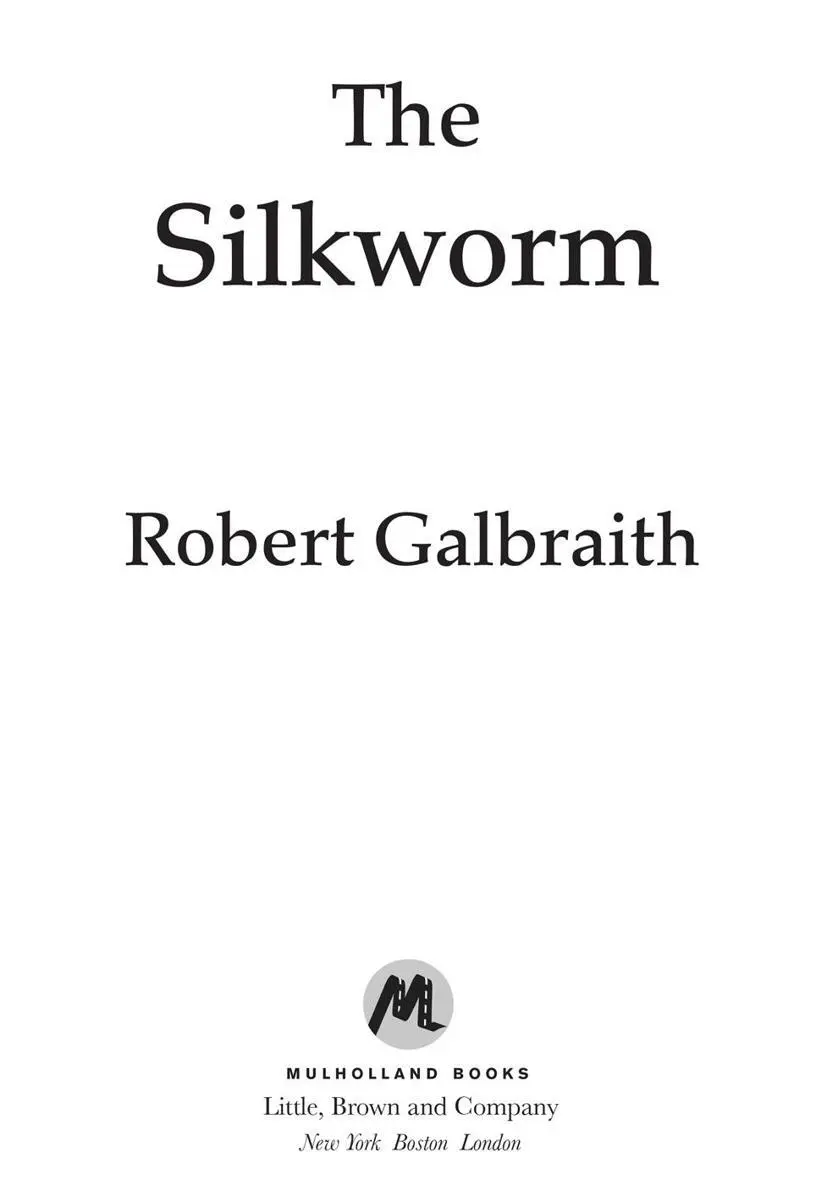
- Название:The Silkworm
- Автор:
- Издательство:Mulholland Books
- Жанр:
- Год:2014
- ISBN:9780316206877
- Рейтинг книги:3 / 5. Голосов: 2
-
Избранное:Добавить в избранное
- Отзывы:
-
Ваша оценка:
The Silkworm: краткое содержание, описание и аннотация
Предлагаем к чтению аннотацию, описание, краткое содержание или предисловие (зависит от того, что написал сам автор книги «The Silkworm»). Если вы не нашли необходимую информацию о книге — напишите в комментариях, мы постараемся отыскать её.
The Silkworm — читать онлайн бесплатно полную книгу (весь текст) целиком
Ниже представлен текст книги, разбитый по страницам. Система сохранения места последней прочитанной страницы, позволяет с удобством читать онлайн бесплатно книгу «The Silkworm», без необходимости каждый раз заново искать на чём Вы остановились. Поставьте закладку, и сможете в любой момент перейти на страницу, на которой закончили чтение.
Интервал:
Закладка:
“I was right, we do have a copy—secondhand. This way.”
He shuffled towards an untidy bin full of books.
“That’s a very important bit of information for the police,” said Robin, following him.
“Yes, indeed,” he said complacently. “Time of death. Yes, I could assure them that he was alive, still, on the eighth.”
“I don’t suppose you could remember what he came in here for,” said Robin with a small laugh. “I’d love to know what he read.”
“Oh yes, I remember,” said her companion at once. “He bought three novels: Jonathan Franzen’s Freedom , Joshua Ferris’s The Unnamed and…and I forget the third…told me he was going away for a break and wanted reading matter. We discussed the digital phenomenon—he more tolerant of reading devices than I… somewhere in here,” he muttered, raking in the bin. Robin joined the search halfheartedly.
“The eighth,” she repeated. “How could you be so sure it was the eighth?”
For the days, she thought, must blend quite seamlessly into each other in this dim atmosphere of mildew.
“It was a Monday,” he said. “A pleasant interlude, discussing Joseph North, of whom he had very fond memories.”
Robin was still none the wiser as to why he believed this particular Monday to have been the eighth, but before she could inquire further he had pulled an ancient paperback from the depths of the bin with a triumphant cry.
“There we are. There we are. I knew I had it.”
“I can never remember dates,” Robin lied as they returned to the till with their trophy. “I don’t suppose you’ve got any Joseph North, while I’m here?”
“There was only one,” said the old man. “ Towards the Mark . Now, I know we’ve got that, one of my personal favorites…”
And he headed, once more, for the ladder.
“I confuse days all the time,” Robin soldiered on bravely as the mustard-colored socks were revealed again.
“Many people do,” he said smugly, “but I am an adept at reconstructive deduction, ha ha. I remembered that it was a Monday, because always on a Monday I buy fresh milk and I had just returned from doing so when Mr. Quine arrived at the shop.”
She waited while he scanned the shelves above her head.
“I explained to the police that I was able to date the particular Monday precisely because that evening I went to my friend Charles’s house, as I do most Mondays, but I distinctly remembered telling him about Owen Quine arriving in my bookshop and discussing the five Anglican bishops who had defected to Rome that day. Charles is a lay preacher in the Anglican Church. He felt it deeply.”
“I see,” said Robin, who was making a mental note to check the date of such a defection. The old man had found North’s book and was slowly descending the ladder.
“Yes, and I remember,” he said, with a spurt of enthusiasm, “Charles showed me some remarkable pictures of a sinkhole that appeared overnight in Schmalkalden, Germany. I was stationed near Schmalkalden during the war. Yes…that evening, I remember, my friend interrupted me telling him about Quine visiting the shop—his interest in writers is negligible—‘Weren’t you in Schmalkalden?’ he said”—the frail, knobbly hands were busy at the till now—“and he told me a huge crater had appeared…extraordinary pictures in the paper next day…
“Memory is a wonderful thing,” he said complacently, handing Robin a brown paper bag containing her two books and receiving her ten-pound note in exchange.
“I remember that sinkhole,” said Robin, which was another lie. She took her mobile out of her pocket and pressed a few buttons while he conscientiously counted change. “Yes, here it is…Schmalkalden…how amazing, that huge hole appearing out of nowhere.
“But that happened,” she said, looking up at him, “on the first of November, not the eighth.”
He blinked.
“No, it was the eighth,” he said, with all the conviction a profound dislike of being mistaken could muster.
“But see here,” said Robin, showing him the tiny screen; he pushed his glasses up his forehead to stare at it. “You definitely remember discussing Owen Quine’s visit and the sinkhole in the same conversation?”
“Some mistake,” he muttered, and whether he referred to the Guardian website, himself or Robin was unclear. He thrust her phone back at her.
“You don’t remem—?”
“Is that all?” he said loudly, flustered. “Then good day to you, good day.”
And Robin, recognizing the stubbornness of an offended old egoist, took her leave to the tinkling of the bell.
36
Mr. Scandal, I shall be very glad to confer with you about these things which he has uttered—his sayings are very mysterious and hieroglyphical.
William Congreve, Love for Love
Strike had thought that Simpson’s-in-the-Strand was an odd place for Jerry Waldegrave to want to meet for lunch and his curiosity increased as he approached the imposing stone façade, with its revolving wooden doors, its brass plaques and hanging lantern. Chess motifs decorated the tiled surround of the entrance. He had never set foot there, aged London institution though it was. He had assumed it to be the home of well-heeled businessmen and out-of-towners treating themselves.
Yet Strike felt at home as soon as he set foot inside the lobby. Once an eighteenth-century gentleman’s chess club, Simpson’s spoke to Strike in an old and familiar language, of hierarchy, order and stately decorum. Here were the dark, sludgy clubland colors that men choose without reference to their womenfolk: thick marble columns and solid leather armchairs that would support a drunken dandy and, glimpsed beyond double doors, past the coat-check girl, a restaurant full of dark wood paneling. He might have been back in one of the sergeants’ messes he had frequented during his military career. All that was needed to make the place feel truly familiar were regimental colors and a portrait of the Queen.
Solid wood-backed chairs, snowy tablecloths, silver salvers on which enormous joints of beef reposed; as Strike sat down at a table for two beside the wall he found himself wondering what Robin would make of the place, whether she would be amused or irritated by its ostentatious traditionalism.
He had been seated for ten minutes before Waldegrave appeared, peering myopically around the dining room. Strike raised a hand and Waldegrave made his way with a shambling walk towards their table.
“Hello, hello. Nice to see you again.”
His light brown hair was as messy as ever and his crumpled jacket had a smear of toothpaste on the lapel. A faint gust of vinous fumes reached Strike across the small table.
“Good of you to see me,” said Strike.
“Not at all. Want to help. Hope you don’t mind coming here. I chose it,” said Waldegrave, “because we won’t run into anyone I know. My father brought me here once, years ago. Don’t think they’ve changed a thing.”
Waldegrave’s round eyes, framed by his horn-rimmed glasses, traveled over the heavily molded plasterwork at the top of the dark wood paneling. It was stained ocher, as though tarnished by long years of cigarette smoke.
“Get enough of your coworkers during office hours, do you?” Strike asked.
“Nothing wrong with them,” said Jerry Waldegrave, pushing his glasses up his nose and waving at a waiter, “but the atmosphere’s poisonous just now. Glass of red, please,” he told the young man who had answered his wave. “I don’t care, anything.”
But the waiter, on whose front a small knight chess piece was embroidered, answered repressively:
“I’ll send over the wine waiter, sir,” and retreated.
Читать дальшеИнтервал:
Закладка:
Похожие книги на «The Silkworm»
Представляем Вашему вниманию похожие книги на «The Silkworm» списком для выбора. Мы отобрали схожую по названию и смыслу литературу в надежде предоставить читателям больше вариантов отыскать новые, интересные, ещё непрочитанные произведения.









Обсуждение, отзывы о книге «The Silkworm» и просто собственные мнения читателей. Оставьте ваши комментарии, напишите, что Вы думаете о произведении, его смысле или главных героях. Укажите что конкретно понравилось, а что нет, и почему Вы так считаете.