Stephen Hunter - Time to Hunt
Здесь есть возможность читать онлайн «Stephen Hunter - Time to Hunt» весь текст электронной книги совершенно бесплатно (целиком полную версию без сокращений). В некоторых случаях можно слушать аудио, скачать через торрент в формате fb2 и присутствует краткое содержание. Жанр: Старинная литература, на английском языке. Описание произведения, (предисловие) а так же отзывы посетителей доступны на портале библиотеки ЛибКат.
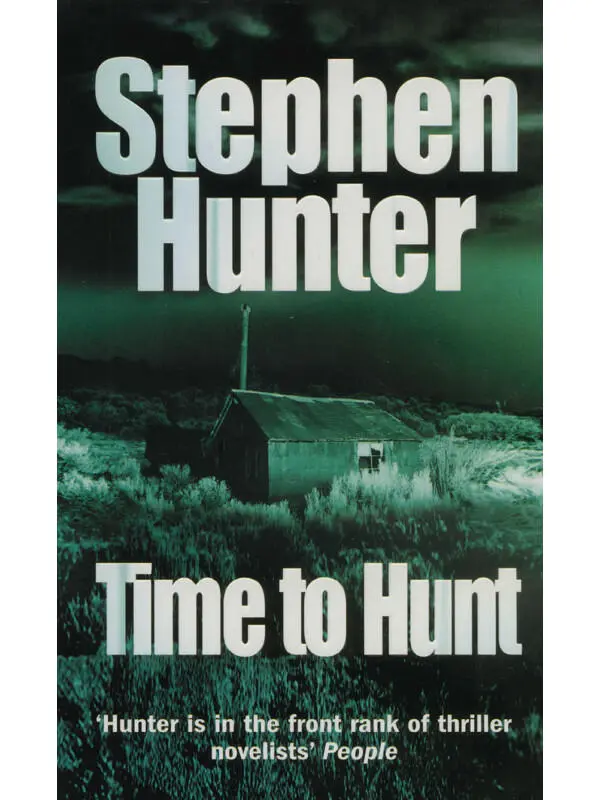
- Название:Time to Hunt
- Автор:
- Жанр:
- Год:неизвестен
- ISBN:нет данных
- Рейтинг книги:3 / 5. Голосов: 1
-
Избранное:Добавить в избранное
- Отзывы:
-
Ваша оценка:
Time to Hunt: краткое содержание, описание и аннотация
Предлагаем к чтению аннотацию, описание, краткое содержание или предисловие (зависит от того, что написал сам автор книги «Time to Hunt»). Если вы не нашли необходимую информацию о книге — напишите в комментариях, мы постараемся отыскать её.
Time to Hunt — читать онлайн бесплатно полную книгу (весь текст) целиком
Ниже представлен текст книги, разбитый по страницам. Система сохранения места последней прочитанной страницы, позволяет с удобством читать онлайн бесплатно книгу «Time to Hunt», без необходимости каждый раз заново искать на чём Вы остановились. Поставьте закладку, и сможете в любой момент перейти на страницу, на которой закончили чтение.
Интервал:
Закладка:
“How’s Suzy?” she asked, and Bob remembered that she and his first wife had had something of an acquaintanceship; at that point, he’d been higher in rank than the man who was hosting him.
“Oh, we don’t talk too much. You heard, I went through some bad times, had a drinking problem. She left me, and was smart to do it. She’s married to a Cadillac dealer now. I hope she’s happy.”
“I actually ran into her last year,” Marge said. “She seemed fine. She asked after you. You’ve had an adventurous few years.”
“I seem to have a knack for trouble.”
“Bob, you won’t get Vern’s career in any trouble? He retires this year after thirty-five years. I’d hate to see anything happen.”
“No, ma’am. I’ll be leaving very shortly. My time here is done, I think.”
They had a nice dinner and Bob tried to hide the melancholy that seeped into him; here was the life he would have had if he hadn’t gotten hit, if Donny hadn’t gotten killed, if it all hadn’t gone so sour on him. He yearned now for a drink, a soothing blur of bourbon to blunt the edge he felt, and he recalled a dozen times on active duty when he and this man or a man just like this man had spent the night recalling sergeants and officers and squids and ships and battles the world over, and enjoying immensely their lives in the place where they’d been born hard-wired to spend it, the United States Marine Corps.
But that was gone now. Face it, he thought. It’s gone, it’s finished, it’s over.
That night they went to a baseball game, Legion Ball, where the youngest boy, a scholarship athlete at the University of Virginia, got three hits while giving up only two as pitcher over the game’s seven innings. Again: a wonderful America, the best America — the suburbs on a spring evening, the weather warm, the night hazy, baseball, family and beer.
“Do you miss your wife?” asked the sergeant major’s wife.
“I do, a lot. I miss my daughter.”
“Tell me about her.”
“Oh,” said Bob, “she’s a rider. She’s a great horsewoman. Her mother has her riding English in case she decides to come east for college.”
And off he went, for twenty uncontrollable minutes, missing his daughter and his wife and the whole thing even more. Black is black , he thought, I want my baby back .
The game was over and in triumph everybody went back to the sergeant major’s house. Beer was opened, though Bob had Coke; some other senior NCOs came over and Bob knew a few, and all had heard of him. It was a good time; cigars came out, the men moved outside, the night was lovely and unthreatening. Then finally a young man showed up, trim, about thirty, with hard eyes and a crew cut, in slacks and a polo shirt. Bob understood that he was the sergeant major’s oldest boy, a major at Quantico, in the training command, back recently from a rough year in Bosnia and before that an even nastier one in the desert.
Bob was introduced and they chatted and once again he encountered a young man who loved him. What good did it do if his own family didn’t? But it was nice, all the same, and eventually the talk turned to his own day. He’d spent it in the DOD library in the Pentagon, where the sergeant major’s pass had got him admitted, going painfully through old phone books, trying to find out what this office was.
“Any luck?” asked the sergeant major.
“Yeah, finally. Room 4598 in Tempo C in the Washington Navy Yard, it was the location of an office of the Naval Investigative Service.”
“Those squid bastards,” said the Command Sergeant Major.
“At least now I’ve got a name to go on,” Bob said. “The CO was some lieutenant commander named Bonson. W. S. Bonson. I wonder what became of him.”
“Bonson?” said the gunny’s son. “Ward Bonson?”
“I guess,” said Bob.
“Well,” said the young officer, “he shouldn’t be too hard to find. I served a tour with the Defense Intelligence Agency in ninety-one. He was in and out of that shop.”
“You knew him?”
“I was just a staff officer,” he said. “He wouldn’t notice or remember me.”
“Who is he?” asked Bob.
“He’s now the deputy director of the Central Intelligence Agency.”
CHAPTER THIRTY-SIX
He watched through binoculars as the car, a black Ford sedan, arrived at 6:30 A.M. and picked up the occupant of 1455 Briarwood, Reston, Virginia. Bob followed at a distance. The lone passenger sat in the back, reading the morning papers as the car wound its way through the nearly empty streets. It progressed toward the Beltway, then followed that road north, toward Maryland; at the George Washington Parkway it surged off, westward, until it reached Langley, and then took that otherwise unremarkable exit. Bob languished back, then broke contact as the car disappeared down the unmarked road that led to the large installation that was unnamed from the road but which he knew to be the headquarters of the Central Intelligence Agency.
Instead, he drove back to Reston and relocated the house. He parked on the next court over — it was in a prosperous unit of connected townhouses — and slid low into the seat. It took almost two hours before he figured the pattern. There were two security vehicles, one a black Chevy Nova and the other a Ford Econoline van. Each had two men in them, and one or the other showed up every forty minutes, pausing on the street in front of the house and on the street in back. At that point, one of the men walked around back, bent in the weeds and checked something, presumably some sort of trembler switch that indicated if any kind of entry had been made.
Bob marked the address and drove to the nearest convenience store. There, he called the fire department and reported a fire in the house two down on the court. By the time he got back, three trucks had arrived, men were stomping in bushes, two cop cars with flashing light bars had set up perimeter security — it was a carnival. When the black Nova arrived, an agent got out, showed credentials, conferred with the police and firemen, then went to Bonson’s door, unlocked it and went in to check the house and secure it. He went around back to reset the trembler switch.
Bob went, found a place for lunch, then came back and parked a court down the line. He checked his watch to make certain neither of the patrol vehicles was expected, then walked back to Bonson’s house, where he knocked on the door. No answer came and, after a bit, he used his credit card to pop the door and slipped inside.
An alarm immediately began to whine. He knew he had sixty seconds to defuse it. The sound of the device enabled Bob to find it in ten seconds, which left fifty. Without giving it a lot of thought, Bob pressed 1-4-7 and nothing happened. The alarm still shrilled. He then hit 1-3-7-9 and the alarm ceased. How had he known? Not that difficult: most people don’t bother with learning numbers; they learn patterns that can easily be found in the dark, or when they are tired or drunk, and 1-4-7, the left-hand side of the nine-unit keypad, is the simplest and the most obvious; 1-3-7-9, the four corners, is the second most obvious. He waited a bit, then slipped out the back and found the trembler switch attached to an electric junction outside the house. It blinked red to indicate entry. With his Case knife, he popped the red plastic cone off the bulb, unscrewed the bulb, then squeezed and compressed the red cone to get it back on. Covering his tracks in the loam, he reentered the house. Soon enough the CIA security team rechecked the house on their rounds, but when the agent got out to check the trembler indicator, he did not get close enough to note the jimmied bulb. He was tired. He’d been through a lot. He returned to the truck.
Читать дальшеИнтервал:
Закладка:
Похожие книги на «Time to Hunt»
Представляем Вашему вниманию похожие книги на «Time to Hunt» списком для выбора. Мы отобрали схожую по названию и смыслу литературу в надежде предоставить читателям больше вариантов отыскать новые, интересные, ещё непрочитанные произведения.



Обсуждение, отзывы о книге «Time to Hunt» и просто собственные мнения читателей. Оставьте ваши комментарии, напишите, что Вы думаете о произведении, его смысле или главных героях. Укажите что конкретно понравилось, а что нет, и почему Вы так считаете.