Upton Sinclair - Love's pilgrimage
Здесь есть возможность читать онлайн «Upton Sinclair - Love's pilgrimage» весь текст электронной книги совершенно бесплатно (целиком полную версию без сокращений). В некоторых случаях можно слушать аудио, скачать через торрент в формате fb2 и присутствует краткое содержание. Год выпуска: 1911, Издательство: New York : M. Kennerley, Жанр: Старинная литература, на английском языке. Описание произведения, (предисловие) а так же отзывы посетителей доступны на портале библиотеки ЛибКат.
- Название:Love's pilgrimage
- Автор:
- Издательство:New York : M. Kennerley
- Жанр:
- Год:1911
- ISBN:нет данных
- Рейтинг книги:4 / 5. Голосов: 1
-
Избранное:Добавить в избранное
- Отзывы:
-
Ваша оценка:
Love's pilgrimage: краткое содержание, описание и аннотация
Предлагаем к чтению аннотацию, описание, краткое содержание или предисловие (зависит от того, что написал сам автор книги «Love's pilgrimage»). Если вы не нашли необходимую информацию о книге — напишите в комментариях, мы постараемся отыскать её.
Love's pilgrimage — читать онлайн бесплатно полную книгу (весь текст) целиком
Ниже представлен текст книги, разбитый по страницам. Система сохранения места последней прочитанной страницы, позволяет с удобством читать онлайн бесплатно книгу «Love's pilgrimage», без необходимости каждый раз заново искать на чём Вы остановились. Поставьте закладку, и сможете в любой момент перейти на страницу, на которой закончили чтение.
Интервал:
Закладка:
Meantime Corydon was growing paler, and more wretched than ever. For her, too, this winter was symbolized as a battle-ground. To him it was a field in which armies clashed, and the issue was uncertain; but to her it was a field of inevitable defeat, strewn with the corpses of her hopes. For hours she would lie upon her couch in the night-watches, silent, alone, staring out of the window at the wide waste of snow in the pitiless moonlight.
Thyrsis would have preferred to sleep in his own study, as he worked so late at night; but Corydon
begged him not to do this, she would rather be wakened, she said.
So, on one occasion, he came over at about two o'clock in the morning, and found her sleeping, as he thought, and crawled into his own cot. He was just dozing off to sleep, when he heard what he thought was a stifled sob.
He listened; he thought that she was crying in her sleep. But then, as the sound grew clearer, he sat up. The moonlight was shining in upon her, and Thyrsis caught a bright glint of steel. Swift as a flash the meaning of that swept over him. He had provided her with a revolver, that she might feel safe when she was left alone; and now he bounded out of bed and sprang-across the room, and found her with the weapon pointed at her head.
He struck it away; and Corydon, with a terrified cry, clutched at him and collapsed in his arms.
"Oh Thyrsis!" she wailed. "Save me! Save me!"
"What is it?" he gasped.
"I couldn't do it!" she cried, choking. "I couldn't! I tried— I tried so hard!"
"Sweetheart", he whispered, in terror.
"Don't let me do it!" she sobbed. "Oh, Thyrsis, you must save me!"
He pressed her to his bosom, shuddering with dread, and trying to soothe her hysterical outburst. So, little by little, he dragged the story from her. For three days she had been making up her mind to shoot herself, and she had chosen that night for the time.
"I've been sitting here for an hour," she whispered —"with the revolver in my hand. And I couldn't get up the courage to pull the trigger."
He clasped her, white with horror.
"I heard you coming," she went on. "I lay down and pretended to sleep. Then I tried again—but I can't, I can't! I'm a coward!"
"Corydon!" he cried.
"There was only one thing that stopped me. You would have got on without me—
"Don't say that, dearest!"
"You would—I know it! I'm only in your way. But oh, my baby! I loved him so, and I couldn't bear to leave him!"
She clung to him convulsively. "Oh, Thyrsis," she panted, "think what it meant to me to leave him. He'd have been without a mother all his life! And something might have happened to you, and he'd have had no one to love him at all!"
"Why did you want to do it?" he cried.
"Oh Thyrsis, I've suffered so! I'm weary—I'm worn out—I'm sick of the fight. I can't stand it any more —and what can I do?"
"My poor, poor girl," he whispered, and pressed her to his heart in a paroxysm of grief. "Oh, my Corydon! My Corydon!"
The horror of the thing overwhelmed him; he began to weep himself—his frame was shaken with tearless, agonizing sobs. What could he do for her, how could he help her?
But already he had helped her; it was not often that she saw him weeping, it was not often she found that she could do something for him. "Thyrsis, do you really want me?" she whispered. "Do you truly love me that much?"
"I love you, I love you!" he sobbed.
And she replied, "Then I'll stay. I'll bear anything, if you need me—if I can be of any use at all."
§ 19. So their tears were mingled; so once more, being sufficiently plowed up with agony, they might behold the deeps of each other's souls. Being at their last gasp, and driven to desperation, they would make the convulsive effort, and break the crust of dullness and commonplace, and reveal again the mighty forces hidden in their depths. At such hours he beheld Cory-don as she was, the flaming spirit, the archangel prisoned in the flesh. If only he could have found the key to those deep chambers, so that he could have had access to them always!
But alas, they knew only one path that led to them, and that through the valley of despair. From despair it led to anguished struggle, and from struggle to defiance, to rage and denunciation—and thence to visions and invocations, raptures and enthralments. So this night, for instance, behold Corydon, first holding her husband's hands, and shuddering with awe, and pledging her faith all over again; and then, later on, when the dawn was breaking, sitting in the cold moonlight with a blanket flung about her, her wild hair tossing, and in her hand the revolver with which she had meant to destroy herself. Behold her, making sport of her own life-drama—turning into wildest phantasy her domestic ignominies, her inhibitions and her helpmate's blunderings; evoking the hosts of the future as to a festival, rehearsing the tragedy of her soul with all posterity as her audience. When once these mad steeds of her fancy were turned loose, one could never tell where their course would be; and strange indeed were the adventures that came to him who rode with her!
There seemed to be no limit to the powers of this subliminal woman within Corydon. Her cheeks would
kindle, her eyes would blaze, and eloquence would pour from her—the language of great poetry, fervid and passionate, with swift flashes of insight and illumination, tumultuous invocations and bursts of prophecy. Thyrsis would listen and marvel. What a mind she had —sharp, like a rapier, swift as the lightning-flash! The powers of penetration and understanding, and above all the sheer splendors of language—the blazes of metaphor, the explosions of coruscating wit! What a tragic actress she might have made—how she would have shaken men's souls, and set them to shuddering with terror! What an opera-singer she could have been, with that rich vibrant voice, and the mien of a disinherited goddess!
It was out of such hours that the faith of their lives was made; and it was out of them also that Thyrsis formed his idea of woman. To him woman was an equal; and this he not only said with his lips, he lived it in his feelings. The time came when he went out into the world, and learned to understand the world's idea, that woman meant vanity and pettiness and frivolity; but Thyrsis let all this pass, knowing the woman-soul. Somewhere underneath, not yet understood and mastered, was pent this mighty force that in the end would revolutionize all human ideas and institutions. Here was faith, here was vision, here was the power of all powers; and how was it to be delivered and made conscious, and brought into the service of life?
Most women liked Thyrsis, because they divined in some vague way this attitude; and some men hated him for the same reason. These men, Thyrsis observed, were the slave-drivers; they held that woman was the weaker vessel, and for this they had their own motive.".
There were women, too, who liked to be ruled; but Thyrsis never argued with them—it was enough, he judged, to treat any slave as a free man, or any servant as a gentleman, and sooner or later they would divine what he meant, and the spirit of revolt would begin to flicker.
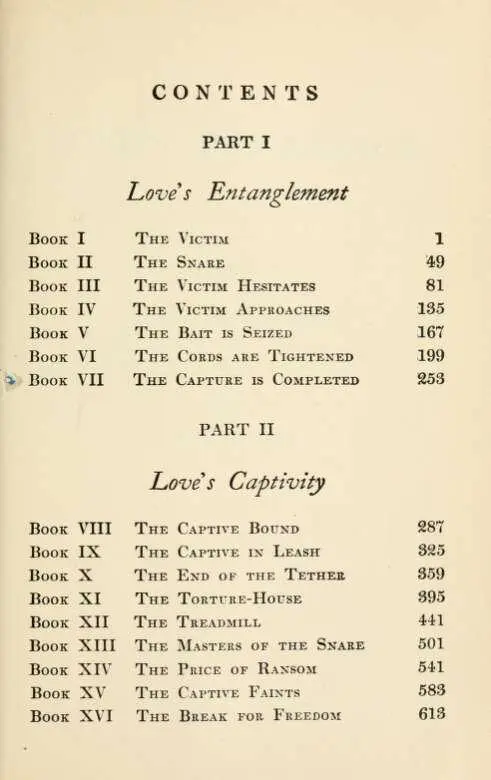
BOOK XIII THE MASTERS OF THE SNARE
They stood upon the porch of the little cabin-, listening to the silence of the night.
"How far away it all seems!" she said —
"How many a dingle on the loved hill-side
Hath since our day put by The coronals of that forgotten time!"
"It makes one feel old," he said — "like the coming of the night!"
"The night!" she repeated, and went on —
"/ feel her finger light
Laid pausefully upon life's headlong train; — The foot less prompt to meet the morning dew, The heart less bounding at emotion new, And hope once crushed less quick to spring again!"
Читать дальшеИнтервал:
Закладка:
Похожие книги на «Love's pilgrimage»
Представляем Вашему вниманию похожие книги на «Love's pilgrimage» списком для выбора. Мы отобрали схожую по названию и смыслу литературу в надежде предоставить читателям больше вариантов отыскать новые, интересные, ещё непрочитанные произведения.












Обсуждение, отзывы о книге «Love's pilgrimage» и просто собственные мнения читателей. Оставьте ваши комментарии, напишите, что Вы думаете о произведении, его смысле или главных героях. Укажите что конкретно понравилось, а что нет, и почему Вы так считаете.