Upton Sinclair - Love's pilgrimage
Здесь есть возможность читать онлайн «Upton Sinclair - Love's pilgrimage» весь текст электронной книги совершенно бесплатно (целиком полную версию без сокращений). В некоторых случаях можно слушать аудио, скачать через торрент в формате fb2 и присутствует краткое содержание. Год выпуска: 1911, Издательство: New York : M. Kennerley, Жанр: Старинная литература, на английском языке. Описание произведения, (предисловие) а так же отзывы посетителей доступны на портале библиотеки ЛибКат.
- Название:Love's pilgrimage
- Автор:
- Издательство:New York : M. Kennerley
- Жанр:
- Год:1911
- ISBN:нет данных
- Рейтинг книги:4 / 5. Голосов: 1
-
Избранное:Добавить в избранное
- Отзывы:
-
Ваша оценка:
Love's pilgrimage: краткое содержание, описание и аннотация
Предлагаем к чтению аннотацию, описание, краткое содержание или предисловие (зависит от того, что написал сам автор книги «Love's pilgrimage»). Если вы не нашли необходимую информацию о книге — напишите в комментариях, мы постараемся отыскать её.
Love's pilgrimage — читать онлайн бесплатно полную книгу (весь текст) целиком
Ниже представлен текст книги, разбитый по страницам. Система сохранения места последней прочитанной страницы, позволяет с удобством читать онлайн бесплатно книгу «Love's pilgrimage», без необходимости каждый раз заново искать на чём Вы остановились. Поставьте закладку, и сможете в любой момент перейти на страницу, на которой закончили чтение.
Интервал:
Закладка:
spirited the body away and burned it, and scattered the ashes. But this was a bad thing for them to do, for the ashes became seeds of the new contagion, and all through the great city, in the strangest and most unaccountable way, men would suddenly begin to speak the truth. And, of course this made business impossible —the merchants and traders had to move away; and how was it possible to preserve authority, when sooner or later all the lawyers and the judges and the politicians would speak truth? So the people arose and declared that they were weary of lies, and they erected a statue of Hathawi at one of the places where his ashes had fallen, and declared that every candidate for office must make his speeches there. After that it was a long time before there were any officials elected—because no man could be found to whom prominence and power were not more precious than public welfare. But meanwhile the people thrived exceedingly.
Finally, however—the climax of the story—the news of all this had spread to other nations, and the rulers of these nations perceived that it was anarchy, and could by no means be permitted—their own people were threatening to rise. It must be clearly shown that a state without a government would be plundered by enemies; and so they prepared to plunder it. And so arose a great agitation in Hathawi's home-state, and men called for a dictator, and for preparations of defence. But the followers of Hathawi cried out, saying, "Let us submit! Let us open our city to these men, and let them do their will—for the power of the truth is greater than even they." And so it was decided.
When the hostile rulers heard of this a great fear took possession of them. They remembered the fate of certain famous diplomatists they had already sent over;
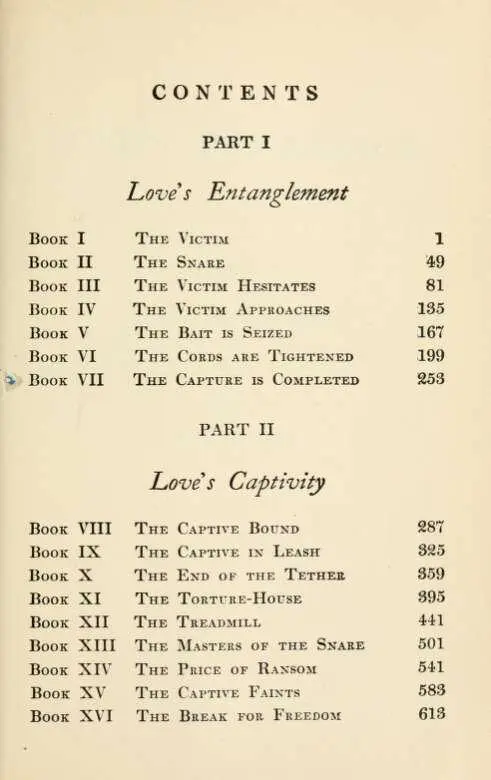
THE CORDS ARE TIGHTENED
and they dared not trust themselves near the statue of the Hearer of Truth. So their plans of invasion came to naught; and among their own people there was laughter and bitter mockery; and behold, one morning, a statue of Hathawi which some one had set up in a public-square! Here the lovers of truth gathered by thousands, and the soldiers who were sent to shoot them laid down their arms and joined them; and so, all over the world, was the end of the dominion of the lie.
§ 11. SUCH was the outline of Thyrsis' story. He judged that it might be a very great story, or a comparatively commonplace one—it all depended upon the power with which it was visioned. He must get into himself and wrestle the thing out. This was to be his act of creation—his baby!
It was the first time since his marriage that Thyrsis had tried really to do what he called work. All things else had been mere echoes of the work he had done the previous summer; but now he had to do something new, something that was an echo of nothing else. Every day that he faced the task, his agony and despair of soul grew greater; for he found that he could not do the work. He could not even begin to do it—he could not even try to do it! He was helpless, bound hand and foot!
It was not his fault, it was not Corydon's fault; it was a tragedy inherent in the very nature of things— in the two natures that were in himself. There was the man, who loved a woman, and hungered to see her happy; and there was the artist, to whom solitude was the very breath of life. To write this book—to write it really—he would have to spend weeks of brooding over it, thinking about nothing else day and night;
LOVE'S PILGRIMAGE
he would have to shape his whole existence to that end, to be free from every distracting circumstance, from everything that called him out of himself. And how could he hope for such a thing, while he was living in a tent with another person?
Thyrsis had his artist's standard of perfection. Of course, he could never actually be satisfied with what he did; but at least he could feel that it was the best he was equal to—he could get a real and honest sense of exhaustion for himself. But now, the moment that he faced the problem fairly, he saw he could never get that real and honest sense of exhaustion again. He was dragged up to the issue and forced to face it in-stantty. The pressure of circumstances upon him was overwhelming; and he had to make up his mind to do something he had never done before—instead of really writing his books, to do the best he could with them!
Yet, inevitable as this was, and clearly as he saw it, he could not make up his mind to it. In reality, he never did make up his mind to it. He did it, and in his inmost heart he knew that he was doing it; but all the time he was trying to deny it, was wrestling with agony and despair in his soul in the effort to do something else.
He would go away in the morning and try to think about the book; and just when he would get started, it would be time for dinner, and there would be the image of Corydon waiting for him. And so he would go home, and go back in the afternoon—and when he had got started again, it would be dark. The next day, having explained his trouble, he would take his lunch away with him ; but in the forenoon there would come a drenching thunder-storm, and he would have to go back again. Or he would try to work in the tent
THE CORDS ARE TIGHTENED 243
at night; and the wind would howl and blow the lamp so that he could not put his mind on anything. Nor did it avail him to rail at himself, to tell himself that he was a fool for being at the mercy of such mishaps. It was none the less a fact that he was at the mercy of them, and that he could no longer give himself up to the sway of his imagination.
And always there was Corydon, yearning for his companionship. It had always been their idea that they should do the work together; so completely would they be fused in the fire of love, that she would share his soul states and write parts of his books. But now that idea had to be abandoned; and this was her tragedy.
"I have to sit and think of my health!" she would exclaim.
"It isn't your health, dear," he would plead; "it's the health of the child!"
"I know that. But then, am I always to sit at home and be placid, while you go away to wrestle with the angels?"
"Not always, Corydon," he said. "This will pass-
;< If I do," she cried, "I only stay to wrestle with the demons. And is that so very good for a pregnant woman ?"
"My dear!" he protested.
"It's just as I said!" she went on. "I ought not to have had the child! I'm only a school-girl, with a school-girl's tasks. And I try and try, but I can't help it—everything within me rebels at the cares of motherhood."
"That's one mood, dear," he said. "But you know that's not true always."
"It's all the clearer to me," she insisted, "since we've
LOVE'S PILGRIMAGE
had to give up our music. I can't work at the piano any more—I may never be able to."
"But even if you could, Corydon, I couldn't afford to get you one now."
'No, of course not. And you have to give up your violin!"
"Much time I have to practice it in our present plight!"
''I know—I know! But don't you see, we lose our last hope of growing together? I've a vision that haunts me all the time—you going away to do your work, and staying for longer and longer periods—and I sitting at home to mind the baby!"
Day after day he would come back, and she would ask him how the book was going; and he would have to answer that it was not going at all. Then, in his desperation, he would make up his mind to write what he could—to be content with this glimpse of one scene, and with that feeble echo of what he knew the next scene ought to be; and he would bring the result to Corydon, and would discover with a secret pang that she did not know the difference. But then he would ask himself—how could she know the difference? The difference did not exist! His vision of the thing had existed in himself, and in himself alone; if he never uttered it, the world would never know what it might have been—and would never care. Ah, what a future was that to look forward to—to filling the ears of the world with lamentations concerning the books that he might have written! And all the time knowing that the ears of the world were deaf to ever}* sound he made!
Читать дальшеИнтервал:
Закладка:
Похожие книги на «Love's pilgrimage»
Представляем Вашему вниманию похожие книги на «Love's pilgrimage» списком для выбора. Мы отобрали схожую по названию и смыслу литературу в надежде предоставить читателям больше вариантов отыскать новые, интересные, ещё непрочитанные произведения.












Обсуждение, отзывы о книге «Love's pilgrimage» и просто собственные мнения читателей. Оставьте ваши комментарии, напишите, что Вы думаете о произведении, его смысле или главных героях. Укажите что конкретно понравилось, а что нет, и почему Вы так считаете.