Bruce Hood - The Self Illusion
Здесь есть возможность читать онлайн «Bruce Hood - The Self Illusion» весь текст электронной книги совершенно бесплатно (целиком полную версию без сокращений). В некоторых случаях можно слушать аудио, скачать через торрент в формате fb2 и присутствует краткое содержание. ISBN: , Издательство: Constable & Robinson, Жанр: Старинная литература, на английском языке. Описание произведения, (предисловие) а так же отзывы посетителей доступны на портале библиотеки ЛибКат.

- Название:The Self Illusion
- Автор:
- Издательство:Constable & Robinson
- Жанр:
- Год:неизвестен
- ISBN:9781780331379
- Рейтинг книги:5 / 5. Голосов: 1
-
Избранное:Добавить в избранное
- Отзывы:
-
Ваша оценка:
The Self Illusion: краткое содержание, описание и аннотация
Предлагаем к чтению аннотацию, описание, краткое содержание или предисловие (зависит от того, что написал сам автор книги «The Self Illusion»). Если вы не нашли необходимую информацию о книге — напишите в комментариях, мы постараемся отыскать её.
The Self Illusion — читать онлайн бесплатно полную книгу (весь текст) целиком
Ниже представлен текст книги, разбитый по страницам. Система сохранения места последней прочитанной страницы, позволяет с удобством читать онлайн бесплатно книгу «The Self Illusion», без необходимости каждый раз заново искать на чём Вы остановились. Поставьте закладку, и сможете в любой момент перейти на страницу, на которой закончили чтение.
Интервал:
Закладка:
Despite the ease of Twitter connectivity, it leads to homophily, with people of the same age, race, religion, education and even temperament tending to follow each other and unfollow those with different views. For example, in one study of over 102,000 Twitter users who produced a combined 129 million tweets in six months, researchers analysed their posting on measures of positive or negative content. 29Upbeat tweets were things like, ‘Nothing feels like a good shower, shave and haircut … love it’, or ‘thanks for your follow, I am following you back, great group of amazing people’. Those of a more miserable disposition posted tweets such as ‘She doesn’t deserve the tears but I cry them anyway’ or ‘I’m sick and my body decides to attack my face and make me break out!! WTF’. When the researchers analysed the social networking of the group they found that those who clustered together shared the same dispositions. This type of clustering is illustrated in Figure 10. Happy users are connected to other happy users and unhappy users are connected to other miserable sods. It was as if there was emotional contagion between Twitter users, like the mimicry of the mirror system we encountered earlier only this time the transfer was entirely virtual. Of course, this type of clustering increases polarization. An analysis of 250,000 tweets during the US congressional midterm elections in 2010 revealed that liberals and conservatives significantly retweeted partisan messages consistent with party line, but not those from the opposing camp. 30
Furthermore, the promise of communication with thousands of users is not fulfilled because of one major stumbling block – our evolved human brain. When the tweets of 1.7 million users over six months were analysed, the researchers made a remarkable discovery. 31As the number of followers increase, the capacity to interact with others becomes more difficult in this ‘economy of attention’. We cannot have meaningful exchanges with unlimited numbers of other people. There simply is not enough time and effort available to respond to everyone. It turns out that within this vast ocean of social networking the optimum number at which reciprocal communication can be maintained, peaks at somewhere between 100 and 200 followers. Likewise, on Facebook, the average user has 130 friends. Does that number seem familiar? It should. It’s close to Dunbar’s again, which describes the relationship between the primate cortex and social group size. It turns out accurately to predict our social activity in the virtual world of social networking sites to be as much as in the real world.
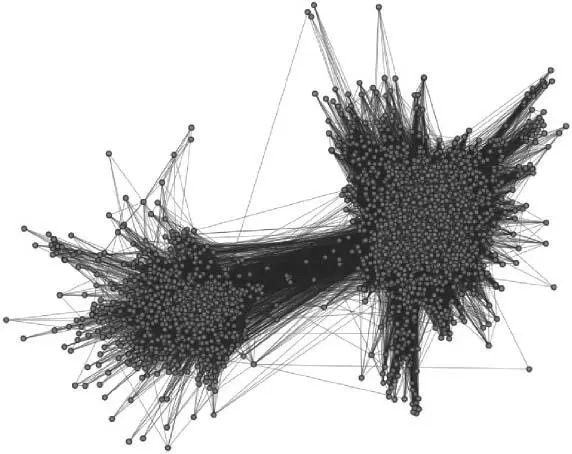
Figure 10: Analysis of communication on Twitter reveals significant grouping (based on a study by Bollen et al., 2011. Copyright permission given).
Time for Our Self
Technology was supposed to liberate us from the mundane chores in life. It was supposed to make us happier. Twentieth-century advertisements promised a world of automaticity and instant gratification. When the computer first came along in the 1960s and then into many Western households during the 1980s and 1990s, we were told that we would have increased freedom to pursue leisure and entertainment. We were supposed to have more time for each other. The computer has certainly made many tasks easier, but paradoxically many of us spend more time alone at our computers than engaging with the people with whom we live and work. My colleague, Simon Baron-Cohen, an expert on autism, has estimated that he answers fifty emails a day and has spent over 1,000 hours a year doing so. 32I think that my online time is much worse. I don’t get as many emails as Simon but I am online every day and cannot remember the last time I had a day offline. Even on holiday or trips, I am connected.
If I am not researching articles or preparing teaching material, then I am keeping in contact with people through social networking sites. I email, write a blog, tweet on Twitter, talk on Skype, have a LinkedIn profile and drop in and out of Facebook. I have joined Google+, the latest development in social networking. I surf the Web relentlessly. I can do this via my office computer, portable laptop, iPad or smartphone. I am all wired up. Even when I watch some important event on television, I have my social network feed running so I can keep track of what other people’s opinions are on the same broadcast. I estimate that I spend at least half of my waking day online from 7 a.m. to midnight. That’s well over 3,000 hours per year – excessive by anyone’s standards. I know that this level of Web presence is not typical and probably not healthy but, if my teenage daughters are anything to go by, many people in the West are increasingly becoming immersed in their online involvement. Some argue that excessive dependence on Web activity should be considered like any other addiction though psychiatrists are not in agreement that it really constitutes a well-defined disorder.
My addiction to the Web began in 2009 when I started my online presence and social networking at the request of the publisher of my first book. Initially, I was asked to write a blog – a website where you write stories and hope that people visit and read what you write. From the outset I thought that blogging was a self-indulgent activity but I agreed to give it a whirl to help promote my book. In spite of my initial reluctance I soon became addicted to feedback. Readers could leave comments about each posting and as an administrator of my site I could see who and how many people where visiting. It was not enough to post blogs for some unseen audience. I needed the validation from visitors that my efforts and opinions were appreciated. These were recorded as ‘hits’ – the number of times people visited my site. This feedback process is supercharged by the accelerated nature of communication on the Web. Unlike peer-reviewed scientific papers or critics’ reviews of your books that can take ages and are unpredictable, social networking sites can create instantaneous gratification from feedback. If the public responds positively to something we have written by increasing traffic or leaving kind comments, this makes us feel very good indeed. It justifies our efforts.
We know the reason for this pleasure from experiments on conditioning behaviour. Conditioning was originally discovered in the 1890s by Russian physiologist Ivan Pavlov, who noted that the dogs he had been studying learned to anticipate feeding time because they would salivate before the food arrived. 33He then presented the sound of a buzzer (not a bell as popular culture portrays it) with the food so that eventually just the sound elicited salivation. The dog had learned to associate the sound with the food. This was an important discovery. The experimenter could shape the behaviour of the dog to respond to a variety of different stimuli. They could be trained or conditioned by reward. Conditioning was soon developed into a whole school of psychological theory called Behaviourism, championed in the United States by individuals like J. B. Watson and B. F. Skinner who claimed that any complex behaviour could be shaped by rewards and punishments. 34In fact, we now know that it is not the rewards that strengthen behaviours but rather the anticipation of rewards, which is so satisfying.
This is because deep inside our brain, close to the brainstem, is a reward system that is invigorated by a cluster of around 15,000–20,000 dopamine neurons that send out long fibres to other regions of the brain. Given the billions of neurons in the brain, it is remarkable that this tiny population is the pleasure centre critical in controlling our behaviour. These neurons enable us to predict and anticipate rewards and punishment. 35Without them, we would be hopelessly inept in decision-making and our behaviour would be erratic. When an animal in a conditioning experiment learns that pressing a lever or pecking a disc will deliver a reward, anticipatory dopamine is released, which reinforces the behaviour rather than the actual reward. We know this because rats with electrodes implanted in the pleasure centre connected to a current will continue to self-stimulate in the absence of any food reward – to the point of starvation. 36The dopamine rush alone is sufficient to condition the behaviour. When patients have electrodes implanted in this same brain region for the treatment of intractable epilepsy, they report feeling pleasure. Like many addictive behaviours from gambling to sex, it’s the thrill of expectation that gives us the best buzz.
Читать дальшеИнтервал:
Закладка:
Похожие книги на «The Self Illusion»
Представляем Вашему вниманию похожие книги на «The Self Illusion» списком для выбора. Мы отобрали схожую по названию и смыслу литературу в надежде предоставить читателям больше вариантов отыскать новые, интересные, ещё непрочитанные произведения.












Обсуждение, отзывы о книге «The Self Illusion» и просто собственные мнения читателей. Оставьте ваши комментарии, напишите, что Вы думаете о произведении, его смысле или главных героях. Укажите что конкретно понравилось, а что нет, и почему Вы так считаете.