Bruce Hood - The Self Illusion
Здесь есть возможность читать онлайн «Bruce Hood - The Self Illusion» весь текст электронной книги совершенно бесплатно (целиком полную версию без сокращений). В некоторых случаях можно слушать аудио, скачать через торрент в формате fb2 и присутствует краткое содержание. ISBN: , Издательство: Constable & Robinson, Жанр: Старинная литература, на английском языке. Описание произведения, (предисловие) а так же отзывы посетителей доступны на портале библиотеки ЛибКат.

- Название:The Self Illusion
- Автор:
- Издательство:Constable & Robinson
- Жанр:
- Год:неизвестен
- ISBN:9781780331379
- Рейтинг книги:5 / 5. Голосов: 1
-
Избранное:Добавить в избранное
- Отзывы:
-
Ваша оценка:
The Self Illusion: краткое содержание, описание и аннотация
Предлагаем к чтению аннотацию, описание, краткое содержание или предисловие (зависит от того, что написал сам автор книги «The Self Illusion»). Если вы не нашли необходимую информацию о книге — напишите в комментариях, мы постараемся отыскать её.
The Self Illusion — читать онлайн бесплатно полную книгу (весь текст) целиком
Ниже представлен текст книги, разбитый по страницам. Система сохранения места последней прочитанной страницы, позволяет с удобством читать онлайн бесплатно книгу «The Self Illusion», без необходимости каждый раз заново искать на чём Вы остановились. Поставьте закладку, и сможете в любой момент перейти на страницу, на которой закончили чтение.
Интервал:
Закладка:
When we conform, it is not so much the power of the group or peer pressure that shapes our behaviour, but rather our desire to be accepted. Our need to conform is a powerful force that shapes us and literally changes the way we think. In other words, it is not just public compliance when we conform to the group but true private acceptance of group norms. For example, when asked to rate the attractiveness of music or faces, 31if there is a discrepancy between an individual’s liking and the group consensus, this triggers activation in brain regions associated with social cognition and reward evaluation. However, as soon as we have an ally, we become more self-opinionated. In Asch’s line test, it only required the presence of one other dissenter to give the right answer for the effect to reduce significantly. When we are accompanied by another dissenter, we are no longer an individual but part of a new group. The same thing unfolded in Twelve Angry Men . That’s why we seek out others who share our opinion, because there is strength in numbers. It’s also one of the reasons that oppressive regimes quash any resistance as soon as it starts to appear. If we feel isolated and powerless, then we submit more readily to authority and are less likely to resist. History teaches that authoritarian regimes have managed to control the people by terrorizing them into submission with acts of human cruelty and atrocity, but to suppress dissent you need others to do your bidding unquestioningly. This is where the power of the group can be manipulated to change the nature of the individual. This is where normal, good-natured people become monsters.
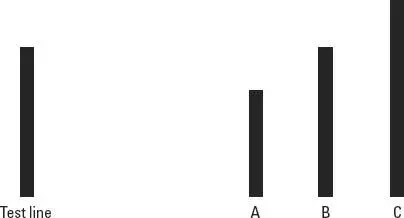
Figure 7: Asch test of compliance. Which line (A, B or C) matches the test line?
The Lucifer Effect
Do you consider your self evil? Could you inflict pain and suffering on another human being or a defenceless animal for that matter? Consider how likely it is that you would do any of the following:
• Electrocute a fellow human until they were dead
• Torture a puppy
• Administer a lethal dose
• Strip-search a co-worker and make them perform a sex act on another worker
Most readers are appalled by such suggestions. However, the Stanford psychologist Phil Zimbardo forces us to think again in his recent book, The Lucifer Effect , 32about how to make good people become evil by putting them in toxic situations that generate a downward spiral into degradation. Zimbardo convincingly argues that all of us are capable of doing the despicable deeds in this list, even though none of us thinks we ever would. This is because we believe that we are essentially good and that only bad people do bad things. Our whole legal system is based on this assumption that individuals are responsible for their own moral choices. But Zimbardo argues that the situations we can find our selves in and the influence of those around us determine how we behave and treat others. If we believe our self illusion has a core morality then it is one that is at the mercy of those around us.
Zimbardo, who rather resembles a popular portrayal of Lucifer with his goatee, is known for his infamous 1971 Stanford Prison Experiment, where he investigated the consequences of simulating an incarceration scenario using ordinary students playing cops and robbers. It was to be a two-week study of the effects of role-playing in the basement of the Stanford psychology department, which had been turned into a makeshift prison. Like Tajfels’s Bristol schoolboy study, on the flip of a coin, the volunteers were divided. Half of the student volunteers were to be the guards and the other half were to be their prisoners, each earning $15 a day for fourteen days. Most thought it would be easy money to loaf around for a couple of weeks. However, what happened next shocked everyone involved and has left a legacy in the literature on the psychology of evil that now explains many unbelievable examples of human cruelty.
To simulate authenticity, the prisoners were arrested on a Sunday by real policemen, handcuffed, blindfolded and taken to the prison where they were stripped and put in smocks without underwear. This was only the beginning of the humiliation. Then the ‘guards’ – uniformed fellow students wearing mirror shades – met them. When they wanted to go to the toilet down the hall, the inmates were led out with bags on their heads. Their guards gave them a long list of rules that they had to memorize and failure to do so led to punishment. Within a very short time, things began to deteriorate. Even though they had never been instructed to harm the inmates, the guards began to spontaneously torment and torture the inmates. In this authoritarian atmosphere, the inmates became psychologically distressed while their guards were getting increasingly out of control.
From a scientific perspective, this was exhilarating. Even though everyone involved knew the set-up was not real, the situation was creating real cruelty and suffering. Thrilled by the speed and ease at which morality seemed to be deteriorating, Zimbardo pushed on, largely as the scientist overseeing the project but also as his role as the Superintendent in charge of the prison. He was becoming a player immersed in his own fantasy story.
His girlfriend at the time, another psychology professor, Christina Maslach, visited to see how the experiment was progressing and was shocked by what she observed. She told Zimbardo, ‘What you’re doing to those boys is a terrible thing!’ A heated row between the lovers ensued and she would later recall, ‘Phil seemed so different from the man I thought I knew. He was not the same man that I had come to love.’ Zimbardo had lost the plot. He seemed unable to see what cruelty he had created. After six days, largely at the bequest of Christina, he terminated the experiment. He married her the following year.
For the next forty years, the Stanford Prison Experiment has remained a controversial study both in terms of the ethics of putting people in this situation as well as the interpretation. 33Zimbardo thinks that the devil is in the deindividuation whereas others claim that all that was demonstrated was over-enthusiastic role-playing. That may be true to some extent. Maybe some of the students had watched too many prison movies like Cool Hand Luke where the guards also wore the same mirrored sunglasses and behaved sadistically. 34One of the student guards even adopted a Southern American accent indicating a well-formulated stereotype of the typical correctional officer. They behaved as they thought the officers and prisoners should. But even if it was all acting, one is still left wondering what is the difference between role-playing and reality. What does it mean to say: that I may act in a terrible way but that’s not the way I really am? Who is the real me, or self?
The Man in the White Coat
Some questioned the authenticity of the Stanford Prison Experiment. What would happen in a real situation of authority? This is where the work of Stanley Milgram is so relevant. Milgram was one of Solomon Asch’s research assistants, and in the early 1960s he wanted to take his mentor’s work further. In what has become one of the most notorious psychology studies, Milgram demonstrated the power of authority when compliance becomes blind obedience. 35
It began with a simple advertisement in which participants were asked to volunteer and would be paid $4 an hour to take part in an experiment on learning and punishment to be conducted at prestigious Yale University. When each of the volunteers arrived at the laboratory, they met with the experimenter, wearing a white lab coat, and another middle-aged man, who was introduced as another participant but who was actually a trained actor. After a supposedly random decision, the experimenter explained that the volunteer would play the role of teacher and the actor would play the role of learner. The learner was led off to another room and it was explained that the teacher would read words to the learner over an intercom. The learner would then repeat the words back to the teacher. If the learner made a mistake, the teacher would press a button that delivered an electric shock to the learner in the other room. There were thirty levels of shock rising in 15-volt increments from an initial 15 volts to 450 volts. Each switch had the level and a description of the shock, ranging from ‘mild’ at the start, through the tenth level (150 volts), ‘strong’; thirteenth level (195 volts), ‘very strong’; seventeenth level (255 volts), ‘intense’; twenty-first level (315 volts), ‘extremely intense’; twenty-fifth level (375 volts), ‘danger, severe shock’. The final two levels of 435 and 450 volts had no label other than an ominous ‘XXX’. To give them an idea of what it felt like, the participant teacher was given a taste of the third level (45 volts), which induced a very real, tingly pain.
Читать дальшеИнтервал:
Закладка:
Похожие книги на «The Self Illusion»
Представляем Вашему вниманию похожие книги на «The Self Illusion» списком для выбора. Мы отобрали схожую по названию и смыслу литературу в надежде предоставить читателям больше вариантов отыскать новые, интересные, ещё непрочитанные произведения.










Обсуждение, отзывы о книге «The Self Illusion» и просто собственные мнения читателей. Оставьте ваши комментарии, напишите, что Вы думаете о произведении, его смысле или главных героях. Укажите что конкретно понравилось, а что нет, и почему Вы так считаете.