Bruce Hood - The Self Illusion
Здесь есть возможность читать онлайн «Bruce Hood - The Self Illusion» весь текст электронной книги совершенно бесплатно (целиком полную версию без сокращений). В некоторых случаях можно слушать аудио, скачать через торрент в формате fb2 и присутствует краткое содержание. ISBN: , Издательство: Constable & Robinson, Жанр: Старинная литература, на английском языке. Описание произведения, (предисловие) а так же отзывы посетителей доступны на портале библиотеки ЛибКат.

- Название:The Self Illusion
- Автор:
- Издательство:Constable & Robinson
- Жанр:
- Год:неизвестен
- ISBN:9781780331379
- Рейтинг книги:5 / 5. Голосов: 1
-
Избранное:Добавить в избранное
- Отзывы:
-
Ваша оценка:
The Self Illusion: краткое содержание, описание и аннотация
Предлагаем к чтению аннотацию, описание, краткое содержание или предисловие (зависит от того, что написал сам автор книги «The Self Illusion»). Если вы не нашли необходимую информацию о книге — напишите в комментариях, мы постараемся отыскать её.
The Self Illusion — читать онлайн бесплатно полную книгу (весь текст) целиком
Ниже представлен текст книги, разбитый по страницам. Система сохранения места последней прочитанной страницы, позволяет с удобством читать онлайн бесплатно книгу «The Self Illusion», без необходимости каждый раз заново искать на чём Вы остановились. Поставьте закладку, и сможете в любой момент перейти на страницу, на которой закончили чтение.
Интервал:
Закладка:
Consider the different questions and implications raised by Cooley’s looking glass self. How do we develop a sense of self in the first place? How do children develop an understanding of what others think and, more importantly, what they think about them? This must be especially important during that most difficult time of adolescence when children try to find their true self. How is our identity shaped by the characteristics that are imposed on us by biology and cultural stereotypes? All of these questions reflect upon the sense that the self is defined by those around us.
Man in the Mirror
When Derek Zoolander looked in the puddle and saw an incredibly good-looking face, he immediately knew who it was staring back at him in the reflection. However, this seemingly trivial ability to recognize one’s self is not something that everyone can do. As we age, brain death can progressively destroy everyday functions that we take for granted – including those that generate our sense of identity. Take TH, a seventy-seven-year-old Australian man who would look in the mirror and describe the gentleman staring back at him as a ‘dead ringer’ for himself, but it was definitely someone else. 2TH had normal intelligence and was not crazy, but he could not appreciate that the reflection in the mirror was his own. When asked where this man in the mirror had come from, TH replied that he must be a neighbour in an adjoining apartment. He confabulated a bizarre story to fit with his experience of the stranger in the mirror, but the truth is TH has a rare neurological condition called ‘mirror misidentification’ in which patients think their own reflection does not belong to them. They appreciate the likeness, but there is no self-recognition. Something in the face-processing circuitry of their brain has failed to register their own outward identity. There is no flicker of familiarity.
Mirror misidentification is one of the dissociation disorders where individuals do not feel connected to reality. Their sense of self and identity within the world is distorted. Sometimes people even believe that they are dead and that the world around them and all their experience are an illusion. This death delusion, known as Cotard’s syndrome, 3is rare but I got an insight into the condition from a colleague whose own father had Cotard’s syndrome and described it as like living in an artificial world where nothing was real. Experiencing the here and now as real is part of being consciously aware of your present surroundings, but disconnection disorders such as Cotard’s remind us that we need a healthy brain to keep us in touch with reality. Sometimes we can all experience a disconnection or depersonalization in which we feel a sense of unreality and detachment from our self. Symptoms include dreamlike states, loss of empathy and a sense of disconnection with our bodies. 4It can seem like we are actors in a play or that we are watching the world from behind glass. It is surprisingly common. Estimates vary but up to three out of four of us have felt like this at some time in our lives, especially after a stressful life event. Over half the combat troops returning from tours of duty are thought to experience depersonalization. Clearly, if brain disorders and stressful life events can distort the personal experience of self such that an individual does not feel that they are really themselves anymore, then these episodes reveal the fragility of the self in the first place.
Even mirror misidentification may not be all that rare. Many of us have had that fleeting experience when the face we observe in the mirror does not seem to be our own – especially when we have been under the influence of various recreational drugs that can distort reality. You can even induce mirror misidentification with hypnosis. 5But you don’t have to be wasted or in an altered state of consciousness to experience a temporary disconnection between your sense of self and your own reflection. Try this out. Turn the room lights down or better still, light a candle. Now have a good look at your self in a mirror. Stare into the eyes that are reflected back at you. Scrutinize the features of your face. After a minute or two you will experience a strange sensation. You will start to experience depersonalization. Within a minute of staring, most people start to see their face distort to the extent that it no longer looks like their own but rather that of a stranger. 6Whatever the self is that we experience when looking in the mirror, it is one that is easily disrupted when we look at it more closely.
What do babies or, for that matter, animals make of their own reflections when they see them for the first time? Following an observation by Charles Darwin that an orang-utan did not seem to recognize itself in a mirror at the London zoo, psychologist Gordon Gallup 7developed a way of measuring self-recognition in animals by placing a small dab of odourless red rouge makeup on their foreheads while they were asleep and then seeing how they responded when they saw themselves in a mirror. If the animal noticed that something about its appearance was not quite right, Gallup argued it had a self concept – an idea of who they were.
Gallup found that many animals, including some adult apes, could recognize themselves since they tried to remove the makeup, but that other animals failed. Numerous other studies have shown that the animals that pass the mirror test are those that live in social groups. It is surprising then that human infants do not typically recognize themselves in the mirror test until well into their second year. 8They simply treat the baby in the mirror as another baby. In effect, very young infants are experiencing mirror misidentification when they see the other baby in the mirror. Some would argue that without this self-recognition in the mirror, they have not yet constructed their own sense of their self. 9
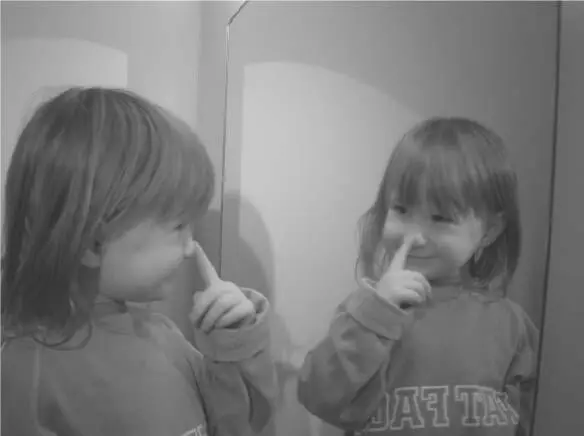
Figure 6: Somewhere around eighteen months, human infants pass the rouge test
Why We Lose Our Self in Reflection
Why can’t we remember what it was like to be a baby? Why can’t we remember our infant self? What’s the earliest memory you have? If you are like most people, it will be sometime around your third to fourth birthday and really patchy. There are always the odd few (and, indeed, they are odd) who say they can remember being born – passing down the birth canal and being slapped on the bottom by the midwife. Most have no memory of self before their second birthday and, even then, the memories from around that time are fragmented and unconnected. 10It’s not that you have forgotten what it was like to be an infant – you simply were not ‘you’ at that age because there was no constructed self, and so you cannot make sense of early experiences in the context of the person to whom these events happened. You can look at photographs and recognize your self, but you cannot get back inside the toddler you once were. Why is this?
Has the passage of time worn out the trace of your memory, like a photograph fading? This seems unlikely. An articulate twelve-year-old is equally oblivious to their own infant memories, as a forty-year-old who can remember events when they were twelve, almost thirty years later. 11The lack of memory cannot be because too much time has passed. Is it the case that babies do not form memories in the first place? Without the ability to form memories, your sense of self would be utterly shattered. This loss happened to Clive Wearing, an eminent musicologist at Cambridge University, who was struck down with Herpes simplex encephalitis in 1985. Herpes simplex is the same infection that produces cold sores, but for Clive it had infiltrated the protective tissue that protects the brain, which caused it to swell and crush the delicate structures of the hippocampus – a region where the neural circuits encode memories. Even though he survived the encephalitis, Clive was left with severe amnesia and is now unable to remember from one moment to the next. In her 2005 memoir, Forever Today , Deborah Wearing describes her husband Clive’s tormented existence:
Читать дальшеИнтервал:
Закладка:
Похожие книги на «The Self Illusion»
Представляем Вашему вниманию похожие книги на «The Self Illusion» списком для выбора. Мы отобрали схожую по названию и смыслу литературу в надежде предоставить читателям больше вариантов отыскать новые, интересные, ещё непрочитанные произведения.







Обсуждение, отзывы о книге «The Self Illusion» и просто собственные мнения читателей. Оставьте ваши комментарии, напишите, что Вы думаете о произведении, его смысле или главных героях. Укажите что конкретно понравилось, а что нет, и почему Вы так считаете.