Hood, Bruce - Supersense
Здесь есть возможность читать онлайн «Hood, Bruce - Supersense» весь текст электронной книги совершенно бесплатно (целиком полную версию без сокращений). В некоторых случаях можно слушать аудио, скачать через торрент в формате fb2 и присутствует краткое содержание. Год выпуска: 2009, Издательство: Constable Robinson, Жанр: Старинная литература, на английском языке. Описание произведения, (предисловие) а так же отзывы посетителей доступны на портале библиотеки ЛибКат.
- Название:Supersense
- Автор:
- Издательство:Constable Robinson
- Жанр:
- Год:2009
- ISBN:нет данных
- Рейтинг книги:3 / 5. Голосов: 1
-
Избранное:Добавить в избранное
- Отзывы:
-
Ваша оценка:
Supersense: краткое содержание, описание и аннотация
Предлагаем к чтению аннотацию, описание, краткое содержание или предисловие (зависит от того, что написал сам автор книги «Supersense»). Если вы не нашли необходимую информацию о книге — напишите в комментариях, мы постараемся отыскать её.
Supersense — читать онлайн бесплатно полную книгу (весь текст) целиком
Ниже представлен текст книги, разбитый по страницам. Система сохранения места последней прочитанной страницы, позволяет с удобством читать онлайн бесплатно книгу «Supersense», без необходимости каждый раз заново искать на чём Вы остановились. Поставьте закладку, и сможете в любой момент перейти на страницу, на которой закончили чтение.
Интервал:
Закладка:
In 1890 William James described the newborn’s world as a ‘blooming, buzzing confusion’ of sensations. 1No organization or knowledge was thought to be present at birth. On entering the world, we were just a bundle of reflexes and dribbles. Reflexes are those behaviours that are automatically triggered. The pupils in your eyes narrow in bright sunshine because of a reflex. When the doctor taps your knee with a hammer and your leg jerks up, that’s another. No thinking is required. In fact, you can’t stop most reflexes because they are beyond any control or thought.
Babies come packaged with many weird and wonderful reflexes. For example, if you gently stroke the cheek of newborns, a rooting reflex makes them turn their head and mouth to the source of the stroking. They do not know to turn. They are simply wired to do so. There is a sucking reflex when any nipple-sized thing causes babies to pucker up their lips. Clearly these two responses are useful for breast-feeding. There’s a stepping reflex where, if you hold the newborn upright with both feet on a surface, it will alternate lifting and placing one leg and then the next in what looks like walking. This astounds parents, because true walking is at least one year off. Then there is the grip reflex.
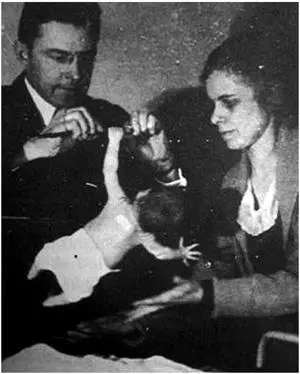
FIG. 5: John Watson demonstrating the strength of the grasp reflex in an infant, dating from around 1919. © THE JOHNS HOPKINS UNIVERSITY, BALTIMORE
Their tiny little fingers clamped onto an object placed in their palm are so powerful that you can lift infants off the ground clinging to that object. John Watson did just this, demonstrating something that no caring parent would dream of trying. 2
In the ‘Moro’ reflex – sometimes referred to as the startle response – the baby will fling its arms outstretched, as if to hug you if you drop its supported head backwards or make a loud noise. No one is quite sure what that could be useful for. Some of these reflexes clearly support early adaptive functions, whereas others may be a legacy from evolution that we still carry today. Some argue that the Moro reflex was a mechanism by which the prehominid infant grasped onto the furry underbelly of the mother as she fled in dangerous situations. 3Most modern women with furry underbellies are unlikely to have babies today, but you can still see this primitive response when wild Rhesus monkeys scoop up their babies and scamper when threatened.
As we grow, we lose many of these reflexive behaviours and hold on to others. However, although many of these early infantile reflexes disappear, they are not truly lost, because they can re-emerge in adult patients with head injuries, especially if there is damage to the frontal parts of the brain. For example, in a coma many of the higher control centres of the brain temporarily shut down, allowing behaviours like the grasp reflex to reveal themselves. 4This is a fascinating feature of our brains, and it may not be limited to simple reflexes. Maybe as we develop we do not entirely abandon all of our initial behaviours and early thoughts. In this way, the brain may be like the hard drive on your computer. Files are never truly deleted, just overwritten but ultimately recoverable.
BRILLIANT BABIES
Apart from reflexes, it was thought that newborns did not have much in the way of what we would call intelligence or knowledge. However, when scientists started to look more closely, they found that newborns are much more aware of their surroundings than simple reflexes would dictate. More striking was the evidence for learning and memory. My own work (the youngest baby I tested was twenty-three minutes old, wrinkled, and covered in afterbirth, but as bright as a button) revealed that newborns can remember and distinguish between different black-and-white-stripe patterns. 5They also have a preference for faces, as we discuss in the next chapter. This memory for stripes and penchant for faces are something more than simple reflexes could achieve. More amazingly, learning does not begin at birth. For example, if you get pregnant mothers in their third trimester to read aloud passages from Dr Seuss’s The Cat in the Hat , their unborn babies can hear and remember this experience. When they are born, if you stick a rubber nipple in their mouth to measure their sucking, they will stop when they hear a tape-recording of their own mother reading the same passages. The only way they could have heard this was from inside the womb. 6Learning clearly takes place before birth. The unborn fetus is listening in on the world and can even remember the theme tune to the TV soap opera that Mum watched during the last months of pregnancy. In one study, the particularly irritating (sorry, memorable) theme tune for the Australian soap Neighbours got stuck in babies’ heads as much as it did in adults’ heads. 7So be careful what you say. When two pregnant women are talking, there are four individuals listening in on the conversation.
Within a year, most babies can have a conversation with their parents, share a joke, and begin wondering why people do the things they do. They babble, gesture, exchange glances, tease, mimic, and basically become sociable little members of the human race. 8This transition from the wrinkled newborn in the delivery suite to the socially savvy twelve-month-old is one of the most amazing transformations in life. Something very smart and very fast is happening. We may think computers are smart, but they are nothing in comparison to what a human infant can achieve over twelve months. It is only since engineers started to build computers that we have come to fully appreciate what being smart really is. All the simple things that babies excel at in their first year are some of the hardest problems that engineers have been trying to solve for decades; voice and face recognition, reaching and grasping, walking, reasoning, communication, understanding that others have minds, and even exhibiting humour. All the rudiments of these complex abilities can be found in human infants before their first birthday.
Fueled by the latest research, many parents in the West have come to regard their babies as miniature geniuses, born with unlimited abilities to think and learn. There is now a whole industry of preschool learning and education that taps into the parental desire to give children the best start in life. By ‘the best start in life’ what we actually mean is to make sure that our offspring are smarter than the next kid. As they choose among products with names like ‘Baby Einstein’, ‘Baby Bach’, ‘Baby Da Vinci’, ‘Baby Van Gogh’, ‘Baby Newton’, and ‘Baby Shakespeare’, I think that parents’ expectations are being somewhat unrealistically raised. In fact, a 2007 study of baby videos and DVDs found that they are associated with impaired language development, a report that infuriated the Walt Disney Company, which owns ‘Baby Einstein.’ 9
Parents are easy pickings for those willing to sell them products to enhance their child’s future earning potential. We buy black-and-white mobiles to hang over our baby’s crib to stimulate the visual areas of the brain (not necessary), chewable toys with bells inside to enhance eye–hand coordination with multisensory input (not necessary), Mozart tapes to improve concentration (myth), flash cards to teach the baby to read (unlikely), and DVDs for the baby to goggle at for hours on end to feed its information-hungry brain (not necessary). 10
Like gardeners nurturing little plants, we have developed a ‘hothouse’ mentality to parenting. It’s mostly a Western obsession that has more to do with aspirations for our children’s success than hard science, but every caring parent is vulnerable. Even my wife, a highly educated medical expert, could not resist the urge to buy the black-and-white mobile. 11Yes, babies stare at them. They’re very noticeable – in the same way that anything black and white is noticeable – but such patterns are not going to accelerate normal growth.
Читать дальшеИнтервал:
Закладка:
Похожие книги на «Supersense»
Представляем Вашему вниманию похожие книги на «Supersense» списком для выбора. Мы отобрали схожую по названию и смыслу литературу в надежде предоставить читателям больше вариантов отыскать новые, интересные, ещё непрочитанные произведения.









Обсуждение, отзывы о книге «Supersense» и просто собственные мнения читателей. Оставьте ваши комментарии, напишите, что Вы думаете о произведении, его смысле или главных героях. Укажите что конкретно понравилось, а что нет, и почему Вы так считаете.