Hood, Bruce - Supersense
Здесь есть возможность читать онлайн «Hood, Bruce - Supersense» весь текст электронной книги совершенно бесплатно (целиком полную версию без сокращений). В некоторых случаях можно слушать аудио, скачать через торрент в формате fb2 и присутствует краткое содержание. Год выпуска: 2009, Издательство: Constable Robinson, Жанр: Старинная литература, на английском языке. Описание произведения, (предисловие) а так же отзывы посетителей доступны на портале библиотеки ЛибКат.

- Название:Supersense
- Автор:
- Издательство:Constable Robinson
- Жанр:
- Год:2009
- ISBN:нет данных
- Рейтинг книги:3 / 5. Голосов: 1
-
Избранное:Добавить в избранное
- Отзывы:
-
Ваша оценка:
Supersense: краткое содержание, описание и аннотация
Предлагаем к чтению аннотацию, описание, краткое содержание или предисловие (зависит от того, что написал сам автор книги «Supersense»). Если вы не нашли необходимую информацию о книге — напишите в комментариях, мы постараемся отыскать её.
Supersense — читать онлайн бесплатно полную книгу (весь текст) целиком
Ниже представлен текст книги, разбитый по страницам. Система сохранения места последней прочитанной страницы, позволяет с удобством читать онлайн бесплатно книгу «Supersense», без необходимости каждый раз заново искать на чём Вы остановились. Поставьте закладку, и сможете в любой момент перейти на страницу, на которой закончили чтение.
Интервал:
Закладка:
But don’t worry. This book is not meant to make you feel foolish or to encourage you to abandon your supersense. Many facets of our behaviour and beliefs have no rational basis. Think of everything that makes us human, and you soon realize that there is much that calls into question our ability to be rational. Love, jealousy, humour, and obsession, for instance, are present in all of us, and even though we know that our beliefs and actions stemming from them can be unbalanced, we would still not want to lose our capacity to experience them. The same can be said for the supersense. So embrace it, learn where it comes from, and understand why it refuses to go away.
Oh, and if you are a sceptic reading this book, thanks for getting this far.
CHAPTER THREE
WHO CREATED CREATIONISM?
The essence of being human is an uncomfortable duality of ‘rational’ technology and ‘irrational’ belief. We are still a species in transition.
– DAVID LEWIS-WILLIAMS,
The Mind in the Cave (2004), p. 18
WHO TEACHES US about the ‘something there’? When do we start thinking that there is a hidden but real dimension to reality? Is it religion, or does religion simply recognize and fulfill that urge in the human psyche that is so great that we seek out those who explain why we feel the way we do and then take comfort in their stories, which make sense of the strange notion that there is something more to existence? To answer this we have to begin at the beginning.
Two summers ago, my wife Kim arranged for the family to visit the Niaux cave in the French Pyrenees. It is one of the last Neolithic caves still open to the public where you can see original prehistoric cave paintings. Most sites are now closed to protect them from the destructive moisture and other corrosive properties of human breath. We booked months in advance, as visits are strictly limited. It may not be on your list of things to do before you die, but if you want to get a true measure of the scale of your own life against where humankind has come from, there can hardly be a more moving experience than marvelling at prehistoric art deep inside the belly of a mountain.
The Niaux system of caves runs over half a mile from the entrance perched high on a Pyrenean cliff face. Outside the temperature was a humid 28 degrees centigrade, but inside it rapidly dropped to a constant 12 degrees. The path was uneven, wet, and slippery, but it was the absolute pitch-blackness that was the most unsettling feature of the caves. The journey varied from claustrophobic passages to wide expanses, created by ancient underground rivers that over the course of millions of years had carved out the inside of the range. Each member of the expedition (I felt like a Jules Verne explorer journeying to the centre of the earth) was given a hand-held flashlight that acted like a light sabre to cut through the ebony shroud. My five-year-old daughter wore those running shoes with lights built into the heels that flashed each time she took a step. She is the fearless type, and she set off with our French guide at the front of the group, picking her way through the tunnel with uncanny ease. The rest of us, unsure of our step, struggled to keep up with the blinking pink flashes that disappeared into the bowels of the earth.
I now understand why people risk their lives exploring underground caverns. The ancient watercourses had sculpted an alien landscape of smooth and bulbous protrusions rising from the floor and dripping from the roof. On the outside, the craggy cliff entrance had been blasted away by modern dynamite, but the inside of the mountain seemed organic and alive. The mica and mineral deposits twinkling in the flashlight triggered childhood memories of Disney grottoes and the seven dwarfs mining for sparkling jewels. Halfway into our descent, we found the hand of man. Mixed in with the graffiti left there by intrepid French youths over the past 350 years was an occasional repeated pattern made up of parallel lines and dots that we were told was much older. Our guide invited us to speculate, but like the experts who carbon-dated the work, we were unable to explain the wood-ash markings put there deliberately for a long-forgotten purpose. 1
After about an hour, we reached a cathedral-like chamber, the salon noir , or black exhibition hall. With our light sabres, we were able to pick out the remarkably well-preserved images of animals and patterns left more than thirteen thousand years ago on the walls of the cavern. This was clearly the focal centre of activity, though no trace of human habitation had ever been found. No bones, no flints, no remnants of someone’s lunch. Only the art remained. I tried to imagine the scene illuminated by the flicker of simple lamps made out of animal fat. The place was magical. So often we take for granted our modern lives and all the technologies available to us and easily forget how fast and how far we have travelled. This revelatory experience in the loins of a mountain was a jaw-dropping moment for a twenty-first-century scientist. The people who painted the cave must have thought so too. David Lewis-Williams studies prehistoric paintings and artefacts. In his book The Mind in the Cave , he argues that subterranean art was not for general public viewing. 2Otherwise, there would be more examples in less remote and more accessible sites. He proposes that the activity in these caves instead reflects early religious attempts to connect symbolically with the earth in its deepest crevices. These places were sacred. The art was deliberately created around the physical properties of each cave. Natural rock patterns and shapes were outlined to form animals in the same way that we see faces in the clouds on a summer’s day. This human capacity to see structure and significance in the natural world is not only a talent of the artistic mind but an essential quality for the spiritual one as well. The images came alive through the combination of flickering shadows from tallow lamps and the power of human imagination. Some decorated spaces were only large enough for a solitary individual to squeeze into. The geometric patterns found here may have been the first evidence of the altered states of consciousness that the early shamans are thought to have achieved. Lewis-Williams speculates that the shamans, cocooned in these narrow cervices, sought to document their crossover to the underground world through images and symbols. This may be wild speculation, but what is undisputed is that prehistoric art depicts a mixture of natural and supernatural images. Animals such as horses and bulls, as well as extinct species such as the aurochs and mammoth, are represented, but so are half-human, half-animal creatures.
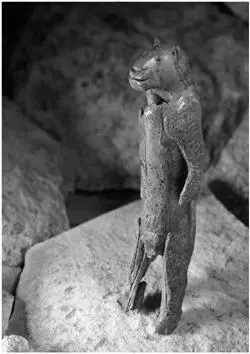
FIG. 3: ‘Lion-Man’, a statuette carved of mammoth tusk, dating from around 32,000 years ago, discovered in a cave at Hohlenstein-Stadel, Germany. PHOTO BY THOMAS STEPHAN, © ULMER MUSEUM.
The most stunning example is not a drawing but a statuette from Germany, the Hohlenstein-Stadel ‘Lion-Man’. Originally nobody knew what it was. It was shattered into two hundred pieces and mixed among ten thousand bone fragments retrieved from a prehistoric cave in southern Germany just before the outbreak of the Second World War. In 1997 it was carefully reassembled. Who could have predicted how spectacular this find would be? The figure has a human body but a lion’s head, stands about 12 inches tall, and is carved from a mammoth tusk. It is not clear whether it is a lion that has taken on human properties or the other way around. Either way, it proves that prehistoric man had imagination and a sense of the unreal. Not only is it one of the most beautiful examples of human art, but it is also one of the earliest. It dates from around thirty-two thousand years ago! Try to get your head around that date for a moment. When it comes to thinking about how long culture and art have been around, we are exceedingly myopic in our outlook.
Читать дальшеИнтервал:
Закладка:
Похожие книги на «Supersense»
Представляем Вашему вниманию похожие книги на «Supersense» списком для выбора. Мы отобрали схожую по названию и смыслу литературу в надежде предоставить читателям больше вариантов отыскать новые, интересные, ещё непрочитанные произведения.










Обсуждение, отзывы о книге «Supersense» и просто собственные мнения читателей. Оставьте ваши комментарии, напишите, что Вы думаете о произведении, его смысле или главных героях. Укажите что конкретно понравилось, а что нет, и почему Вы так считаете.