Алан Милн - Once a Week
Здесь есть возможность читать онлайн «Алан Милн - Once a Week» весь текст электронной книги совершенно бесплатно (целиком полную версию без сокращений). В некоторых случаях можно слушать аудио, скачать через торрент в формате fb2 и присутствует краткое содержание. Год выпуска: 2014, Издательство: epubBooks Classics, Жанр: Юмористическая проза, на английском языке. Описание произведения, (предисловие) а так же отзывы посетителей доступны на портале библиотеки ЛибКат.
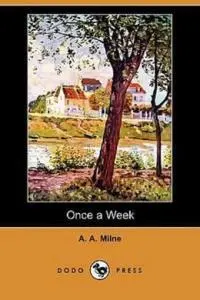
- Название:Once a Week
- Автор:
- Издательство:epubBooks Classics
- Жанр:
- Год:2014
- ISBN:нет данных
- Рейтинг книги:5 / 5. Голосов: 1
-
Избранное:Добавить в избранное
- Отзывы:
-
Ваша оценка:
Once a Week: краткое содержание, описание и аннотация
Предлагаем к чтению аннотацию, описание, краткое содержание или предисловие (зависит от того, что написал сам автор книги «Once a Week»). Если вы не нашли необходимую информацию о книге — напишите в комментариях, мы постараемся отыскать её.
Once a Week — читать онлайн бесплатно полную книгу (весь текст) целиком
Ниже представлен текст книги, разбитый по страницам. Система сохранения места последней прочитанной страницы, позволяет с удобством читать онлайн бесплатно книгу «Once a Week», без необходимости каждый раз заново искать на чём Вы остановились. Поставьте закладку, и сможете в любой момент перейти на страницу, на которой закончили чтение.
Интервал:
Закладка:
"Probably I shouldn't suspect either, until I had bitten on it suddenly. Perhaps you'd better not bother. It would be simpler if you got Jane's card to–morrow instead."
"But of course I will. That is to say, I'll tell Jane to get it herself. It's her cinema evening out."
Once a week Jane leaves us and goes to a cinema. Her life is full of variety.
Ten days elapsed, and then one evening I said― At least I didn't. Before I could get it out Celia interrupted:
"No, not yet. You see, there's been a hitch."
I curbed my anger and spoke calmly.
"What sort of a hitch?"
"Well, Jane forgot last Wednesday, and I forgot to remind her this Wednesday. But next Wednesday―"
"Why don't you do it yourself?"
"Well, if you'll tell me what to do I'll do it."
"Well—er—you just—you—I mean—well, they'll tell you at the post–office."
"That's exactly how I keep explaining it to Jane," said Celia.
I looked at her mournfully.
"What shall we do?" I asked. "I feel quite hopeless about it. It seems too late now to do anything with Jane. Let's get a new staff and begin again properly."
"Lose Jane?" cried Celia. "I'd sooner go to prison—I mean I'd sooner you went to prison. Why can't you be a man and do something?"
Celia doesn't seem to realize that I married her with the sole idea of getting free of all this sort of bother. As it is, I nearly die once a year in the attempt to fill up my income–tax form. Any traffic in insurance cards would, my doctor says, be absolutely fatal.
However, something had to be done. Last week I went into a neighbouring post–office in order to send a telegram. The post–office is an annexe of the grocer's where the sardines come from on Jane's cinema evening. Having sent the telegram, I took a sudden desperate resolve. I—I myself—would do something.
"I want," I said bravely, "an insurance stamp."
"Sixpenny or sevenpenny?" said the girl, trying to put me off my balance at the very beginning.
"What's the difference?" I asked. "You needn't say a penny, because that is obvious."
However, she had no wish to be funny.
"Sevenpenny for men–servants, sixpenny for women," she explained.
I wasn't going to give away our domestic arrangements to so near a neighbour.
"Three sixpenny and four sevenpenny," I said casually, flicking the dust off my shoes with a handkerchief. "Tut, tut, I was forgetting Thomas," I added. "Five sevenpenny."
I took the stamps home and showered them on Celia.
"You see," I said, "it's not really difficult."
"Oh, you angel! What do I do with them?"
"Stick them on Jane," I said grandly. "Dot them about the house. Stamp your letters with them—I can always get you plenty more."
"Didn't you get a card too?"
"N–no. No, I didn't. The fact is, it's your turn now, Celia. You get the card."
"Oh, all right. I—er—suppose you just ask for a—a card?"
"I suppose so. And—er—choose a doctor, and—er—decide on an approved society, and—er—explain why it is you hadn't got a card before, and—er― Well, anyhow, it's your turn now, Celia."
"It's really still Jane's turn," said Celia, "only she's so stupid about it."
But she turned out to be not so stupid as we thought. For yesterday there came a ring at the bell. Feeling instinctively that it was the inspector, Celia and I got behind the sofa … and emerged some minutes later to find Jane alone in the room.
"Somebody come to see about an insurance card or something," she said. "I said you were both out, and would he come to–morrow."
Technically I suppose we were both out. That is, we were not receiving.
"Thank you, Jane," I said stiffly. I turned to Celia. "There you are," I said. "To–morrow something must be done."
"I always said I'd do it to–morrow," said Celia.
Silver Linings
"We want some more coal," said Celia suddenly at breakfast.
"Sorry," I said, engrossed in my paper, and I passed her the marmalade.
"More coal," she repeated.
I pushed across the toast.
Celia sighed and held up her hand.
"Please may I speak to you a moment?" she said, trying to snap her fingers. "Good; I've caught his eye. We want―"
"I'm awfully sorry. What is it?"
"We want some more coal. Never mind this once whether Inman beat Hobbs or not. Just help me."
"Celia, you've been reading the paper," I said in surprise. "I thought you only read the feuill —the serial story. How did you know Inman was playing Hobbs?"
"Well, Poulton or Carpentier or whoever it is. Look here, we're out of coal. What shall I do?"
"That's easy. Order some more. What do you do when you're out of nutmegs?"
"It depends if the nutmeg porters are striking."
"Striking! Good heavens, I never thought about that." I glanced hastily down the headlines of my paper. "Celia, this is serious. I shall have to think about this seriously. Will you order a fire in the library? I shall retire to the library and think this over."
"You can retire to the library, but you can't have a fire there. There's only just enough for the kitchen for two days."
"Then come and chaperon me in the kitchen. Don't leave me alone with Jane. You and I and Jane will assemble round the oven and discuss the matter. B–r–r–r. It's cold."
"Not the kitchen. I'll assemble with you round the electric light somewhere. Come on."
We went into the library and rallied round a wax vesta. It was a terribly cold morning.
"I can't think like this," I said, after fifteen seconds' reflection. "I'm going to the office. There's a fire there, anyway."
"You wouldn't like a nice secretary," said Celia timidly, "or an office girl, or somebody to lick the stamps?"
"I should never do any work if you came," I said, looking at her thoughtfully. "Do come."
"No, I shall be all right. I've got shopping to do this morning, and I'm going out to lunch, and I can pay some calls afterwards."
"Right. And you might find out what other people are doing, the people you call on. And—er—if you should be left alone in the drawing–room a moment … and the coal–box is at all adjacent…. You'll have your muff with you, you see, and― Well, I leave that to you. Do what you can."
I had a good day at the office and have never been so loth to leave. I always felt I should get to like my work some time. I arrived home again about six. Celia was a trifle later, and I met her on the mat as she came in.
"Any luck?" I asked eagerly, feeling in her muff. "Dash it, Celia, there are nothing but hands here. Do you mean to say you didn't pick up anything at all?"
"Only information," she said, leading the way into the drawing–room. "Hallo, what's this? A fire!"
"A small involuntary contribution from the office. I brought it home under my hat. Well, what's the news?"
"That if we want any coal we shall have to fetch it ourselves. And we can get it in small amounts from greengrocers. Why greengrocers, I don't know."
"I suppose they have to have fires to force the cabbages. But what about the striking coal porters? If you do their job, won't they picket you or pickaxe you or something?"
"Oh, of course, I should hate to go alone. But I shall be all right if you come with me."
Celia's faith in me is very touching. I am not quite so confident about myself. No doubt I could protect her easily against five or six great brawny hulking porters … armed with coal–hammers … but I am seriously doubtful whether a dozen or so, aided with a little luck, mightn't get the better of me.
"Don't let us be rash," I said thoughtfully. "Don't let us infuriate them."
"You aren't afraid of a striker?" asked Celia in amazement.
Читать дальшеИнтервал:
Закладка:
Похожие книги на «Once a Week»
Представляем Вашему вниманию похожие книги на «Once a Week» списком для выбора. Мы отобрали схожую по названию и смыслу литературу в надежде предоставить читателям больше вариантов отыскать новые, интересные, ещё непрочитанные произведения.

Обсуждение, отзывы о книге «Once a Week» и просто собственные мнения читателей. Оставьте ваши комментарии, напишите, что Вы думаете о произведении, его смысле или главных героях. Укажите что конкретно понравилось, а что нет, и почему Вы так считаете.