Kingsley Amis - Dear Illusion - Selected Stories
Здесь есть возможность читать онлайн «Kingsley Amis - Dear Illusion - Selected Stories» весь текст электронной книги совершенно бесплатно (целиком полную версию без сокращений). В некоторых случаях можно слушать аудио, скачать через торрент в формате fb2 и присутствует краткое содержание. Год выпуска: 2015, Издательство: New York Review of Books, Жанр: Современная проза, на английском языке. Описание произведения, (предисловие) а так же отзывы посетителей доступны на портале библиотеки ЛибКат.
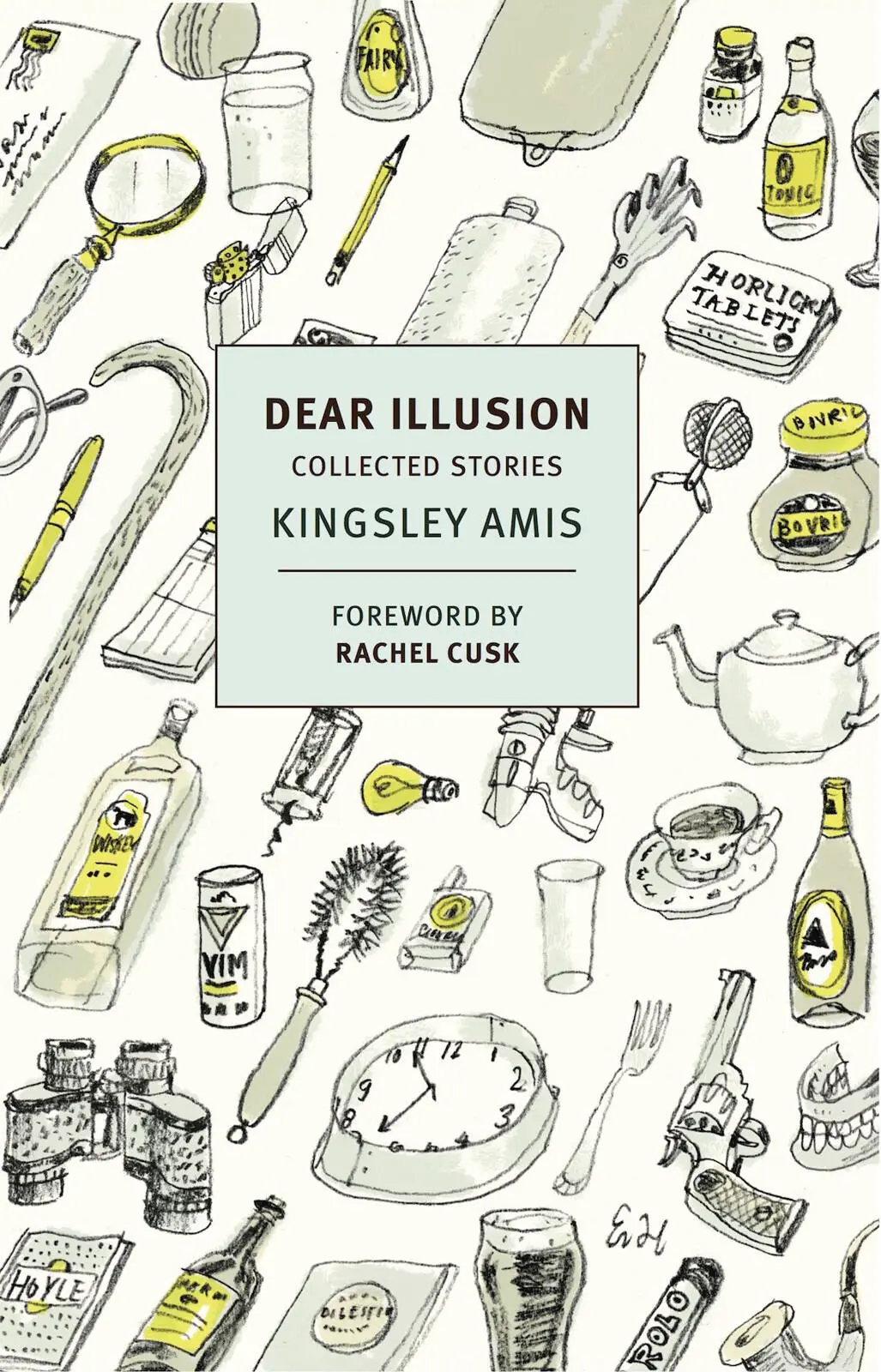
- Название:Dear Illusion: Selected Stories
- Автор:
- Издательство:New York Review of Books
- Жанр:
- Год:2015
- ISBN:нет данных
- Рейтинг книги:4 / 5. Голосов: 1
-
Избранное:Добавить в избранное
- Отзывы:
-
Ваша оценка:
Dear Illusion: Selected Stories: краткое содержание, описание и аннотация
Предлагаем к чтению аннотацию, описание, краткое содержание или предисловие (зависит от того, что написал сам автор книги «Dear Illusion: Selected Stories»). Если вы не нашли необходимую информацию о книге — напишите в комментариях, мы постараемся отыскать её.
Dear Illusion: Selected Stories — читать онлайн бесплатно полную книгу (весь текст) целиком
Ниже представлен текст книги, разбитый по страницам. Система сохранения места последней прочитанной страницы, позволяет с удобством читать онлайн бесплатно книгу «Dear Illusion: Selected Stories», без необходимости каждый раз заново искать на чём Вы остановились. Поставьте закладку, и сможете в любой момент перейти на страницу, на которой закончили чтение.
Интервал:
Закладка:
Wondering dimly if some trick of the TIOPEPE had managed to move him back into some unfrequented corner of the 1960s, Simpson became aware that a man at the next table had been watching him closely. When their eyes met, the stranger came over and, with a word of apology, sat down opposite him. (It was extraordinary, Simpson was fond of remarking, how often people did just this sort of thing when he visited the future.)
‘Do excuse me,’ the man said politely, ‘but from your expression just now I’d guess you’re a conozer — am I right? Oh, my name’s Piotr Davies, by the way, on leave from Greenland Fruiteries. You’re not Earth-based, I take it?’
‘Oh… no, I’m just in from Mercury. My first trip since I was a lad, in fact.’ Simpson noticed that Piotr Davies’s face was covered by a thick network of burst veins, and his nose carried the richest growth of grog-blossom Simpson had ever seen. (He avoided looking at the Director when he told us this.) ‘Yes,’ he struggled on after giving his name, ‘I am a bit of a connoiss — conozer, I suppose. I do try to discriminate a little in my—’
‘You’ve hit it,’ Piotr Davies said excitedly. ‘Discrimination. That’s it, the very word. I knew I was right about you. Discrimination. And tradition. Well, you won’t find much of either on Earth these days, I’m afraid. Nor on Mercury, from what I hear.’
‘No — no, you certainly won’t.’
‘We conozers are having a hard time. The Planetary War, of course. And the Aftermath.’ Davies paused, and seemed to be sizing up Simpson afresh. Then: ‘Tell me, are you doing anything tonight? More or less right away?’
‘Well, I have got an appointment I must keep in just under two hours, but until then I—’
‘Perfect. Let’s go.’
‘But what about my dinner?’
‘You won’t want any after you’ve been where I’m going to take you.’
‘But where are you—?’
‘Somewhere absolutely made for a conozer like you. What a bit of luck you happened to run into me. I’ll explain on the way.’
Outside, they boarded a sort of wheel-less taxicab and headed into what seemed to be a prosperous quarter. Davies’s explanations were copious and complete; Simpson made full use of his supposed status as one long absent from the centre of things. It appeared that the Planetary War had destroyed every one of the vast, centralized, fully automated distilleries of strong liquors; that bacteriological warfare had put paid to many crops, including vines, barley, hops and even sugar; that the fanatical religious movements of the Aftermath, many of them with government backing, had outlawed all drink for nearly twenty years. Simpson shuddered at that news.
‘And when people came to their senses,’ Davies said glumly, ‘it was too late. The knowledge had died. Oh, you can’t kill a process like distillation. Too fundamental. Or fermentation, either. But the special processes, the extra ingredients, the skills, the tradition — gone for ever. Whisky — what a rich, evocative word. What can the stuff have tasted like? What little there is about it in the surviving literature gives a very poor idea. Muzzle — that was a white wine, we’re pretty sure, from Germany, about where the Great Crater is. Gin — a spirit flavoured with juniper, we know that much. There isn’t any juniper now, of course.
‘So, what with one thing and another, drinking went out. Real, civilized drinking, that is — I’m not talking about that stuff they tried to give you back there. I and a few like-minded friends tried to get some of the basic information together, but to no avail. And then, quite by chance, one of us, an archaeologist, turned up a primitive two-dimensional television film that dated back almost two hundred years, giving a full description of some ancient drinks and a portrayal of the habits that went with them — all the details. The film was called ‘The Down-and-Outs’, which is an archaic expression referring to people of limited prosperity, but which we immediately understood as being satirically or ironically intended in this instance. That period, you know, was very strong on satire. Anyway, the eventual result of our friend’s discovery was… this.’
With something of a flourish, Davies drew a pasteboard card from his pocket and passed it to Simpson. It read:
THE FRIENDS OF PLONK
Established 2139 for the drinking of traditional liquors in traditional dress and in traditional surroundings
Before Simpson could puzzle this out, his companion halted the taxi and a moment later was shepherding him through the portals of a large and magnificent mansion. At the far end of a thickly carpeted foyer was a steep, narrow staircase, which they descended. When they came to its foot, Davies reached into a cupboard and brought out what Simpson recognized as a trilby hat of the sort his father had used to wear, a cloth cap, a large piece of sacking and a tattered brown blanket. All four articles appeared to be covered with stains and dirt. At the same time Simpson became aware of a curious and unpleasant mixture of smells and a subdued grumbling of voices.
In silence, Davies handed him the cap and the blanket and himself donned the sacking, stole-fashion, and the trilby. Simpson followed his lead. Then Davies ushered him through a low doorway.
The room they entered was dimly lit by candles stuck into bottles, and it was a moment before Simpson could take in the scene. At first he felt pure astonishment. There was no trace here of the luxury he had glimpsed upstairs: the walls, of undressed stone, were grimy and damp, the floor was covered at random with sacks and decaying lumps of matting. A coke stove made the cellar stiflingly hot; the air swam with cigarette smoke; the atmosphere was thick and malodorous. Against one wall stood a trestle table piled with bottles and what looked like teacups. Among other items Simpson uncomprehendingly saw there were several loaves of bread, some bottles of milk, a pile of small circular tins and, off in a corner, an old-fashioned and rusty gas-cooker or its replica.
But his surprise and bewilderment turned to mild alarm when he surveyed the dozen or so men sitting about on packing-cases or broken chairs and squatting or sprawling on the floor, each wearing some sort of battered headgear and with a blanket or sack thrown round his shoulders. All of them were muttering unintelligibly, in some instances to a companion, more often just to themselves. Davies took Simpson’s arm and led him to a splintery bench near the wall.
‘These blankets and so on must have been a means of asserting the essential democracy of drink,’ Davies whispered. ‘Anyway, we’re near the end of the purely ritualistic part now. Our film didn’t make its full significance clear, but it was obviously a kind of self-preparation, perhaps even prayer. The rest of the proceedings will be much less formal. Ah…’
Two of the men had been muttering more loudly at each other and now closed physically, but their blows and struggles were symbolic, a mime, as in ballet or the Japanese theatre. Soon one of them had his adversary pinned to the floor and was raining token punches upon him. (‘We’re rather in the dark about this bit,’ Davies murmured. ‘Perhaps an enacted reference to the ancient role of drink as a sequel to physical exertion.’) When the prostrate combatant had begun to feign unconsciousness, a loud and authoritative voice spoke.
‘End of Part One.’
At once all was animation: everybody sprang up and threw off his borrowed garments, revealing himself as smartly clad in the formal dress of the era. Davies led Simpson up to the man who had made the announcement, probably a member of one of the professions and clearly the host of the occasion. His face was sprayed with broken veins to a degree that outdid Davies’s.
Читать дальшеИнтервал:
Закладка:
Похожие книги на «Dear Illusion: Selected Stories»
Представляем Вашему вниманию похожие книги на «Dear Illusion: Selected Stories» списком для выбора. Мы отобрали схожую по названию и смыслу литературу в надежде предоставить читателям больше вариантов отыскать новые, интересные, ещё непрочитанные произведения.












Обсуждение, отзывы о книге «Dear Illusion: Selected Stories» и просто собственные мнения читателей. Оставьте ваши комментарии, напишите, что Вы думаете о произведении, его смысле или главных героях. Укажите что конкретно понравилось, а что нет, и почему Вы так считаете.