Kingsley Amis - Dear Illusion - Selected Stories
Здесь есть возможность читать онлайн «Kingsley Amis - Dear Illusion - Selected Stories» весь текст электронной книги совершенно бесплатно (целиком полную версию без сокращений). В некоторых случаях можно слушать аудио, скачать через торрент в формате fb2 и присутствует краткое содержание. Год выпуска: 2015, Издательство: New York Review of Books, Жанр: Современная проза, на английском языке. Описание произведения, (предисловие) а так же отзывы посетителей доступны на портале библиотеки ЛибКат.
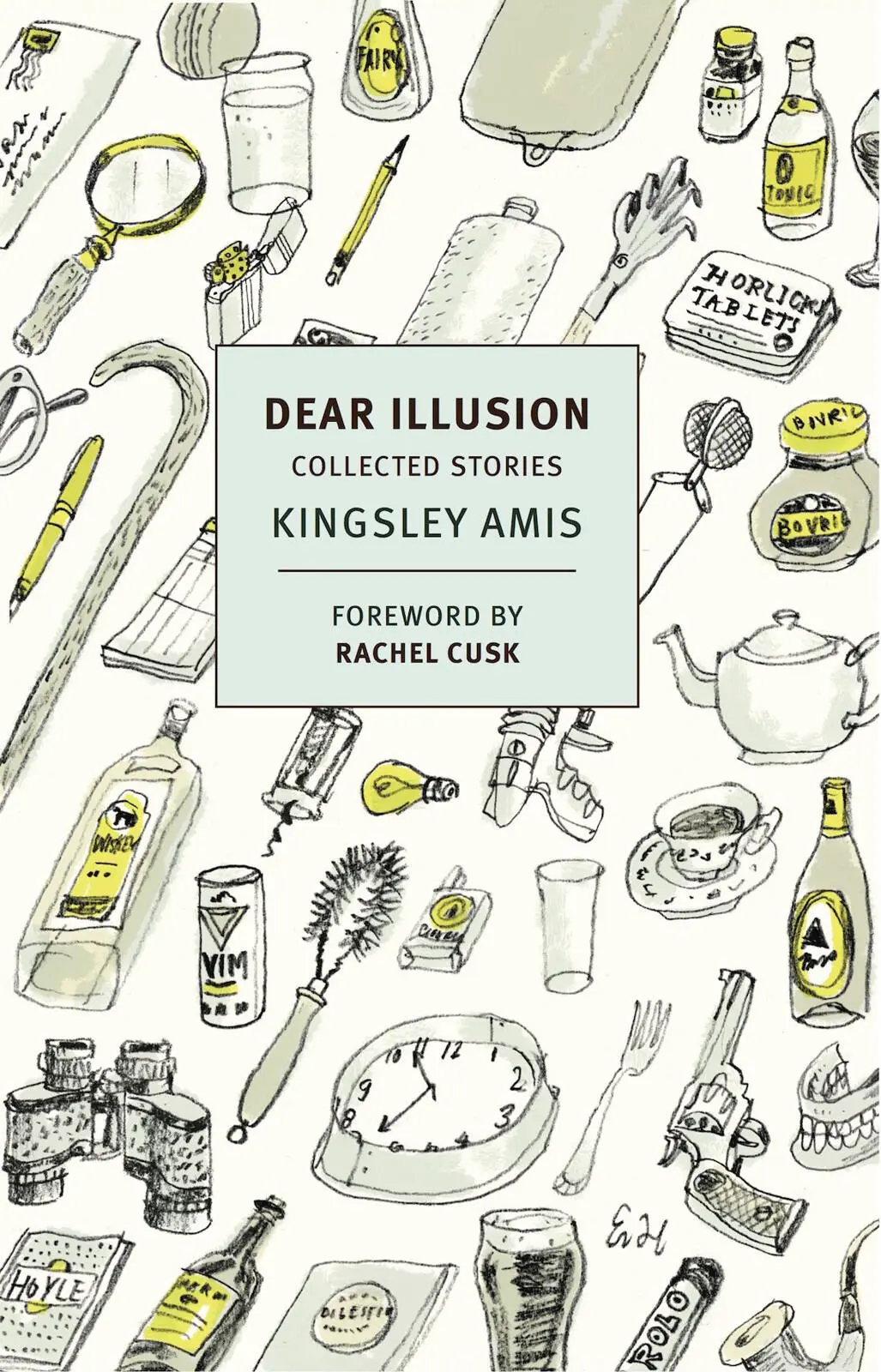
- Название:Dear Illusion: Selected Stories
- Автор:
- Издательство:New York Review of Books
- Жанр:
- Год:2015
- ISBN:нет данных
- Рейтинг книги:4 / 5. Голосов: 1
-
Избранное:Добавить в избранное
- Отзывы:
-
Ваша оценка:
Dear Illusion: Selected Stories: краткое содержание, описание и аннотация
Предлагаем к чтению аннотацию, описание, краткое содержание или предисловие (зависит от того, что написал сам автор книги «Dear Illusion: Selected Stories»). Если вы не нашли необходимую информацию о книге — напишите в комментариях, мы постараемся отыскать её.
Dear Illusion: Selected Stories — читать онлайн бесплатно полную книгу (весь текст) целиком
Ниже представлен текст книги, разбитый по страницам. Система сохранения места последней прочитанной страницы, позволяет с удобством читать онлайн бесплатно книгу «Dear Illusion: Selected Stories», без необходимости каждый раз заново искать на чём Вы остановились. Поставьте закладку, и сможете в любой момент перейти на страницу, на которой закончили чтение.
Интервал:
Закладка:
‘You must be the Reverend Daniel Davidson.’ The accent was American.
‘I am he. And you must be Mr Leo Marzoni.’
‘Correct. But I’m not only that, I’m your twin brother. Did you know I existed?’
‘No.’
‘Nevertheless I do, as you see, and that is what I am. But I have the advantage of you: I knew about you already. If you like to ask me in I can tell you more.’
‘Please come in,’ said Daniel mechanically. ‘I’m sorry, I wasn’t thinking.’
‘Oh, you’re forgiven,’ said his visitor, with a sudden smile that communicated no warmth. ‘The circumstances are out of the ordinary.’
Ever since he heard the bell ring, Daniel had been under the delusion that his words and actions were proceeding of themselves, without any need of his premeditation or will. He felt powerless to behave otherwise as he moved back to allow the man called Leo Marzoni to cross the threshold, and did no more than note his own instinct or whatever it was that told him that the other could not be what he said or seemed and that his coming here meant some incalculable harm. These feelings showed no signs of lessening while he took the stranger into his workroom and introduced a startled but not obviously frightened Ruth. Daniel found himself pronouncing words of reassurance to her and others meant to be explanatory about twins and doubles, and went on to tell her something of the American he had run into some weeks previously. Marzoni, on the other hand, appeared to find the situation little more than exceptional, striking, perhaps difficult. In a straightforward style he apologized for his various antics, for having had the absurd idea of waiting to catch Daniel as he came out of the house and especially for having panicked just now and taken off down the street before having the sense to turn back. He added that he would tell his story in full when they had all had a little time.
By the end of this recital, Daniel had begun to struggle free of his impression that events were taking place somewhere that, despite obvious resemblances, was not the world he knew. But he only really came to himself when the three of them were sitting in the kitchen over cups of coffee and the man he must learn to think of as his brother had duly begun the first instalment of his story. Several instalments were to follow; later, he was able to fit them together in his mind.
Leopold Marzoni was now thirty-eight years old. He had been brought up by a couple whom he treated in every way as his parents and whom he loved as a son, but he could not remember a time when he had not known that he was not biologically their son. He understood from them that he had been born in Brighton, England, and taken to America in infancy. His true mother had died soon after giving birth to him and to his twin brother. Leopold’s foster parents had purposely avoided making the least move towards locating or even inquiring after this brother, whom they assumed to have also been adopted but no doubt reared in England. They had felt it their duty to tell Leopold this much, but had also impressed upon him that any attempt on his part to find his twin would be a dubious and almost certainly useless undertaking. Although he could remember, in his childhood, treating a British brother as an invisible companion in times of solitude, he had hardly given the real person a thought for thirty years.
So far, indeed, had that person been from Leopold’s mind that he had said nothing of any twin brother when a neighbour, Irving Rothberg, had announced a forthcoming trip to England. But when Rothberg had come to see him on his first day back home and had spoken excitedly of having seen and talked briefly to an Englishman who was Leopold’s replica, the latter had given his twin more than a thought. At once he had acted counter to parental advice and set about finding the Englishman in question.
‘How did you manage to do that?’ asked Daniel.
‘It was easy, given Irving’s memory. He remembered your name and the fact that you were an Anglican minister, so I got on to your General Synod and they delivered right away. It seems there’s a Daniel Davies in Liverpool, but I ruled him out. Too old, for one thing. You must have had quite a shock, Daniel, when Irving sprang into your path and started calling you Leo.’
‘I suppose it might have helped if I’d known I had a twin brother.’
‘But your foster parents didn’t tell you.’
‘I didn’t have foster parents in your sense, Leo. I was brought up in an orphanage, by an orphanage.’ Without either of them being more than half aware of it, Daniel and Ruth joined hands as he said these words. ‘They couldn’t have been kinder or nicer to me or have done more for me than they did, but no, they didn’t tell me I had a brother.’
‘I see.’ Leopold Marzoni looked almost grim, or at least as though he was coming to a less straightforward part of his tale. ‘Not merely a brother, but a twin brother, as you said. And not merely a twin brother, but an identical twin brother, such that you and I look exactly alike. And I mean exactly alike, more alike even than most other identical twins. The nail on your left middle finger is smaller than usual, like mine. Your left eyebrow takes a little turn upward at the end and so does mine. And do you by any chance have a mole shaped like a horseshoe just below your navel? So do I.’
‘And the pair of you don’t merely look alike, you sound alike,’ said Ruth. ‘You have the same voice. One moment it talks with an American accent and the next it turns British, but it’s the same voice, from the, I don’t know, from the same part of the mouth, with the same little hesitations.’
‘So Irving noticed,’ said Leo, still rather sombrely. ‘But you and I, Daniel, we don’t merely look alike and sound alike. To understand the extent of our likeness, you need to know something about twins in general, okay? It’s pretty solid stuff, so you’d better be sure you want it. No objections? Good, very good. For ease of digestion I’ll give it to you in bits. Here comes Part I.’
Most cultures (said Leo) had greeted the occurrence of twins with hostility and even dread. Comparatively recently, attitudes had improved and serious study been possible. This had defined the difference between identical twins, who were always of the same sex, and the much commoner fraternal twins, who were often of unlike sex and no more similar than ordinary brothers and sisters. The difference was primordial and intrinsic.
Monozygotic or MZ twins, popularly known as identical twins, were the separate fruits of a single fertilized ovum that for some reason still under study had split into two. The name emphasized the fact that such twins have identical genes, are clones of each other. Fraternal twins were the product of two discrete fertilized ova and had only half their genes in common. Psychologists, biologists, geneticists and others interested in heredity had studied twins for many years. More lately, research had focused on MZ twins who had been separated soon after birth and reared apart. These individuals were rare, but there were probably a few thousand of them in the contemporary Western world, and recent investigations at Minnesota University had tracked down and studied more than a hundred of them.
Such was the gist of Part I. Daniel respected his twin’s seriousness of purpose, while far from clear what that purpose was. At any rate, by the time Part II began he was seeing Leo as just a man and not as some kind of unearthly visitant.
When such twins were subjected to a full comparison (Leo continued), the close similarities between members of a pair in physical attributes, such as height, fingerprints and hair colour, might have been predicted. What was rather more surprising was the similarity of non-physical attributes such as tolerance, self-control and sociability. But most people would have been very much surprised by something more than similarity in the case of what might be called biographical detail. For instance, such correspondences between a pair of twins as recorded in 1979 included the following, selected from more than thirty such:
Читать дальшеИнтервал:
Закладка:
Похожие книги на «Dear Illusion: Selected Stories»
Представляем Вашему вниманию похожие книги на «Dear Illusion: Selected Stories» списком для выбора. Мы отобрали схожую по названию и смыслу литературу в надежде предоставить читателям больше вариантов отыскать новые, интересные, ещё непрочитанные произведения.







Обсуждение, отзывы о книге «Dear Illusion: Selected Stories» и просто собственные мнения читателей. Оставьте ваши комментарии, напишите, что Вы думаете о произведении, его смысле или главных героях. Укажите что конкретно понравилось, а что нет, и почему Вы так считаете.