Hubert Haddad - Rochester Knockings - A Novel of the Fox Sisters
Здесь есть возможность читать онлайн «Hubert Haddad - Rochester Knockings - A Novel of the Fox Sisters» весь текст электронной книги совершенно бесплатно (целиком полную версию без сокращений). В некоторых случаях можно слушать аудио, скачать через торрент в формате fb2 и присутствует краткое содержание. Год выпуска: 2015, Издательство: Open Letter, Жанр: Современная проза, на английском языке. Описание произведения, (предисловие) а так же отзывы посетителей доступны на портале библиотеки ЛибКат.
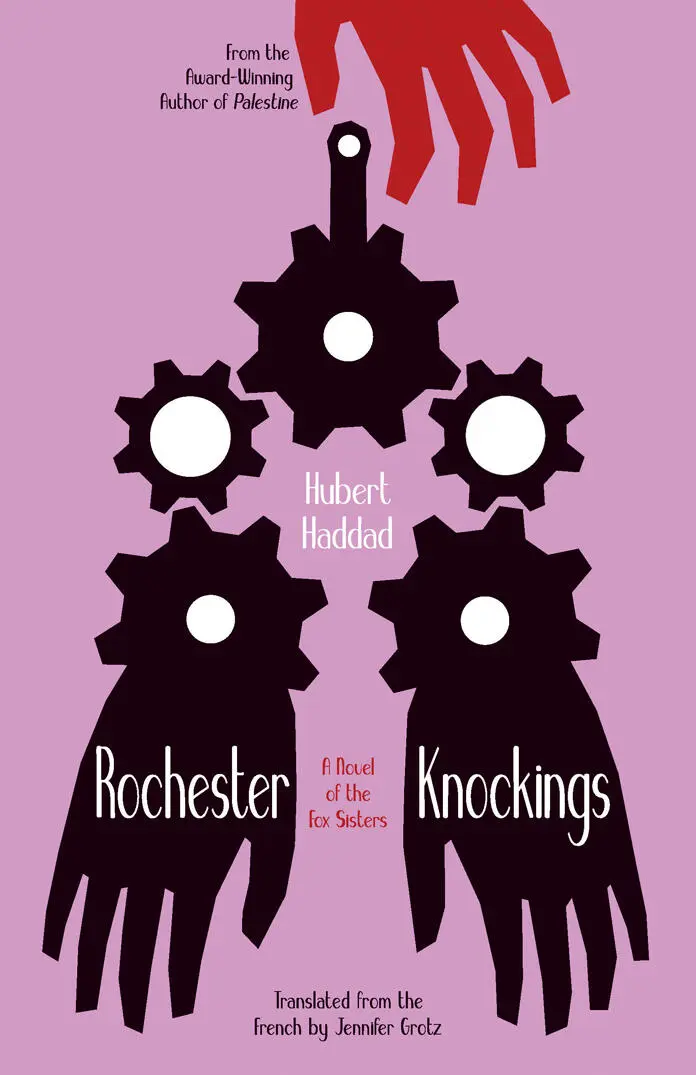
- Название:Rochester Knockings: A Novel of the Fox Sisters
- Автор:
- Издательство:Open Letter
- Жанр:
- Год:2015
- ISBN:нет данных
- Рейтинг книги:4 / 5. Голосов: 1
-
Избранное:Добавить в избранное
- Отзывы:
-
Ваша оценка:
Rochester Knockings: A Novel of the Fox Sisters: краткое содержание, описание и аннотация
Предлагаем к чтению аннотацию, описание, краткое содержание или предисловие (зависит от того, что написал сам автор книги «Rochester Knockings: A Novel of the Fox Sisters»). Если вы не нашли необходимую информацию о книге — напишите в комментариях, мы постараемся отыскать её.
The Fox sisters grew up just outside of Rochester, NY, in a house that had a reputation for being haunted, due in large part to a series of strange "rappings" or "knockings" that plagued its inhabitants. Fed up by whatever was responsible for the knockings, the youngest of the sisters (who was twelve at the time) challenged the ghost and ended up communicating with the spirit of Charles Haynes, who had been murdered in the house and buried in the cellar.
Thanks to the enthusiasm of one Isaac Post, the Fox sisters became instantly famous for talking to the dead, launching the Spiritualist Movement in the US. After taking Rochester by storm, the sisters moved to New York where they were the most famous mediums of the time, giving séances for hundreds of people.
Then, it all fell apart, and the sisters were exposed as frauds. Nevertheless, even today the Fox sisters are considered to be the founders of Spiritualism, one of the most popular religious movements of the past couple centuries (consider the success of Long Island Medium and the hundreds of thousands who visit Lily Dale every year).
Rich in historical detail,
novelizes the rise and fall of these most infamous of mediums.
Hubert Haddad
Palestine
Tango chinois
La Condition magique
Rochester Knockings: A Novel of the Fox Sisters — читать онлайн бесплатно полную книгу (весь текст) целиком
Ниже представлен текст книги, разбитый по страницам. Система сохранения места последней прочитанной страницы, позволяет с удобством читать онлайн бесплатно книгу «Rochester Knockings: A Novel of the Fox Sisters», без необходимости каждый раз заново искать на чём Вы остановились. Поставьте закладку, и сможете в любой момент перейти на страницу, на которой закончили чтение.
Интервал:
Закладка:
For years, two or three nights a week, in the room where Estelle had passed away, séances were perpetuated, all doors and windows closed. In a trance state, before a little pedestal table clearly in view of her host, Kate was free to proceed with any kind of invocation, to write with her bare hand or through a rolling planchette. On the forty-third séance, between the four-poster bed and an armoire mirror that reflected the motionless flame of a single candle, Livermore perceived a halo to which he could not give a name. The phenomenon amplified in the sessions that followed, without any sound. When the first knocks were heard, he no longer doubted the success of the experiment, but in his thirst for certainty, he imposed all sorts of precautions and controls on Kate Fox, binding her wrists and even holding her bare feet in his palms. When the knocks didn’t stop, wild with the darkest happiness, Charles Livermore wanted to add evidence to his certainty and on a few nights invited over unimpeachable witnesses, authorities such as Professor Mapes of the National Academy or the jurisconsult Edmonds, who had eventually gone along with the late Robert Hare of the University of Pennsylvania, fighting on the side of the Fox sisters after having long constituted an inquisitorial tribunal persecuting the new heresy. By different operating strategies, Professor Mapes was able to anticipate or thwart all the usual ruses of illusionists and other falsifiers. Kate Fox was one of the very rare mediums with physical effects never caught in the act of deception. The energies set in motion in her presence could never be assigned to any artifice, unless the whole thing was faked. Satisfied and confident after all the tests and audits — hands isolated in an aquarium, zinc separator plates, levers arranged on a spiral scale with a mobile indicator to measure the forces in action — Livermore asked Kate to intercede with the spirit of Benjamin Franklin, whom he had worshipped from a young age. That one of the founding fathers of the United States agreed to appear in Estelle’s company had been a transcendent confirmation for him, more credible than all the physical evidence, of the substantial incarnation of his late wife. Estelle never ceased to write with the lead pencil held in Kate’s left hand, and what she recounted, her style and written form, brought back so well the happy life of yesteryear, with warmth and in the smallest details, that Livermore soon found himself overcome beyond any consolation. That he was transitorily in love with Kate, through whom the voice and appearance of Estelle kept manifesting, in no way contradicted his passion for the marble angel. The materializations followed one another with ever more influence, and the weak Kate, permanently besieged by a monstrous energy, disintegrated little by little like a straw mannequin between two burning lenses.
On her three hundred eighty-eighth apparition, Estelle announced that it would be her final one, that the hour of deliverance had come for her. Kate must have fainted at the end of the session. She woke up in a nightshirt, in her room on the pavilion, at the dawn of the new day, and realized that she had been entirely undressed.
Charles Livermore, become once again the respectable man she had known in town, left to her the choice between a life of leisure and study next to him, or freedom. Knowing that her mental and physical health were hanging only by a thread, Kate bade him farewell before visiting one last time the angel of the chapel. As a sign of gratitude, in order that the cause of spiritualism might progress, the Wall Street banker offered to her, whom he considered his savior, a stay in England and the means to pursue her investigations for some time. In a long letter vibrant with praises and saturated with exhortations, he recommended in advance Kate Fox to his correspondent Benjamin Coleman, freemason and fervent follower of what was now referred to overseas under the name of spiritism, imposed by the very scrupulous Allan Kardec, coauthor with the spirits themselves of the Book of Spirits.
Sitting in his upstairs office with large bay windows overlooking the entrance to the park, the banker reread his letter with the mild recoiling one always feels in front of the written expression of a well-kept secret:
“Miss Fox is incontestably the most marvelous medium alive. I received so much more from her during these grim years of grief than I can say, in my own house, to the point of feeling indebted to her. It’s now to you, my faithful companion, that I entrust her. Above all that you will take good care of her while she is away from her family. At thirty-five years of age, Kate still has the heart and spontaneity of a child; she feels the particular atmospheres of each individual so strongly that she can become excessively nervous and apparently capricious. Take measure quickly of her natural genius and learn well how to tame her, it’s on her esteem and trust in you that her extraordinary receptivity to other dimensions will depend. .”
At the moment of sealing the letter, Livermore saw down below, leaving the chapel, Kate’s silhouette headed into the tall trees of the park, and felt, without wanting to explain it to himself, a sharp twinge of sorrow.
III.The Green Fairy and the Murderer
Slow waves of snow fell obliquely onto Floss Avenue. Margaret was immobilized among other passersby in front of the windows of the J & M Nicols department store, where frightening mannequins with human figures dressed in manufactured clothes had just been installed, immediately evoking the materializations of the so-called medium William Mac Orpheus, barker at Barnum’s Great Circus Museum and Menagerie, which had pitched its tents for a few days in Rochester. Such a novelty brought forth the gloomy memory of a beautiful dead woman embalmed with an injection of vitriol and nitric acid, whom Margaret had had to work to make speak.
Collar gripped tight against the cold, she made her way close to the buildings’ façades to avoid the splashes of mud from the carts and carriages. Her return to Rochester, in deep winter, had the effect of a private cataclysm on her. She had lived a fairy tale in this city in her youth; here she and Katie had known a kind of glory under the yoke of their older sister. Fortune, even managed by a third party, made everything back then obvious and right. Wasn’t it Mister Splitfoot who had encouraged them to bring the good word to town? The spirits loved fashionable furniture, high wood-paneled ceilings and heavy drapes. In their former home on Central Avenue, Margaret had long believed in these stories of communication with the afterlife. Besides, the tables really were tipping, there was no doubt about it. And when she forgot her failures and resentment, certain phenomena still occasionally occurred. But a part of her had been consumed in the dreary fire of the years. Her living forces devoured all along by a public of vampires, she turned sometimes, more and more often, to various contrivances, expertly calculated ruses. The conjuror’s tricks of this Mac Orpheus that she could have seen at the Barnum circus were without mystery for her now. Moreover, spiritualism was no longer what it had been since the mass arrival of spirits with the flow of new Catholic immigrants. Margaret understood nothing of all these spiritual hierarchies nor of the purgative effects of reincarnation on the soul in transit to the divine light. From what she could tell, except for the women suffering seizures and a few authentic necromancers in a pact with obscure powers, everyone was faking and mystifying in that domain.
But she had to live somehow, and despite everything she still kept a little of the Fox sisters’ prestige in the shadow of Leah Underhill, now become high priestess of a religion of five or six million converts. Her own immortal soul she continued to sell off for a few dollars’ representation. Margaret shrugged before a blind beggar crouched under an awning who, dark glasses on his forehead, was counting his money. She turned onto a dark narrow street where, like feathers from a plucked chicken, thick flakes flew in every direction. The shop sign of the Good Apostle creaked in the wind, adorned with a stalactite beard. She pushed open the yellow-paned door and was comforted by the stove’s warmth. Thankfully, one could have the green fairy in the wet states. Nose in her glass, the absinthe of dubious quality and the cheapest in the house, a woman no longer has a reputation; it made no difference to drop her guard alongside the sailors and the millers. She poured only a thin stream of water on her slotted spoon and the sugar never entirely melted. At her third or fourth absinthe, its color like that of zinc sulfate, she felt better, finally able to examine the world. There behind the counter was John, the cafe owner, distiller, and brewer behind the scenes, among his bottles, glasses, and barrels, holding forth with a hymn-singer and the driver of the next stagecoach to New York, ahead by a few drinks.
Читать дальшеИнтервал:
Закладка:
Похожие книги на «Rochester Knockings: A Novel of the Fox Sisters»
Представляем Вашему вниманию похожие книги на «Rochester Knockings: A Novel of the Fox Sisters» списком для выбора. Мы отобрали схожую по названию и смыслу литературу в надежде предоставить читателям больше вариантов отыскать новые, интересные, ещё непрочитанные произведения.







Обсуждение, отзывы о книге «Rochester Knockings: A Novel of the Fox Sisters» и просто собственные мнения читателей. Оставьте ваши комментарии, напишите, что Вы думаете о произведении, его смысле или главных героях. Укажите что конкретно понравилось, а что нет, и почему Вы так считаете.