Hubert Haddad - Rochester Knockings - A Novel of the Fox Sisters
Здесь есть возможность читать онлайн «Hubert Haddad - Rochester Knockings - A Novel of the Fox Sisters» весь текст электронной книги совершенно бесплатно (целиком полную версию без сокращений). В некоторых случаях можно слушать аудио, скачать через торрент в формате fb2 и присутствует краткое содержание. Год выпуска: 2015, Издательство: Open Letter, Жанр: Современная проза, на английском языке. Описание произведения, (предисловие) а так же отзывы посетителей доступны на портале библиотеки ЛибКат.
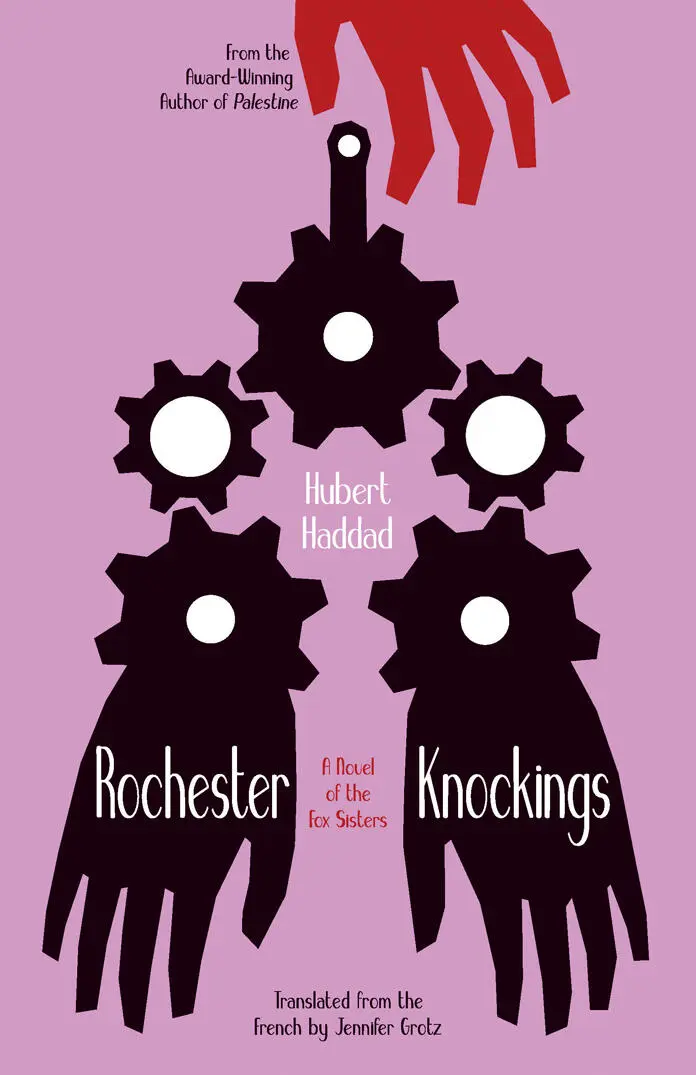
- Название:Rochester Knockings: A Novel of the Fox Sisters
- Автор:
- Издательство:Open Letter
- Жанр:
- Год:2015
- ISBN:нет данных
- Рейтинг книги:4 / 5. Голосов: 1
-
Избранное:Добавить в избранное
- Отзывы:
-
Ваша оценка:
Rochester Knockings: A Novel of the Fox Sisters: краткое содержание, описание и аннотация
Предлагаем к чтению аннотацию, описание, краткое содержание или предисловие (зависит от того, что написал сам автор книги «Rochester Knockings: A Novel of the Fox Sisters»). Если вы не нашли необходимую информацию о книге — напишите в комментариях, мы постараемся отыскать её.
The Fox sisters grew up just outside of Rochester, NY, in a house that had a reputation for being haunted, due in large part to a series of strange "rappings" or "knockings" that plagued its inhabitants. Fed up by whatever was responsible for the knockings, the youngest of the sisters (who was twelve at the time) challenged the ghost and ended up communicating with the spirit of Charles Haynes, who had been murdered in the house and buried in the cellar.
Thanks to the enthusiasm of one Isaac Post, the Fox sisters became instantly famous for talking to the dead, launching the Spiritualist Movement in the US. After taking Rochester by storm, the sisters moved to New York where they were the most famous mediums of the time, giving séances for hundreds of people.
Then, it all fell apart, and the sisters were exposed as frauds. Nevertheless, even today the Fox sisters are considered to be the founders of Spiritualism, one of the most popular religious movements of the past couple centuries (consider the success of Long Island Medium and the hundreds of thousands who visit Lily Dale every year).
Rich in historical detail,
novelizes the rise and fall of these most infamous of mediums.
Hubert Haddad
Palestine
Tango chinois
La Condition magique
Rochester Knockings: A Novel of the Fox Sisters — читать онлайн бесплатно полную книгу (весь текст) целиком
Ниже представлен текст книги, разбитый по страницам. Система сохранения места последней прочитанной страницы, позволяет с удобством читать онлайн бесплатно книгу «Rochester Knockings: A Novel of the Fox Sisters», без необходимости каждый раз заново искать на чём Вы остановились. Поставьте закладку, и сможете в любой момент перейти на страницу, на которой закончили чтение.
Интервал:
Закладка:
Guns and howitzers now thundered forth over a crackling of muskets and one could see here and there, without a plausible link to these sustained shots, fallen groups of soldiers or spurts of earth and stone carrying numerous puppets blown to pieces. The fighting shook the most beautiful slopes under the impeccable azure. A lark shrilled, inaudible. Alexander Cruik remembered the hidden miracles of sight and speech. He raised his head toward the bird perched on its summit and cried out, his eyes filled with tears: “Don’t prophesy! One mustn’t prophesy such things!” Although half destroyed, the Union battalions were at this moment retreating in good alignment to their outposts while the dislocated enemy columns ebbed in disorder beyond their positions, leaving room for a few scattered soldiers who, severely shocked by the intensity of the charge, were still firing in isolation, unable to come to their senses. A non-commissioned officer with flaming hair, face pockmarked, his uniform stained with blood, appeared suddenly before him like a handsome devil, bayonet high, staring perplexedly at him in passing. Those in his company followed him with heads down so as not to count the missing comrades.
With the steps of a sleepwalker, despite the calls from the returning sergeant, Alexander rushed toward the deserted battlefield that the relief workers, waiting for the signal of a truce, had not yet entered. As he stepped into the open field, imploring God’s mercy, his dark silhouette stretching over a pile of corpses, a Southerner wounded in the legs and head, thinking he saw a vulture circling above him, had the strength to lift his musket and shoot before rendering up his own soul. Hit in the chest, Alexander Cruik fell to his knees, hands on the ground, face to face with his murderer. He thought to himself that this dead man resembled him like a brother. Sobbing for the first time since he was a small child, he kissed that bloody face full on the mouth.
The sergeant had observed the scene from the shelter of a cannon breach. After a moment of disbelief, he stepped over the fascines and tangled remains, crouched down, and came quickly to join him.
“It’s not worth it anymore,” said the chaplain.
“I recognize you,” William Pill cried out. “You are the evangelist of the Redskins, the friend of the Fox sisters!”
The officer raised Cruik’s head up off the ground to moisten his lips with his alcohol flask. “It’s going to be all right,” he said, “I’ll take you back. .”
“Useless, you’d just be bringing back a corpse. I remember you too,” the chaplain added, leaning on one elbow. “But come closer. I have loved only one woman in my life. We could have done such great things, she and I. . Listen: I’m wearing an amulet of no monetary value around my neck. Promise me to give it to Kate Fox. It came to me on the day my mother was killed by the Cherokees, right before my eyes. We had been heading west like so many others. The Indians discovered me at the bottom of the carriage, but they didn’t hurt me. Before abandoning me to my kind they tied this amulet around my neck, I don’t know why. It has never left me. .”
William Pill brought the cadaver back anyway. And it was in front of a witness, recording the last will of the chaplain Alexander Cruik, that he pocketed the iron chain and amulet.
In the meadows and hills battered with the holes of shells, where disemboweled horses rotted in the sun, tens of thousands of soldiers from both sides lay who hadn’t had the time to write their names and addresses on a scrap of paper. Mass graves were dug throughout. Faced with such carnage, the governor of Pennsylvania subsidized a sanitation committee for the site as well as the construction of a cemetery. However, the battle of Gettysburg gave the advantage to the Unionists and Sergeant William Pill, taking his chances at each new engagement, won his lieutenant’s stripes there. The front line delimiting the warring territories moved like a snake in its cage for months, from one region or state to the other: no victory brought about a truce and the two camps were by now tallying their martyrs in the hundreds of thousands. In April of 1865, President Lincoln who, thanks to the war effort, had raised the Union to the status of industrial power, was finally and triumphantly able to enter Richmond, the capital of the Confederates that General Grant, his chief of staff, had just conquered.
With one finger on his left hand blown off by a Minié ball, his chest slashed by a bayonet, and having miraculously survived a fire provoked by a famous general enthusiastic about scorched earth, William Pill left his uniform without regret. Not an hour of his life since his recruitment in the first months of the conflict had passed without his thinking of Pearl Gascoigne. Despite his ordeals, the Union’s victory mattered less to him than the possibility of seeing Pearl again. He had watched his companions die fighting, and himself had killed without fail, carried by a single thought: of one day seeing again the woman he loved more than God or America. Pearl, however, had left him, she’d betrayed him for a chimera, a figment of the imagination, the worst of insanities: to be a free woman, to write books, to be accomplished.
Barely off the train, Pill reclaimed his American Quarter Horse from a breeder in Monroe County to whom he’d entrusted it three years earlier. The animal had also aged, but still turned on itself like clockwork, and it was at a gallop that the demobilized lieutenant headed back to Rochester, determined to forget the recent troubles and grumbling, unable to get out of his mind an air that the black recruits loved to hum in hoarse voices before the fight:
Oh, Babylon’s falling, falling, falling
Babylon’s falling to rise no more
Oh, Babylon’s falling, falling, falling
Babylon’s falling to rise no more
II.Livermore’s Good Influence
Nothing more appears after one pulls out her first white hair — age must wait for the second. Kate put on her golden fox coat and crossed the sparkling, dewy park along a flowering path that intersected the road. Walking from the gamekeeper’s house, which had been converted into a small office and salon next to the Livermore mansion, there was hardly time to breathe in all the beds of roses and lilies that were the pride of the grounds-keeper — an almost-black Jamaican with a cockney accent who Charles Livermore kept in service in memory of his wife. Was there any object or custom that wasn’t being kept in memory of Estelle? The financier had settled into his memory, and mourning for him could only be an acute form of attention paid to the absent woman. From then on, his banking career on Wall Street had in no way been troubled, business only being an abstract way to occupy his time, an opportunity for circumstantial oblivion that not even sleep could provide better.
Kate had accepted the widower’s proposal in the middle of the Civil War, one year after Estelle’s death. The years of studies lavished on her by Horace Greeley couldn’t add up any longer. The more one learns, the heavier the tray of ignorance becomes. The exclusive engagement proposed by Livermore had been nothing more for her than an opportunity to untie herself from a singular alienation — for what music theory or philosophy could restore the medium eye-to-eye with the other world? — without which she was under the same constraint to follow the example of Margaret who, disinherited by her in-laws, had resumed touring city to city in the grip of an unscrupulous manager, or else of Leah Underhill, who for her part only practiced spiritualism for the additional fame and fortune, in hostage to a sterile pride.
In this unspoiled corner of Manhattan Island, close to the development work of a giant park and acclimatized gardens with wildlife reserves, Kate forgot the fever of New York City, where all the world’s wars seemed ready to break out at any time in miniature. Her employer and a trust of businessmen led by Mr. Greeley were even strongly opposing the hare-brained idea of Fernando Wood, the mayor of the city who, under the guise of economic dealings with the Southern States, was plainly recommending that New York be the next to secede.
Читать дальшеИнтервал:
Закладка:
Похожие книги на «Rochester Knockings: A Novel of the Fox Sisters»
Представляем Вашему вниманию похожие книги на «Rochester Knockings: A Novel of the Fox Sisters» списком для выбора. Мы отобрали схожую по названию и смыслу литературу в надежде предоставить читателям больше вариантов отыскать новые, интересные, ещё непрочитанные произведения.












Обсуждение, отзывы о книге «Rochester Knockings: A Novel of the Fox Sisters» и просто собственные мнения читателей. Оставьте ваши комментарии, напишите, что Вы думаете о произведении, его смысле или главных героях. Укажите что конкретно понравилось, а что нет, и почему Вы так считаете.