John Gardner - October Light
Здесь есть возможность читать онлайн «John Gardner - October Light» весь текст электронной книги совершенно бесплатно (целиком полную версию без сокращений). В некоторых случаях можно слушать аудио, скачать через торрент в формате fb2 и присутствует краткое содержание. Год выпуска: 2010, Издательство: Open Road Media, Жанр: Современная проза, на английском языке. Описание произведения, (предисловие) а так же отзывы посетителей доступны на портале библиотеки ЛибКат.
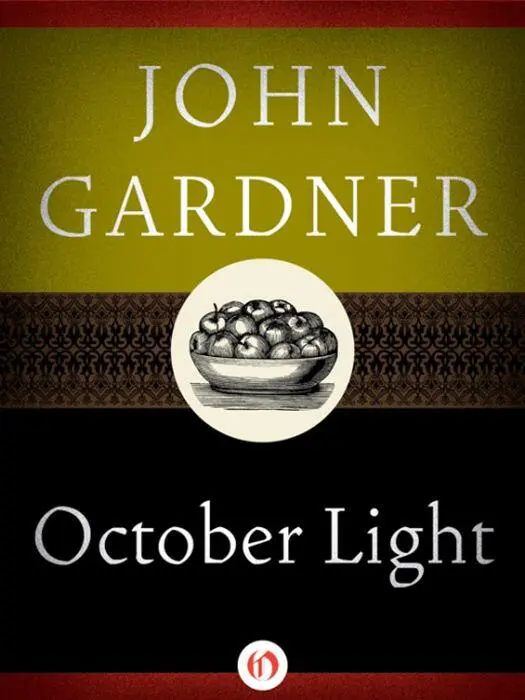
- Название:October Light
- Автор:
- Издательство:Open Road Media
- Жанр:
- Год:2010
- ISBN:нет данных
- Рейтинг книги:5 / 5. Голосов: 1
-
Избранное:Добавить в избранное
- Отзывы:
-
Ваша оценка:
October Light: краткое содержание, описание и аннотация
Предлагаем к чтению аннотацию, описание, краткое содержание или предисловие (зависит от того, что написал сам автор книги «October Light»). Если вы не нашли необходимую информацию о книге — напишите в комментариях, мы постараемся отыскать её.
October Light — читать онлайн бесплатно полную книгу (весь текст) целиком
Ниже представлен текст книги, разбитый по страницам. Система сохранения места последней прочитанной страницы, позволяет с удобством читать онлайн бесплатно книгу «October Light», без необходимости каждый раз заново искать на чём Вы остановились. Поставьте закладку, и сможете в любой момент перейти на страницу, на которой закончили чтение.
Интервал:
Закладка:
“I’m not a formally educated man.” He simpered and bowed. “Almost the only philosophers I know are the ones I read in the Harvard Classics. But I will say this: the ones I know I know well, the way we know our dearest friends. They have been my constant companions, in dingy hotels, in jails, on the seven seas … They have been, I might say, among the closest friends I have.” He simpered and sniffed, deeply touched, then suddenly remembered that his legs were free and he could pace. He lifted one stiff leg, set it down, lurched over onto it, then did the same with the other. Soon he was more or less walking, jerking stiffly back and forth, keeping his balance with the cane.
“Among my favorite philosophers,” he said, simpering again, “is Jean Jacques Rousseau. A number of things these gentlemen have said have turned my mind to that great man’s writings — for example, his discourse on the question ‘Whether the Progress of the Sciences and of Letters Has Tended to Corrupt or to Elevate Morals,’ and also, for example, his ‘Discourse on Inequality.’ I should like, with your permission, to dedicate these few remarks of mine, this little apologia, to that great, high-minded philosopher to whom all of us here in America owe so much.”
He bowed his head, memorial. When he raised it he turned it slowly, mournfully, like a cannon turning on a battleship, to Dancer. “Would you mind if I had my right hand free?” he asked. “It’s so difficult to talk without gestures.”
Dancer sighed and shook his head, then went over and untied the Captain’s right hand. Jane brought him a glass of water.
“Thank you,” the Captain said.
“Let us reflect once again on the savage,” he said. He took a sip of water, put it down on the rock, and paced again.
“The body being the only instrument that savage man is acquainted with, he naturally employs it to different uses, of which ours, for want of practice, are incapable.” He nodded, thinking it over, seeing that it was so. “Had the savage a hatchet, would his hand so easily snap from an oak so stout a branch? Had he a sling, would his hand dart a stone so far? Or had he a ladder, would he run up, so nimbly, a tree? Give civilized man but time to collect his mechanisms, and no doubt he would be an overmatch for the savage. But if you care to see a contest even more unequal, place the two naked and unarmed one opposite the other—” He struck a pose: “—Nature against Art!
“An animal is a mere machine, to which nature hath given senses to wind itself up and guard, to a degree, its life. The human machine is the same, with this difference, that nature alone works the workings of the animal, whereas man, as a free agent, has a share in his. One chooses by instinct, the other — I must here disagree with my friends — by an act of liberty; for which reason the beast cannot deviate from the rules that have been prescribed to it, even in cases where such deviation might prove useful. Thus a pigeon might starve near a fine, rare steak, or a cat beside a bowl of ripe cherries!
“Nature speaks to all animals, and beasts obey her voice. Man feels the same impression, but he at the same time perceives that he is free to resist or acquiesce. And it is surely in consciousness of this liberty that the spirituality of his soul chiefly arises: for natural philosophy explains, in some measure, the mechanism of the senses and the formation of ideas; but in the power of willing, or rather of choosing, and in the consciousness of this power, nothing can be discovered but acts outside the laws of mechanics. Let me add, for the benefit of my friend Mr. Nit, that even if all a man’s deeds are ultimately mechanical (as he so persuasively maintains), his consciousness that he might do otherwise, and his anxiety at being unable to do both, are sufficient signs of his liberty. I am as deeply impressed as is Mr. Nit (I presume) that the root pressure of a common tomato can throw a one-inch column of water a hundred and eighty-two feet straight up. But a man who did the same would be proud of it, or, in another situation, chagrined.
“However, I digress.”
Dancer was shaking his head and moaning.
The Captain slipped his free hand inside the lapel of his overcoat and stood, like Sam Adams, with one fat leg thrust forward.
“To see and to feel would be the first conditions of savage man, which he would enjoy in common with other animals. To will and not to will, to wish and to fear, would be the first and only operations of his soul. Let professors say what they will, my friends — blathering of ‘models’ like Hektor and Akhelleus, heroes who reveal to us the ways of the gods — the human understanding is profoundly indebted to the passions. It is by their activity that our reason improves: we covet knowledge merely because we covet pleasure, and it is impossible to conceive why a man exempt from fears and desires should take the trouble to reason. The passions, in their turn, owe their origin to our wants, and their increase to our progress in science. For we cannot desire or fear anything but in consequence of the ideas we have of it, and savage man, ideally considered, destitute of every species of knowledge …
Another gap.
… And what are all these, to speak more directly, but empathy — the unconscious outreach of soul to soul, the direct, precognitive experience of another man’s toothache?
“Obviously this identification must have been infinitely more perfect in the state of nature than in the state of reason. It is reason that makes man keep aloof from every thing that can bother him. So psychologists tell us, whose whole occupation is to get us back in touch with our emotions. It is philosophy that destroys our connections with other men. What can disturb the calm sleep of the philosopher and force him from his bed? One man may slit another’s throat with impunity under his open window: the philosopher needs only to clap his hands to his ears, argue with himself a little, and rest. In riots and street brawls, the lowest and meanest of the populace flock together, the prudent sneak off.
“And I might add in support of Mr. Wagner’s perhaps somewhat antifeminist position—” he made a depreciatory little gesture, as if to say everyone has his little faults “—that all I’ve said concerning empathy can be said as well of so-called sexual love. The physical part of love is easily enough dismissed: the general desire which prompts the two sexes to unite. A form of empathy rewarded. But what is the ‘moral’ part of love? The ‘moral’ part, as all truly modern men perceive, is a factitious not to say meretricious sentiment, dismissed by feminists while it suits their whim and fleshly greed, then later cried up by them, with great care and address, in order that they may establish their empire and secure command for the sex which ought rightly to obey. How decadently civilized, how advanced and reasonable, is this ‘moral’ love whose signs and proofs are jealous rages, murdered philanderers, the sorrows and sicknesses of whorehouses, and the black shame of death by abortion — yes, I say, death by abortion!”
Captain Fist paused, heaving and panting, surveying his audience. They were visibly shaken. He looked all but distraught.
“Perhaps you are asking yourselves, ‘What has all this to do with Captain Fist?’ I will tell you. You see before you, in my humble person, the extreme of the civilized philosopher, dread image (if you’ll forgive me) of your own too ironic, too self-conscious selves: a man so distant from the simple and lovable emotions of the savage that nothing makes him weep but a nicely constructed argument, true or false; a man who, tossing in his bed, instead of counting sheep, invents bland, sophisticated chatter on world-wide starvation. I am deeply, deeply aware of this fault. As a matter of fact, I carry newspaper clippings in my pocket — touching and uplifting things that I think it might do my soul good to peruse from time to time; for believe me, my fellow Americans and guests, philosophy will not save us! Intelligence will not save us! Art will not save us! We must find our way back to authentic emotion, back to the Spirit that carried our forefathers through Valley Forge, and the Battle of the Marne, and Okinawa! It is our hearts that must save us, our pure and uncomplicated Yankee emotion — Ben Franklin, Mark Twain, Norman Rockwell! I carry such clippings as this, for instance—”
Читать дальшеИнтервал:
Закладка:
Похожие книги на «October Light»
Представляем Вашему вниманию похожие книги на «October Light» списком для выбора. Мы отобрали схожую по названию и смыслу литературу в надежде предоставить читателям больше вариантов отыскать новые, интересные, ещё непрочитанные произведения.

Обсуждение, отзывы о книге «October Light» и просто собственные мнения читателей. Оставьте ваши комментарии, напишите, что Вы думаете о произведении, его смысле или главных героях. Укажите что конкретно понравилось, а что нет, и почему Вы так считаете.