John Gardner - October Light
Здесь есть возможность читать онлайн «John Gardner - October Light» весь текст электронной книги совершенно бесплатно (целиком полную версию без сокращений). В некоторых случаях можно слушать аудио, скачать через торрент в формате fb2 и присутствует краткое содержание. Год выпуска: 2010, Издательство: Open Road Media, Жанр: Современная проза, на английском языке. Описание произведения, (предисловие) а так же отзывы посетителей доступны на портале библиотеки ЛибКат.
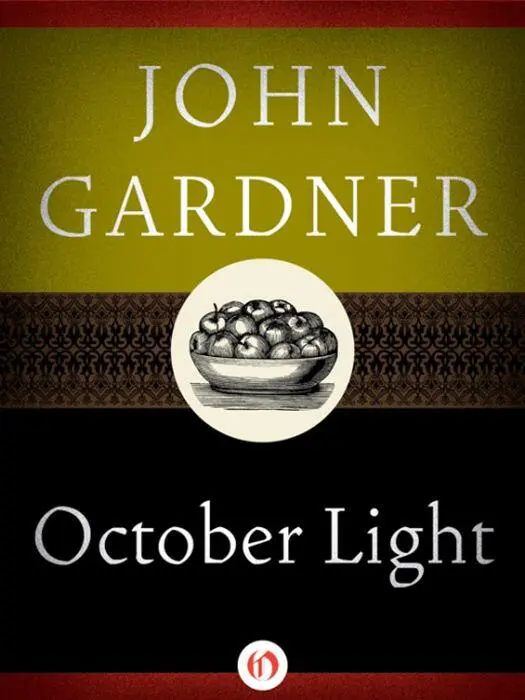
- Название:October Light
- Автор:
- Издательство:Open Road Media
- Жанр:
- Год:2010
- ISBN:нет данных
- Рейтинг книги:5 / 5. Голосов: 1
-
Избранное:Добавить в избранное
- Отзывы:
-
Ваша оценка:
October Light: краткое содержание, описание и аннотация
Предлагаем к чтению аннотацию, описание, краткое содержание или предисловие (зависит от того, что написал сам автор книги «October Light»). Если вы не нашли необходимую информацию о книге — напишите в комментариях, мы постараемся отыскать её.
October Light — читать онлайн бесплатно полную книгу (весь текст) целиком
Ниже представлен текст книги, разбитый по страницам. Система сохранения места последней прочитанной страницы, позволяет с удобством читать онлайн бесплатно книгу «October Light», без необходимости каждый раз заново искать на чём Вы остановились. Поставьте закладку, и сможете в любой момент перейти на страницу, на которой закончили чтение.
Интервал:
Закладка:
“What?” Ginny called.
“I wouldn’t bother if I was you. I won’t eat, and after you’re gone he’ll just feed it to the pigs.”
Ginny took a deep breath, mostly cigarette smoke, or so it seemed to Lewis. He’d always been a worrier, and Ginny’s smoking was the chief of his worries, though he rarely spoke of it. We ought to be getting back, he thought. She knew well enough the situation was hopeless, but she kept at it. Lewis shook his head, miserable, picked at his moustache, and then, catching himself, pushed his hands into his coveralls pockets. “We ought to be getting back to Dickey,” he said casually.
“I know that,” she said, and as if he were surprised that he’d spoken the offending words aloud, he lifted his eyebrows, tipped his head, and focused his attention on the chipping, cream-colored paint on the bedroom door. Without thinking he raised his left hand and with one square fingernail picked experimentally at the edge of a chipped place. A larger chip came off. Ought to be scraped to the wood, he thought, and knew if it were done it would be he who’d have to do it, and then he’d have to do the rest of the doors, and the moldings, to make them match, and then new papering — for no money, because he was a son-in-law, and old James Page was tighter than a snakeskin. More than before he felt guilty and depressed. Now that he’d noticed the chipping paint, he had a feeling it was his duty, in a way, to fix it.
Aunt Sally was saying, full of righteous indignation and self-pity, enjoying herself, “It’s a free country. Just you tell him that. I have rights the same as the next person.”
“Any time she wants,” Ginny’s father called, “she’s free to pack her bags and go live where she damn well pleases.”
“That’s the way he thinks!” Aunt Sally said. The way she pounced on it, even a perfect stranger would have known it was an idea she’d been over and over in her mind. “It’s a free country to die in, that’s all! You ever hear him talk about Welfare?”
“Aunt Sally,” Ginny began, but she knew it was useless. They all did.
“You get him on Welfare and that man will stutter and foam at the mouth like a rabid wolf. You just try it. ‘Welfare’s the ruin of this country,’ he’ll say. ‘Let the people that’s fit to work eat, and let the rest go hang!’”
From the bottom of the stairs Ginny’s father shouted, “Let the people that’s willing and able to work eat. You get it wrong on puppose.”
“Same thing,” she snapped.
“Ain’t the same at ah!” But he bit off all the rest of what he had to say, how it wasn’t child labor he was asking for, or turning a deaf ear to the whimperings of the sick, but if a healthy man was too fussy to take a job when it was offered him — and so forth and so on, they’d heard it many times, so that even Lewis Hicks, who agreed with the old man, was glad to hear him stop. Yet at the same time, confusingly, Lewis was sorry to see the truth choked off, as it so often was in this miserable world, it seemed to him. He could see old James Page, in his mind’s eye, with his mouth clamped shut like a snapping turtle’s, arms folded tight across his chest, down there at the foot of the stairs, his eyes aglitter with cold fury.
“Just get him onto Social Security,” she said. The old woman pounced on that subject too with malicious glee. She knew her brother. It was no case of “tensions raised by misunderstanding.” Struggle as he might, bite his false teeth together hard as he pleased, hop on one foot with his eyes shut, he couldn’t help answering. “I’d rather see the Government rob banks than have Social Security,” he cried out.
“You see?” she shrieked.
Lewis could picture her with her hands squeezed together, behind that door, lips violently trembling, her smile like the smile of an axe-murderer. Without thinking he said, as if he thought he was in heaven and reason might settle the whole dispute, “Social Security’s a terrible thing though, you got to admit it, Aunt Sally. You pay all your life, and then when you retire it ain’t enough to live on, and if you go get a job you ain’t eligible for your own damn money. It’s dollers down a rat-hole.”
“Oh, Lewis,” Ginny said.
“Well, it’s true, sweet-hot.” He spoke gently, eyebrows lifted, not insisting on the point, just appealing to common sense.
“What’s true has nothing to do with it,” she said.
That too, he realized, was true. He turned from her, feeling, as usual, stupid as an Indian, and absently picked another chip from the door. He’d had things to do tonight. Jack up the kitchen. Repair the woodshed door.
“A person can believe what he pleases in a democracy,” Aunt Sally said firmly, “and say what he pleases, and live as he pleases, and watch whatever television programs he pleases, or read whatever books. That’s the law of the land.”
“Not in this house,” Ginny’s father shouted up, then went silent.
The old woman, too, went silent now. Ginny waited, watching Lewis, hoping perhaps for some suggestion. Nothing came. He could hear the old woman moving about, slowly, stiffly, in her bedroom slippers.
He might have thought once it was an easy question, what rights a person had when they moved into somebody else’s house. But nothing was simple. That was the only thing he’d learnt all these years, though he’d been born, could be, with an intuition of the fact. You heard all your life about people who moved in with relatives, how they kept to themselves, did whatever bit of work they could think of to do, washed dishes, cleaned storm-windows and sap-buckets, helped with chores; and the relatives would say they were no trouble at all, though occasionally the relatives might briefly complain, with great pains making nothing much of it. That was all — or so he’d more or less taken for granted — how things ought to be. His grandmother had lived with his parents for years, and that had been, generally, how it had been then: an old woman for the most part invisible as a ghost, darning socks, dusting floors, warming baby bottles — more like an old, inefficient family servant grateful to be kept on, happy to be of whatever small use, than like a grandmother, someone who had once been a wife and mother, with a life of her own. Lewis nodded, encountering the same thought again: nothing’s simple.
Picking at the paint, only half aware what he was doing or thinking, he saw his grandmother again — she’d been dead for years — her yellow-white hair in a bun on her head, clamped with amber pins, her brown eyes quick as a squirrel’s or a doe’s, and he realized he’d been fond of her; and mixed with that image, distinct and clear and yet a part of it, joined with it as images join in dreams, he saw the furniture he’d had to help move from Aunt Sally’s when she’d finally sold off the last of it. It had been expensive once — more expensive, anyway, than anything Ginny and he would be able to afford in this Vale of Tears. A rocking chair, for instance, of inlaid mahogany; an old cherry table with hardly a scratch; a standing lamp of brass, with etched glass bowls for the lightbulbs; a tallboy of pearwood. The furniture had been sold, the house soon after. With a few trunks and bags and a shawl around her head, she’d come away from the place like a refugee. Even if the thing had been her fault, it would hardly have been fair, somehow; and it had not been, so far as he could see, her fault. Ten years ago or more, she’d tried to make the house an antique shop. She’d been unlucky. She knew nothing about antiques, and had no real way to find out about them. People who knew more cleaned her out when she had good things and sold her mediocre things for more than they were worth. He’d repaired old tables and chairs for Aunt Sally, from time to time, and whenever he went into her living-room shop he’d had a feeling, clear as a chill, that things were out of hand. She’d been in business, if one could call it business, less than two years, then finally had resigned herself to living on her savings and the insurance and, now and then, some housecleaning work. But she’d lived too long by a good ten years, and besides, she’d been generous, giving to political campaigns and charities as her husband had done, though she knew, Lewis Hicks suspected, nothing much about them. Perhaps he could have helped her, somehow another. But she was too proud to reason with, he’d known without trying, and who was he to give anyone advice, the un-luckiest man he knew? So he’d shook his head, wondering what would come of it all, no surer than any of the rest of them how much money she had left, and one morning — it had seemed at the time just that sudden — they’d found out Aunt Sally was a pauper.
Читать дальшеИнтервал:
Закладка:
Похожие книги на «October Light»
Представляем Вашему вниманию похожие книги на «October Light» списком для выбора. Мы отобрали схожую по названию и смыслу литературу в надежде предоставить читателям больше вариантов отыскать новые, интересные, ещё непрочитанные произведения.





Обсуждение, отзывы о книге «October Light» и просто собственные мнения читателей. Оставьте ваши комментарии, напишите, что Вы думаете о произведении, его смысле или главных героях. Укажите что конкретно понравилось, а что нет, и почему Вы так считаете.