Rattawant Lapcharoensap - Sightseeing - Stories
Здесь есть возможность читать онлайн «Rattawant Lapcharoensap - Sightseeing - Stories» весь текст электронной книги совершенно бесплатно (целиком полную версию без сокращений). В некоторых случаях можно слушать аудио, скачать через торрент в формате fb2 и присутствует краткое содержание. Год выпуска: 2004, Издательство: Grove Press, Жанр: Современная проза, на английском языке. Описание произведения, (предисловие) а так же отзывы посетителей доступны на портале библиотеки ЛибКат.
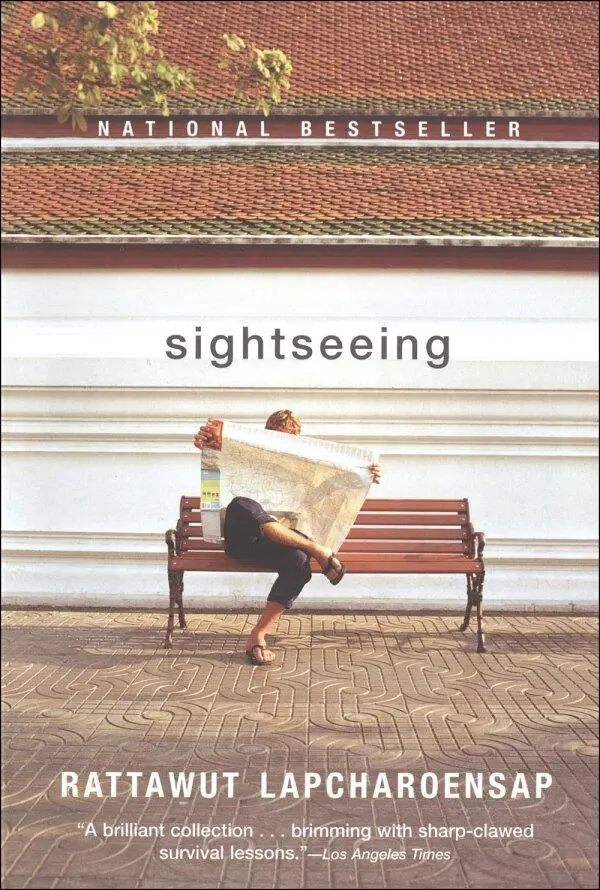
- Название:Sightseeing: Stories
- Автор:
- Издательство:Grove Press
- Жанр:
- Год:2004
- ISBN:нет данных
- Рейтинг книги:4 / 5. Голосов: 1
-
Избранное:Добавить в избранное
- Отзывы:
-
Ваша оценка:
Sightseeing: Stories: краткое содержание, описание и аннотация
Предлагаем к чтению аннотацию, описание, краткое содержание или предисловие (зависит от того, что написал сам автор книги «Sightseeing: Stories»). Если вы не нашли необходимую информацию о книге — напишите в комментариях, мы постараемся отыскать её.
is a masterful story collection by an award-winning young author. Set in contemporary Thailand, these are generous, radiant tales of family bonds, youthful romance, generational conflicts and cultural shiftings beneath the glossy surface of a warm, Edenic setting. Written with exceptional acuity, grace and sophistication, the stories present a nation far removed from its exoticized stereotypes. In the prize-winning opening story "Farangs," the son of a beachside motel owner commits the cardinal sin of falling for a pretty American tourist. In the novella, "Cockfighter," a young girl witnesses her proud father's valiant but foolhardy battle against a local delinquent whose family has a vicious stranglehold on the villagers. Through his vivid assemblage of parents and children, natives and transients, ardent lovers and sworn enemies, Lapcharoensap dares us to look with new eyes at the circumstances that shape our views and the prejudices that form our blind spots. Gorgeous and lush, painful and candid,
is an extraordinary reading experience, one that powerfully reveals that when it comes to how we respond to pain, anger, hurt, and love, no place is too far from home.
Sightseeing: Stories — читать онлайн бесплатно полную книгу (весь текст) целиком
Ниже представлен текст книги, разбитый по страницам. Система сохранения места последней прочитанной страницы, позволяет с удобством читать онлайн бесплатно книгу «Sightseeing: Stories», без необходимости каждый раз заново искать на чём Вы остановились. Поставьте закладку, и сможете в любой момент перейти на страницу, на которой закончили чтение.
Интервал:
Закладка:
I think of the spirit of dead prisoners, of fishermen’s tales, but realize quickly that it’s only Ma with the oil lantern, that the tide has receded considerably since I went to sleep, the edge of the beach where the water meets the sand some distance away.
The flame of the oil lantern gets smaller and smaller and soon it is merely a pinprick against the dark night. It’s my mother walking on water, I think. It moves sideways now, moves along the bottom of the dark shadow across the bay, comes to a resting place. It’s my mother on an island with no name.
I walk toward the water, toward the flickering light. The flame is like an orange eye winking at me from across the divide. The sand is damp, soft as a slab of fresh clay, my feet sinking into its warmth as I walk.
When I come upon the water’s edge, I realize there is still considerable distance between where I am standing and the light of Ma’s lantern on the island across the bay. Perhaps the water is shallow enough to walk across, but I remember from swimming here yesterday that the bottom quickly falls away and that my mother is not a very strong swimmer.
And then I see it. I see a thin luminous line out of the corner of my eye. I see a thread running faintly across the bay. An opaque sandbar stretched between the islands like an exposed vein.
I walk toward the sandbar, across the beach, my eyes fixed on the flame. I see that the path is no more than a meter wide, a white trail running across the surface of the water. The black sky turns a deep indigo, night slowly relenting to day, and I can make out Ma’s small shape sitting beside the flickering lantern. I’m walking onto the sandbar, warm waves licking up across my bare feet, out to watch the sun rise with Ma, and then to bring her back before the tide heaves, before the ocean rises, before this sand becomes the seafloor again.
PRISCILLA THE CAMBODIAN
The only thing I ever learned about wealth was Priscilla the Cambodian’s beautiful teeth. All her teeth were lovely ingots, each one crowned in a cap of pure gold. When she smiled it sometimes looked like that little girl had swallowed the sun. Dong and I would often ask to look and Priscilla would open her mouth wide. We’d move in close, stare into its recesses until her jaw got sore. “You’re rich,” Dong and I would say, and Priscilla the Cambodian would smile and giggle like we’d just told her she was beautiful.
Her father was a dentist. When things started looking bad in Cambodia, he hired somebody to smelt the family’s gold. He put all that gold in Priscilla’s mouth. And then they took him away. Priscilla remembered sitting on his dentist’s chair in the empty hospital while bombs fell on Phnom Penh. Over the next three years, as Priscilla and her mother moved from camp to camp, she sometimes went for days without opening her mouth — her mother was afraid the guards might get ideas. She made Priscilla nibble on gruel and salted fish in the relative secrecy of the warehouse they shared with hundreds of other refugees. “Awesome,” we’d say. “They should make a movie about your life, girlie.”
This was the summer Dong and I wasted in the empty community pool the development company never got around to finishing. Priscilla and her mother had recently arrived in Bangkok with two other Cambodian families. They all squatted in a tin shack compound by the train tracks bordering the development. Before we met Priscilla, Dong and I in our unflappable boredom would sometimes stand on the rails and throw rocks just to hear the satisfying clang on the Cambodians’ corrugated roofs. Priscilla’s short, flat-faced mother would run out and bark at us in a language we didn’t understand, but it wasn’t too hard to understand the rusted shovel she waved threateningly in our direction, so we’d run and laugh like delighted hyenas.
Mother said the refugees were a bad sign. “God’s trying to tell us something,” she said. “God’s probably saying, ‘Hey, sorry, but there won’t be a health club or a community garden or a playground or a pool or any of those other things you suckers thought you were getting when you first came to the development. I’m gonna give you some Cambodian refugees instead. They’re not as fun, but hey, life isn’t a store, sometimes you don’t get what you pay for.’” Father nodded and said refugees meant one thing and one thing only. It meant we’d be living in the middle of a slum soon. “Those fuckers move in packs,” he said. Their little refugee camp would get so big we’d probably start thinking we were refugees too.
By that time the prognosis was already bad. The factories had moved to the Philippines and Malaysia. Mother was reduced to sewing panty hose out of a Chinese woman’s house. Father carried concrete beams at a construction site for minimum wage. Some of the families in the development had already moved on, leaving their pets and potted plants and empty duplexes behind. Early in the summer, Father and Mother tried to sell like the others. But the market had turned; it was already too late. When the development company realtor came to appraise, Father’s face turned so pale I was afraid he’d pass out. “That’s a goddamn crime,” Father said, after the realtor offered little more than half the duplex’s original price. “No crime here,” the realtor replied, fingering the knot of his tie. “Just old-fashioned economics.” So Father said, “Get out of my house. Get out or I’m gonna show you something else that’s old-fashioned.” But the realtor just kept smiling and said, “Fine. Suit yourself. Have fun living like savages.”
One April afternoon, Dong and I were breaking our asses attempting stupid bike tricks in the unfinished pool. I sat in the shallow end wiping a stain on my pants while Dong prepared to ride off the diving board. It was going to be a good trick, we thought. A girl-seducing trick. We were sure that once all the girls saw us soar off that diving board and land in the deep end they’d swoon, fall on their knees, and trip over each other in the hopes of doing some delightfully nasty dancing with us. Dong and I had decided that our access to dancing of any kind would not easily be granted on our good looks alone. For one, we were both too dark. For another, my dogged asthma had earned me the moniker of Black Wheezy from the Thicknecks at school. And, for yet another, Dong was knock-kneed and kind of fat. The Thicknecks called him the Pregnant Duck. When girls were around, all they’d have to say was “Hey look, guys, there goes Black Wheezy and the Pregnant Duck” or “Quack-Quack! Hack-hack!” and suddenly it was like the word Handsome had just been emblazoned on their foreheads. Needless to say, this was not funny to us at all — not even a little bit — but apparently very funny to Dong’s parents and my own, because they laughed so long and hard when we went crying to them that we believed we’d become the most psychotically depressed eleven-year-old boys in the history of the planet. So we needed a talent. Aerial acrobatics seemed like a good idea. Unfortunately, none of our attempts thus far had been very acrobatic or even very aerial.
That afternoon, just as Dong got halfway down the diving board, Priscilla the Cambodian appeared poolside out of nowhere. “Wheeeeee!” she squealed like a happy little succubus. Dong hesitated, turned to look at Priscilla, lost crucial velocity, and tumbled off the edge of the diving board. It made a bad sound. It sounded like a dog getting hit by a car because even with all the bike’s clanging and screeching I could still hear Dong yelp when he hit the pool’s hard bottom. Priscilla pointed and laughed, and that’s when I glimpsed her gold fangs glinting for the very first time.
“Refugee fuckass,” Dong muttered, getting up off the mildewed tiles. “What do you think you’re doing?” He collected his bike, teetered on his feet. But Priscilla the Cambodian just laughed and laughed some more. “Hey,” I said, walking down toward Dong in the deep end. “The pool’s ours. Get out of here.” She looked at me curiously. She was younger than us. She wore an old Kasikon Bank T-shirt that came down to her knees. Short black hair sprouted in matted tufts all over her head. And she had that mouthful of gold.
Читать дальшеИнтервал:
Закладка:
Похожие книги на «Sightseeing: Stories»
Представляем Вашему вниманию похожие книги на «Sightseeing: Stories» списком для выбора. Мы отобрали схожую по названию и смыслу литературу в надежде предоставить читателям больше вариантов отыскать новые, интересные, ещё непрочитанные произведения.










Обсуждение, отзывы о книге «Sightseeing: Stories» и просто собственные мнения читателей. Оставьте ваши комментарии, напишите, что Вы думаете о произведении, его смысле или главных героях. Укажите что конкретно понравилось, а что нет, и почему Вы так считаете.