John Gardner - The Sunlight Dialogues
Здесь есть возможность читать онлайн «John Gardner - The Sunlight Dialogues» весь текст электронной книги совершенно бесплатно (целиком полную версию без сокращений). В некоторых случаях можно слушать аудио, скачать через торрент в формате fb2 и присутствует краткое содержание. Год выпуска: 2010, Издательство: Open Road Media, Жанр: Современная проза, на английском языке. Описание произведения, (предисловие) а так же отзывы посетителей доступны на портале библиотеки ЛибКат.
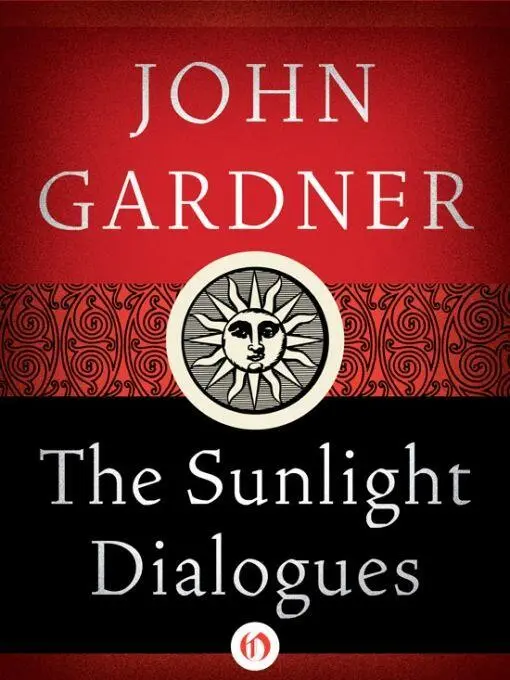
- Название:The Sunlight Dialogues
- Автор:
- Издательство:Open Road Media
- Жанр:
- Год:2010
- ISBN:нет данных
- Рейтинг книги:4 / 5. Голосов: 1
-
Избранное:Добавить в избранное
- Отзывы:
-
Ваша оценка:
The Sunlight Dialogues: краткое содержание, описание и аннотация
Предлагаем к чтению аннотацию, описание, краткое содержание или предисловие (зависит от того, что написал сам автор книги «The Sunlight Dialogues»). Если вы не нашли необходимую информацию о книге — напишите в комментариях, мы постараемся отыскать её.
Beautifully expansive and imbued with exceptional social insight,
is John Gardner’s most ambitious work andestablished him as one of the most important fiction writers in post — World War II America.
The Sunlight Dialogues — читать онлайн бесплатно полную книгу (весь текст) целиком
Ниже представлен текст книги, разбитый по страницам. Система сохранения места последней прочитанной страницы, позволяет с удобством читать онлайн бесплатно книгу «The Sunlight Dialogues», без необходимости каждый раз заново искать на чём Вы остановились. Поставьте закладку, и сможете в любой момент перейти на страницу, на которой закончили чтение.
Интервал:
Закладка:
Hodge said, “Are you really blind to it? — that it’s you who drove her mad?”
“I will not discuss it.”
“No, of course. Will merely correct it. Find her a pretty garden, perhaps. Buy her keepers.”
“Mr. Hodge, I have engagements. I’ll see you in court.”
Hodge calmed himself. He could understand the Old Man’s side. That was the horror. So one understood Germany, or the Chinese Communists, or Africa. The clear head’s burden. Thus by abstraction he fought the urge to murder his father-in-law, because she loved him. He stepped back from the door, letting him through. “I’ll see you in hell,” he said calmly.
The Old Man nodded — a strange thing, now that Hodge thought about it. Soberly nodded as if to say, “That’s so.”
He’d been working faster and faster, as if in flight from the memory burning in his head.
From the magazine, too, he had debts. They were slight, compared to the rest. They were among the debts he had meant to pay off, because Mollman was a friend of sorts, a former classmate, and besides that, a rare printer, the kind who took on obscure magazines from faith in them, gave honest prices and did a first-rate printing job. He even made a go of it — the riskiest business in the world, not even a business, as a matter of fact. No arty little journal really paid. You supported them by sweat and begging and living off the hog’s toes. So Hodge had planned to pay, the same way others paid, by sacrifice. But he had not gotten to it; never would. Whatever bills came, month by month, he threw out with the trash. He would read them, pay up, when his ship came in. So he’d told himself. But his ship was sunk. He admitted that now. He would have to start all over, maybe Argentina. He must not think about it. Deadly Opinions, he’d called it. A subscription list of two hundred, mostly unpaid. He had somewhere card-catalogs of names, a bundle of unreturned manuscripts, packets of galley proof.
He would think about the weather.
The night was pleasant.
that time of night when the troublesome cares of humanity drift from our hearts and on seas of luxury streaming in gold we swim together, and make for a shore that is nowhere
(To the white-mantled maidens
of Tanagra I sing my sweet lays,
I am the pride of my city
for my conversational singing)
Greater love hath no man than this: that he give up his head for his beloved.
“That’s enough,” he said. He thought of striking his hand with the hammer.
“I need a drink,” he said. That, at least, was true, but he did not stop working.
The inability to act, except absurdly. Familiar plague of his existence. He’d been doing it, walking the same circle, round and round, since before the time …
It was not true that he himself was blameless. Had the Old Man sensed that, for all the sharp-steel brutality of his mind?
In the beginning, before he knew that the sickness was serious, he had been unfaithful to her in his thought. She’d made demands, was forever interrupting his work, insisted on knowing everywhere he went, constantly spoke of his scuffed shoes, his untrimmed hair. She complained that he was getting fat.
“You’re sick,” he said, lashing out viciously, and she answered that he was the sick one, and made him believe it. They would have terrible fights, frequently about her father. Then it would all be as it had been before, for a while. He would notice the beauty of her walk, would sit on the bed watching her fix her face for a party, and he would reach out to touch her when she passed. Then it would happen again, and he would endure it for a time, withdrawing to his thoughts. Sometimes she would go rigid with anger, would talk gibberish; and he, though he held her, soothed her, assured her of his love, would be full of secret hate. The Old Man had started it perhaps, but he himself had pushed it along. He had drawn back into his mind, and when she beat him with her fists, ludicrously futile, he had endured her violence with scorn. What she said of him was cruel and false, and because it was painful he had developed defenses. There were plenty of people who did not find him fat, ugly, stupid, malicious, whatever it was she accused him of at the moment. They became his battlements against her. He began to long with all his heart to be rid of her, not to be with some other woman — her cruelty made him hate all her kind — but merely to be free, to prove himself in some battle worth the trouble. And at the same time, precisely because he was no longer able to believe in any of them, he wanted to couple with every woman he saw. It was true, he would see later, that he was sick. He would realize with a shock of horror why it was that he’d been able to win her so easily from her father: it was no victory, the same regime.
But he had not known that yet and would not make it out until too late, after he had won by destroying her, had snapped her mind because he would not learn what his father’s life taught: stop, listen, wait.
It takes strength to listen and wait, and neither one of us was strong. To desire too much, to think oneself unfit—
Not a circle, a spiral inward (introversion) to a madness of cool objectivity.
Nothing passes belief when a god’s intention
We weren’t ready yet, either of us; we loved each other and were at war for fear that we didn’t deserve what we took. Withdrew by separate paths. You forward to madness, and as for me—
Deadly Opinions. He had meant it to be ironic, but the title told the truth. Thoughts of a mind half god, half goat. It was like that, yes. He had written once.
Burning nights and days in his sullen grove,
Funereal as onyx, hind legs splayed,
Sick and omnivorous, the ruptured goat
Participates in the antics of the brain.
His monstrous groin cries out to mount the wind
As the mind cries out for subtleties worth thought
And the heart for a sacrifice as thick as time:
Hunger and surfeit gathered in one red heat.
His eyes are blank as stones. He has no name,
No physics for his rage. Collects his force,
Attacks and painfully couples; then, alone,
Broods once more on anger; finally dies.
I am unhinged by that fierce unholy image:
Fed up with gentleness, and sick with thought,
I will tear down my kingdom hedge by hedge,
Make war on the scree-gashed mountains, lord the night!
I turn to life! In every glittering maid
I’ll plant my burning wrath till the last flame
That cracks my chest is spent away to head
And the parched ribcage cools to easy dying.
I’ll learn to mock responsibilities,
These cold whereases capping the living well
That churns, beneath the ground, by fiercer laws.
I’ll have no truck with words. Discretion. Guilt.
I’ll put on joy, or something brother to joy;
Butt down the delicate gates I’ve helped to firm.
I’ll turn blind eyes on tears, stone ears on sighs,
No more the pale good friend. A mindless storm.
For I have cause! I’ve proved what reason is—
Paid with contempt, indifference. Honored laws
I do not need; made peace with foolishness
That steals my hurtling-downhill time and laughs.
I too have blood to burn. I know the case
Of those I am of use to. A human voice
Making the time pass, keeping the night outdoors.
Читать дальшеИнтервал:
Закладка:
Похожие книги на «The Sunlight Dialogues»
Представляем Вашему вниманию похожие книги на «The Sunlight Dialogues» списком для выбора. Мы отобрали схожую по названию и смыслу литературу в надежде предоставить читателям больше вариантов отыскать новые, интересные, ещё непрочитанные произведения.


Обсуждение, отзывы о книге «The Sunlight Dialogues» и просто собственные мнения читателей. Оставьте ваши комментарии, напишите, что Вы думаете о произведении, его смысле или главных героях. Укажите что конкретно понравилось, а что нет, и почему Вы так считаете.