John Gardner - The Sunlight Dialogues
Здесь есть возможность читать онлайн «John Gardner - The Sunlight Dialogues» весь текст электронной книги совершенно бесплатно (целиком полную версию без сокращений). В некоторых случаях можно слушать аудио, скачать через торрент в формате fb2 и присутствует краткое содержание. Год выпуска: 2010, Издательство: Open Road Media, Жанр: Современная проза, на английском языке. Описание произведения, (предисловие) а так же отзывы посетителей доступны на портале библиотеки ЛибКат.
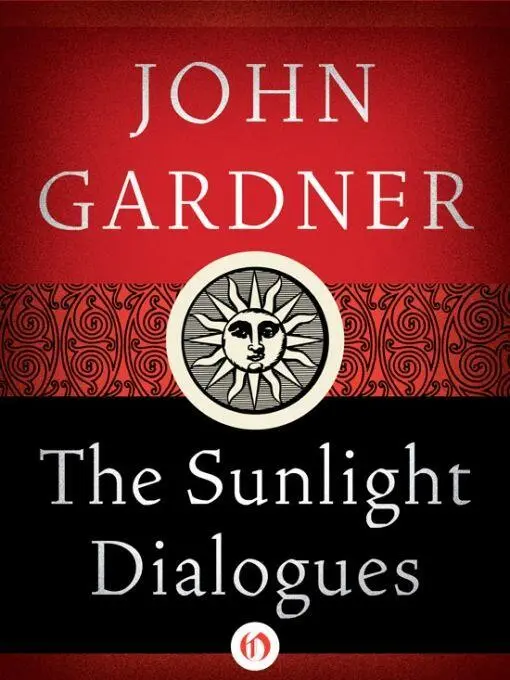
- Название:The Sunlight Dialogues
- Автор:
- Издательство:Open Road Media
- Жанр:
- Год:2010
- ISBN:нет данных
- Рейтинг книги:4 / 5. Голосов: 1
-
Избранное:Добавить в избранное
- Отзывы:
-
Ваша оценка:
The Sunlight Dialogues: краткое содержание, описание и аннотация
Предлагаем к чтению аннотацию, описание, краткое содержание или предисловие (зависит от того, что написал сам автор книги «The Sunlight Dialogues»). Если вы не нашли необходимую информацию о книге — напишите в комментариях, мы постараемся отыскать её.
Beautifully expansive and imbued with exceptional social insight,
is John Gardner’s most ambitious work andestablished him as one of the most important fiction writers in post — World War II America.
The Sunlight Dialogues — читать онлайн бесплатно полную книгу (весь текст) целиком
Ниже представлен текст книги, разбитый по страницам. Система сохранения места последней прочитанной страницы, позволяет с удобством читать онлайн бесплатно книгу «The Sunlight Dialogues», без необходимости каждый раз заново искать на чём Вы остановились. Поставьте закладку, и сможете в любой момент перейти на страницу, на которой закончили чтение.
Интервал:
Закладка:
She was coming up the stairs now, stealthy. There was no doubt of it then. She had the gun. Though still he felt nothing, the air around him sickened. Was he to be responsible for the world? The sour smell of the cellblock was behind them, and the policeman full of rules he only dimly understood walked trembling ahead of the Indian boy who tiptoed though there was no need, his flat face twisted up like twisted iron, a rage of rules. And a rule said to the policeman, “Duck and turn!” and another howled to the Indian, “Get the gun!” The room exploded and fire leaped out of the walls, and the policeman fell back, thrashing and gurgling. They began to run, stepping lightly through the flames. It was not his fault. He could construct a fault, but not one he believed. He was not the one who had englished the tottering world off course, slammed home this debauchery of laws to crucify the living heart and nail the dead in place with a stake of ash.
Nor was it his fault that Millie was coming down the hallway with a tread absurdly light to attack his trance. Like a man asleep, he stood up, or part of him stood up, and moved without a sound toward the door. (Erxias, where is all this useless army gathering to go?) She stood outside the door, motionless, listening for his breathing. The doorknob turned, so noisily, as it seemed to him, that it might have wick’d the dead. He stood across the room in the absolute blackness and watched himself watching the doorknob. Then a breeze came. The door was opening. He slipped the gun from her hand so lightly, he knew by practice, that she would not know for a moment that it was gone. “The tigress strikes,” he whispered, the same instant.
She started back and realized the gun was gone.
“La bête féroce,” he whispered. “Do not think I cannot guess why you have come.” He began a wild patter of lunatic talk, patting her cheek, tousling her hair, hissing, howling, whining. She did not realize until too late that she was naked to the waist. A lightning flash filled the room and revealed his face. She screamed, though an instant before, crazily, she had been willing; almost willing. The Sunlight Man lifted his arm to hide his ugliness and backed away. He shook with anger and believed for a moment in the fire breaking out at his feet.
“Keep it down in there,” Clumly said.
Kathleen’s father stood at his shoulder, dead.
4
Ed Tank slid out of his prowlcar and hurried to the barn door. There he stopped, bent forward, listening. Hearing nothing, he drew his pistol and went in. A tangle of old rope, a harrow that had not been used in years, two old woodstoves leaned against the wall for storage; otherwise nothing. He could take in the whole barn at a glance — there had been no hay in the mows for a long time. Light came through holes in the roof. He came out again and went around the side, and there, sitting against an old barrel, was what he was after.
He saw at once that it was not the Sunlight Man but somebody else, a short young man wearing a heavy black coat and a black Amish hat, though the morning was already hot. His beard was small and scraggly. The young man nodded, curiously polite and remote. Ed Tank put the gun in its holster.
“What you doing here?”
“Just resting.”
It might be true. There was a battered metal suitcase by his leg. He might be some kind of tramp just passing through. Tank scowled and scratched his stomach. “You better come with me.”
“Ever you say,” he said. He leaned forward and rose to his feet. He bent over for the suitcase. The hem of the black coat came almost to the ground.
“What’s your name?” Tank said.
“Freeman,” he said. He smiled and held out his hand as if to shake.
Tank ignored it, then thought perhaps he shouldn’t have. Might be a harmless nut, one of those halfwits you heard about, wandering around from place to place. There were birds on the fence, he didn’t know what kind, watching them.
“What’s yours?” the young man said.
“Mine?”
“Your name.”
He studied him. At last he said, “Officer Tank.”
“Ah!” the boy said. Again he held out his hand, and this time, thinking he must be crazy as he did it, Tank accepted the handshake.
“Am I bothering someone?” the boy said.
“You’ll find out down at headquarters.” He moved guiltily toward the car and the boy came, as if voluntarily, beside him. The sun was still low but it had lost its redness. Houses and trees stood out clean and sharp and sounds were very clear — the bell-like ring of a milkcan cover being knocked off the can, the sound of a compressor starting up. Tank reported in. Then he started up the motor, backed away from the barn, and turned toward the crumbling-asphalt street.
“Law Street,” the boy said, seeing the sign. He smiled.
Tank said, “You live around hereabouts?”
“New Jersey,” the boy said. “I’m just visiting.”
“Who?”
“Oh, nobody special. Just visiting. Nice country.”
Miller bounced the empty flowerseed packet up and down in his palm. Tank leaned against the door with his arms folded. “How many of these you take?” Miller said.
“I don’t know,” the boy said. He sat with his arms around the hat in his lap. “As I say, I was hungry.”
“Mmm,” Miller said.
“Did I break some particular law?” the boy said as if concerned.
Miller looked at him, thinking about other things. At last he said, “Not any law that’s written down.”
“Ah,” the boy said. He nodded. “An unwritten law.” He did not smile.
“How old are you?” Miller said.
“Twenty-four. How old are you?”
“Pretty old.” He dropped the package in the wastebasket. “You’re just passing through, right?”
The boy nodded.
“Good. Keep passing and we’ll forget about this.”
“Keep passing?” He showed nothing at first. Then little by little a look of incredulity came. He tipped his head. “Excuse me, are you saying I must go, whether I prefer to go or not?”
“I’m advising—”
“I don’t understand. It seems to me—” He opened his hands to show his amazement. “Why in the world should I leave?”
“Look, take it easy on us, will you? Just vanish.”
Head tipped, he stared fixedly at Miller. “I’m sorry about your unwritten law, but that’s your bag, it seems to me. Since I’m thoroughly inoffensive and a great respecter of law, and since I’m not ready just yet to move away from here—”
Ed Tank broke in, “What if everybody started eating morning-glory seeds?”
The boy shrugged. “It might be a good thing. I’m no philosopher, but it seems to me like you people could use some. Meaning no offense. Pretty colors, funny shapes—” He gestured.
“It looks like we’ll have to lock him up,” Miller said.
“For what?” the boy said.
“We’ll think of something.”
The boy shrugged sadly, resigned to it already.
Ed Tank said, “A person doesn’t have a right to destroy his own mind.”
The boy smiled hopelessly.
Miller said, “Suppose you start pushing this stuff. Pretty soon we got kids all over town that are hooked on it, maybe dead, some of ‘’em.”
“That’s fantastic,” the boy said. “Why compared to plain beer—” He saw it was hopeless. “I was hungry. I told you that. Even if I knew the stuff was psychedelic, as long as there’s no law—”
“Do you realize what you’re doing to your mind?” Miller said.
The boy sighed. “Your information’s bad. But I’m no converter. Two thousand years of wrong information—”
“Ok, book him,” Miller said.
The boy sighed. He put on the black hat to show his sorrow.
Читать дальшеИнтервал:
Закладка:
Похожие книги на «The Sunlight Dialogues»
Представляем Вашему вниманию похожие книги на «The Sunlight Dialogues» списком для выбора. Мы отобрали схожую по названию и смыслу литературу в надежде предоставить читателям больше вариантов отыскать новые, интересные, ещё непрочитанные произведения.





Обсуждение, отзывы о книге «The Sunlight Dialogues» и просто собственные мнения читателей. Оставьте ваши комментарии, напишите, что Вы думаете о произведении, его смысле или главных героях. Укажите что конкретно понравилось, а что нет, и почему Вы так считаете.