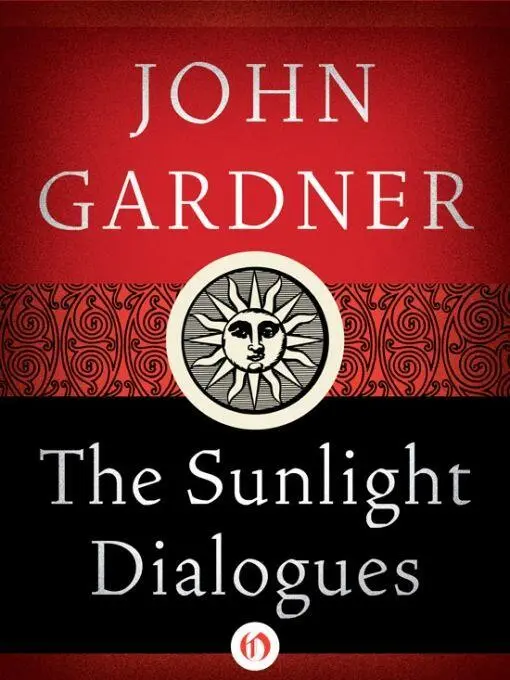
John Gardner - The Sunlight Dialogues
Здесь есть возможность читать онлайн «John Gardner - The Sunlight Dialogues» весь текст электронной книги совершенно бесплатно (целиком полную версию без сокращений). В некоторых случаях можно слушать аудио, скачать через торрент в формате fb2 и присутствует краткое содержание. Год выпуска: 2010, Издательство: Open Road Media, Жанр: Современная проза, на английском языке. Описание произведения, (предисловие) а так же отзывы посетителей доступны на портале библиотеки ЛибКат.
- Название:The Sunlight Dialogues
- Автор:
- Издательство:Open Road Media
- Жанр:
- Год:2010
- ISBN:нет данных
- Рейтинг книги:4 / 5. Голосов: 1
-
Избранное:Добавить в избранное
- Отзывы:
-
Ваша оценка:
The Sunlight Dialogues: краткое содержание, описание и аннотация
Предлагаем к чтению аннотацию, описание, краткое содержание или предисловие (зависит от того, что написал сам автор книги «The Sunlight Dialogues»). Если вы не нашли необходимую информацию о книге — напишите в комментариях, мы постараемся отыскать её.
Beautifully expansive and imbued with exceptional social insight,
is John Gardner’s most ambitious work andestablished him as one of the most important fiction writers in post — World War II America.
The Sunlight Dialogues — читать онлайн бесплатно полную книгу (весь текст) целиком
Ниже представлен текст книги, разбитый по страницам. Система сохранения места последней прочитанной страницы, позволяет с удобством читать онлайн бесплатно книгу «The Sunlight Dialogues», без необходимости каждый раз заново искать на чём Вы остановились. Поставьте закладку, и сможете в любой момент перейти на страницу, на которой закончили чтение.
Интервал:
Закладка:
He relit the cold cigar hurriedly and got up to go around his desk to the filing cabinet. He jerked the drawer open. Mess. Have to clean all this up, get organized. Part of the file was in the manilla envelope, where it belonged, but some of the tapes from their examinations of the prisoner were mixed in with other things, and he couldn’t lay his hand on the picture until he tried the drawer below. He called for Figlow, and after a minute he came in.
“Take this,” Clumly said. “Get a copy to the F.B.I, if they haven’t been sent one. Have ’em check the print file. Rush it.”
“Yessir.” He started to leave.
“One thing more.” He sucked at his cigar, crafty, waiting for the butterflies to settle. “This stuff on the desk.” He jerked his thumb toward it. “Get it out of here.”
“It’s mail, sir. What shall I do with it?”
“Who knows? Give it to the Boy Scouts. Send it to the Mayor and let him draw pictures on it.”
Figlow was wincing, his hand closed lightly around his tie, fiddling with it.
“Oh hell,” Clumly said. “Then leave it where it is.” He gestured toward his visor, still holding the cigar, and Figlow returned the salute. As Figlow reached the door Clumly stopped him. “Word from Miller?”
“Nothing much. A question for you. Wants to know if you want pawnshops checked for the clothes.”
“Certainly.”
Figlow shrugged, but he put off leaving. “You think it was kids, then?” he asked.
“Epidemic of it,” Clumly said. “You know that yourself. A sign of the times.” He pushed the drawer shut and leaned on it. “What’s the matter, don’t you read the papers? All over the world there’s kids gone wild. Sweden for instance. Juvenile Delinquency’s tripled in the past fifteen years … main age of offenders is fourteen. Thefts, burglary, willful destruction of property, the same as Batavia. And the same kind of truck. Clothes, office equipment, things like that. Or they vandalize public telephones, park benches, schoolrooms, playgrounds, bus seats. Police can’t solve but a third of the cases. Talk about car thefts! Thirty thousand cars in the past five years — in five years a fifty per cent increase. And why? Well I’ll tell you what the article says — a piece in Look. Urbanization, the rapid growth of towns. Unemployment. Parents have been raised in the country or in towns like Batavia use to be, and they got small-town or country values, but the kids want to live the way city kids live, or the way they think they do. They think cities take toughness, and so pretty soon the kids are at war with the parents, as well as with everybody else. Psychologist’s opinion. I recommend you read it.”
“And that’s what it was tonight, eh?” He was so incredulous he took the cigarette out of his mouth.
Clumly waved. “All over the world, Figlow. Even in Russia and China, where the cops outnumber the people. Take Leningrad. The vodka sales went up thirty per cent in the past five years, almost all the increase to juveniles. When the cops ask the drunk-and-disorderlies why they did it, over sixty per cent of them say it was ‘for kicks.’ Little thing, you thinking? You thinking, Anybody can get stoned? Fifty-eight per cent of the criminal offenses in Leningrad this year were committed by drunken kids. And what are the offenses? They steal clothes and office equipment and household gadgets. It was all in the paper. Or they wreck public telephones and park benches and schoolrooms and playgrounds and bus seats. But the reason’s different in Russia, you understand. Capitalist liquor sellers.” He laughed like a murderer. “Or you take London.”
Figlow said, “But this shooting tonight, I don’t know.” Then, detaching himself, replacing the cigarette, “Maybe you’re right.”
Clumly scowled and went over to the window. The light was off in the Mayor’s office now. He sucked at the cigar. Then he turned to study Figlow with small icy eyes. “Right,” he echoed. He laughed. “You think I’m crazy? He cut that telephone wire to give himself two, three extra minutes — the time it would take a man to run to a phone at his neighbor’s. That’s no panicky kid, Figlow. When they check that bullet, they’ll find it’s from Salvador’s gun.” He turned back to the window as though he were finished.
Figlow said, “So it was him.”
Clumly grunted. “Who else goes in and out of locked doors like they were nothing? It was locked when Hodge got there, according to Hodge — I don’t think Hodge has realized the importance of that just yet.”
“How?” Figlow said quietly. “How did he do it?”
Clumly looked up past the firehouse roof at the clouds. The roof tiles gleamed from the rain. “I’m not sure,” he said. “But I’ll tell you my guess. My guess is, he opened the door with Will Hodge’s key.”
“Is it possible?”
“Who knows what’s possible?” He looked at his watch. “I’d better go home. Poor wife will be out of her head.”
In the car he thought: Hodge’s key. It had hardly seemed worth considering until Figlow had asked. But now it seemed beyond speculation. It was not possible, but that was irrelevant. It wasn’t possible, either, for a man who stunk like a backed-up sewer to sneak up on a cop who was sitting at his desk and bind him and gag him and blindfold him and never leave so much as an impression of who the assailant was, though the cop had smelled him often.
“So he’d bathed and changed,” he said aloud.
That too was incredible. Bathed where? At the Y.M.C.A.? The sink in some church? He’d have to have washed his clothes, too. Or changed them. Where?
When he stopped for the light at North Lyon Street it came to him that he wasn’t alone in the car. There was someone crouched in the back seat behind him. Slowly and carefully, heart burning in his throat, he jerked around to look. There was no one. The boy and girl in the car beside his were looking at him, solemn. He pulled the visor of his cap lower and set his jaw firmly. “Little hooligans,” he said. When the light changed the couple took off fast. He thought of switching on the siren and hauling them in. But this was where he turned, thank God. They couldn’t see him any more. In the rear-view mirror the lights of Main Street, though the stores had been closed for hours now, fell away yellow, blue, green, white, like the eyes of watchful dragons.
When he reached the end of his driveway he was afraid to open the garage doors. He didn’t even fight it. Some fights were worth the trouble and some were not. He left the car sitting where it was, locked up, and went up on the porch. He was afraid to look for the newspaper. Why should he? He bent toward the door to listen. The house was all dark. A car came around the Oak Street corner and very slowly passed his house. His heart was hammering. It was the Mayor! But it wasn’t. He slipped the key into the lock and opened the door just wide enough that he could slip his hand in and flick on the light.
“Is that you, Fred?”
She was sitting on the couch waiting up for him, working on that sewing she’d been at all these years. It must be every thing she did on it she had to undo and do over. Her glass eyes glittered.
“Just me,” he said. The strength had gone out of his legs. He sat down quickly on the arm of the couch, the door still open behind him.
“You look sick,” she said. She got up and came toward him. He would have sworn the glass eyes could see.
“Be quiet,” he said. “Listen.”
It was only the rain starting up again, whispering in the leaves. He saw once more the glittering eyes of the dead woman sitting by the wall.
“Just tired,” he said.
“Let me fix you a nice cup of tea,” she said.
Читать дальшеИнтервал:
Закладка:
Похожие книги на «The Sunlight Dialogues»
Представляем Вашему вниманию похожие книги на «The Sunlight Dialogues» списком для выбора. Мы отобрали схожую по названию и смыслу литературу в надежде предоставить читателям больше вариантов отыскать новые, интересные, ещё непрочитанные произведения.



Обсуждение, отзывы о книге «The Sunlight Dialogues» и просто собственные мнения читателей. Оставьте ваши комментарии, напишите, что Вы думаете о произведении, его смысле или главных героях. Укажите что конкретно понравилось, а что нет, и почему Вы так считаете.