John Gardner - The Sunlight Dialogues
Здесь есть возможность читать онлайн «John Gardner - The Sunlight Dialogues» весь текст электронной книги совершенно бесплатно (целиком полную версию без сокращений). В некоторых случаях можно слушать аудио, скачать через торрент в формате fb2 и присутствует краткое содержание. Год выпуска: 2010, Издательство: Open Road Media, Жанр: Современная проза, на английском языке. Описание произведения, (предисловие) а так же отзывы посетителей доступны на портале библиотеки ЛибКат.
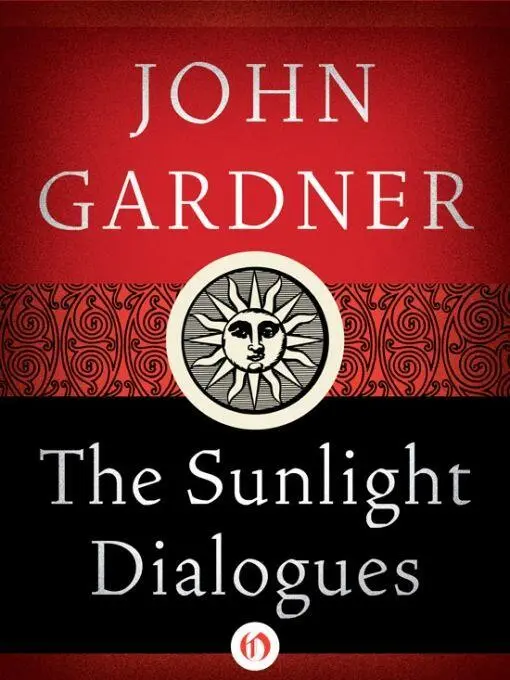
- Название:The Sunlight Dialogues
- Автор:
- Издательство:Open Road Media
- Жанр:
- Год:2010
- ISBN:нет данных
- Рейтинг книги:4 / 5. Голосов: 1
-
Избранное:Добавить в избранное
- Отзывы:
-
Ваша оценка:
The Sunlight Dialogues: краткое содержание, описание и аннотация
Предлагаем к чтению аннотацию, описание, краткое содержание или предисловие (зависит от того, что написал сам автор книги «The Sunlight Dialogues»). Если вы не нашли необходимую информацию о книге — напишите в комментариях, мы постараемся отыскать её.
Beautifully expansive and imbued with exceptional social insight,
is John Gardner’s most ambitious work andestablished him as one of the most important fiction writers in post — World War II America.
The Sunlight Dialogues — читать онлайн бесплатно полную книгу (весь текст) целиком
Ниже представлен текст книги, разбитый по страницам. Система сохранения места последней прочитанной страницы, позволяет с удобством читать онлайн бесплатно книгу «The Sunlight Dialogues», без необходимости каждый раз заново искать на чём Вы остановились. Поставьте закладку, и сможете в любой момент перейти на страницу, на которой закончили чтение.
Интервал:
Закладка:
“I said, look,” he said. All righteousness.
As if casually, she turned her head.
Nothing she saw shocked her. She had expected and grown used to it long ago. She had planned it, in a way, or so it seemed to her now — as to him. She had perhaps begun planning the destruction of Stony Hill years before she knew she was going to get it from the Hodges and sell it for trash. Though she knew there were people living there — the Negroes Will Jr had found for her when she wanted to sell it — it looked abandoned, the wind-wrecked remains of a farm no longer fit for an Arab to pitch his tent on, or a shepherd to put up his sheep in. Only a small patch of the wide, sloping lawn was mowed, a square directly in front of the balustered and pillared porch. The rest of it, to the left and right and rising beyond the deeply shadowed walnut trees to the nearest of the barns, was grown up like fallow pasture except for, here and there, a burnt-out black patch where it looked as if some dragon had recently lain. The globes she remembered on the lightning rods of the three barns visible from the driveway gate were gone now, the rods themselves crooked or broken off. The high, square silo was precariously tilted, and patches of siding were missing from the barn walls. But the house was worse. The pillars on the front porch were gouged as if by woodpeckers, there were squares of cardboard in some of the windows, nothing was painted, nothing any longer upright. A wide new door had been neatly sawed into the side of the house, the wooden frame left unpainted, and over the gap hung a Sears Roebuck aluminum screen with a large italic M. There were toys lying here and there in the grass, half hidden — a mud-caked bicycle, a rust- and oil-blackened wagon — on the porch steps a naked, headless doll. In the shelter of the wide old walnut trees there was a black Cadillac with a heavily pitted chrome visor.
“It must give you great satisfaction,” Luke said.
Her anger rose sharply, but she said, “You’ll never know the half of it.” She sounded calm and collected. A place for doleful creatures, a dance of satyrs.
He shifted into low and the truck jerked forward. He was squinting badly, and, precisely though Millie Hodge understood the familiar chaos of her emotions, there was nothing she could do against the touch of nausea rising and growing inside her like ugly weather. It was unreasonable that she should be asked to regret for his sake what had nothing whatever to do with him, nothing even to do with his father, little as Luke might understand that; and unreasonable that merely because she was there she should be asked, required, to endure his childish and confused vengeance for wrongs in which she had no part. He was a baby, a twenty-two-year-old baby: the slightest cut, the slightest affront, and home he came howling to mother, the source of all grief. I’m sick of it, she thought, but even as she thought it she knew it was rhetoric.
(She had waited in the livingroom, pretending to read the novel that had come from an old friend, male, that afternoon, knowing Luke would be purposely late and carefully not worrying when the time they had agreed on came, but worrying in spite of that, growing angrier with the passing of each of the minutes she had known would pass, because Luke was childish — she could never be sure how childish — and because she, Millie Hodge, self-regarding bitch, as she described herself, invincible to all reasonable and honest attacks, had been forced again into the silly and degrading role of poor suffering Mama. He had been betrayed by his Indian boy; he’d broken out of jail. The minute she’d heard it — Ben Hodge had told her, stopping by with some of that honey from his bedroom wall (inedible, as always, yellow-gray and specked with unidentifiable pieces, wings maybe) — she had known she was in for trouble. Within half an hour — Ben Hodge was barely out the door — Luke had called, asking if she’d come to supper. “Why Luke!” she’d said coyly, well aware that the girlish act repelled him, but not aware until later just why she’d turned it on. Luke had ignored it. So far he was only upset, he hadn’t yet distorted the Indian boy’s trifling betrayal of Luke’s ridiculous faith into something cosmic, unavengeable except on his mother. Or at any rate — since he’d called, after all — he had only just now begun to distort it. There was a pause, after she’d accepted — no sound but the inevitable humming and clicking of Luke’s country line — and she had said sympathetically, “Ben was here. He says Nick’s broken out of jail.” Luke had said, “Yeah. Bastard.” That was all. But she had known (waiting like Whistler’s Mother in the livingroom) what Luke’s irritation would lead to. When he arrived not in the car but in the pick-up truck — but at least, thank God, it wasn’t the semi — she knew he was angrier than she’d expected, and she’d taken a quick Miltown before going out to him. She’d said only, “Hail the late Mr. Hodge!” “Car wouldn’t start,” he’d said. She’d said, “No, I imagine.”)
They had crossed Route 20 and were climbing the Attica hills, toward Luke’s farm overlooking the Attica Prison.
She said, half by accident, “Beautiful time of day.”
“I hadn’t noticed,” he said.
“Well do notice. Don’t be a philistine.”
“Oh, I come by it naturally enough.” He stared fiercely ahead, fists clenched on the steering wheel; and almost without thinking, as lightly and quickly as she’d have swatted a fly, she said: “Not on my side.” Instantly she saw she’d cut deep, and she realized what she’d realized before and conveniently forgotten a thousand times, that Luke could cut, but he couldn’t take it — or no, worse: he couldn’t even cut; would say merely childishly snippy things so far from the mark that they carried no sting, then would wither at just one word from her because she knew every sore spot he had, all sixteen hundred and six of them and all with one name: Father.
“You,” he said, choking, “what would you know?”
“Skip it,” she said. He was speeding up though, taking the curves too fast already — the cars on the lower road, half a mile down, had their lights on, and the sky, the creek far below them, the dirt road ahead of them were gray, the hills, stretching away toward the town of Wyoming, black. In studied slow-motion she got out a cigarette and lit it. “Why do we put up with each other?” she thought. But the time wasn’t right for saying it. “It’s turning out to be one hell of a date,” she said.
“Stop it,” he hissed.
I exist; and nothing else. No one sees me.
(Seven-thirty, according to her watch. If she hadn’t had to come hold Luke’s hand she’d be riding up the Thruway now with Sol Ravitz, to the lecture at Buffalo U. She’d be sitting laughing and smoking and talking, telling him he hadn’t the faintest idea what Plato meant by imitation, because Sol liked being attacked head-on — and because it was true, he really was all confused about Plato — and she would feel unnaturally alert, alive, both her body and her mind; would be conscious — as though she were balanced on a tightrope — of the distance between himself and her and the distance between herself and the door on her side: conscious that she smelled good, that when he glanced over at her she was pretty, so that sooner or later it would occur to even Solomon Ravitz that perhaps after the lecture and the drinks, coming home along the Niagara River or driving through the park, they might stop for a little; she might not take offense. She thought, I have my world. They had come, in her mind, to where blue-white lights splayed over the Thruway, impersonal and stark as the lights at the prison, to their left and right the outlines of tall buildings, the lights on the far-off office windows as precise and clean-cut as stars. The night air would be thick and warm, tinged with the smell of the chemical plants a mile away, and with the city all around them, the cold lights on the pavement, the car would be cozier than ever, the conversation full of overtones Sol would not yet be catching. “It’s absurd to trace art to ritual,” she said. “It’s as silly as saying sex began as religion.” He glanced at her, smiling. It came to her that what she was saying was truer than she’d realized at first. “Art and sex are very much alike,” she said. “I suppose the similarity is the reason for Freud’s mistake.” “What I like about you is your humility,” he said. She blew smoke at him and laughed. When she reached to the ashtray to scrape off her cigarette her hand was less than four inches from his, and she concentrated on the flutter of excitement she felt, wondering if he too felt it now and whether he ever felt it any more with his fat, stupid wife. It was impossible that he should, she knew. Perhaps he was not repelled by her, as she had been repelled for God knew how long, living out her best years with Hodge. But the thrill was dead, inevitably; created to die from before the beginning, like all illusions, and impossible to revive except feebly, momentarily, when one happened to be made jealous. “Love is revolt,” someone had told her — Stanley Burrish, when they met in San Francisco three years ago — and it was true. A flight from the humdrum, from reality: you shucked off all you had been before and the world that went with it, you became the enemy of the universe and imagined your lover to be another just like you, and so for a moment the two of you were free, lifted out of all ordinary dullness, out of the old vulnerability, became godlike or childlike or a little of both, and the world, no longer a fence around you, was beautiful. So that love was doomed, the new world sickened like the old. Move on. She stood in a white dress waiting at the underpass, half a mile from the paintless tenant-house where her father sat on the porch staring, spitting sometimes, his mouth sunk until the tip of his nose almost touched his chin, cracks of black dust encircling his neck, a ne’er-do-well, but no worse than her mother who whined and cried and peopled the yard with worthless Jewels, the boys doomed to tenant-farming like their father, or to factory work, or to working as guards at the Attica Prison, the girls doomed to whining and childbirth and sour old age: but not Millie, waiting in a white dress, standing erect and dignified (she was sixteen), as casual and as wide awake as a lynx. She knew the lights of the Hodge Pierce Arrow the minute they appeared at the top of the hill, and she put her hand out awkwardly, as though she did not know how to hitchhike. She waited until they had already seen her before she smiled as if with pleased surprise. More often than not it would be Ben, and he would tip his cap grandly, like his father at election time, and say, “Millie Jewel!” as though he too were surprised. Ben was a year older than she was, in Millie’s opinion the most beautiful boy on earth. He drove with his left hand clinging to the windshield post, all the windows wide open, the leather top roaring behind her ears, his right hand not closed on the steering wheel but walking it with his fingertips. He would say, “Where tonight?” “To class,” she would say, and he would smile, kind, as though there were a sweet, sad secret between them, and she would think, terribly moved, Oh Ben, Ben! but would stay where she was, pressed to her door, erect and polite, smiling.
Читать дальшеИнтервал:
Закладка:
Похожие книги на «The Sunlight Dialogues»
Представляем Вашему вниманию похожие книги на «The Sunlight Dialogues» списком для выбора. Мы отобрали схожую по названию и смыслу литературу в надежде предоставить читателям больше вариантов отыскать новые, интересные, ещё непрочитанные произведения.





Обсуждение, отзывы о книге «The Sunlight Dialogues» и просто собственные мнения читателей. Оставьте ваши комментарии, напишите, что Вы думаете о произведении, его смысле или главных героях. Укажите что конкретно понравилось, а что нет, и почему Вы так считаете.