John Gardner - The Sunlight Dialogues
Здесь есть возможность читать онлайн «John Gardner - The Sunlight Dialogues» весь текст электронной книги совершенно бесплатно (целиком полную версию без сокращений). В некоторых случаях можно слушать аудио, скачать через торрент в формате fb2 и присутствует краткое содержание. Год выпуска: 2010, Издательство: Open Road Media, Жанр: Современная проза, на английском языке. Описание произведения, (предисловие) а так же отзывы посетителей доступны на портале библиотеки ЛибКат.
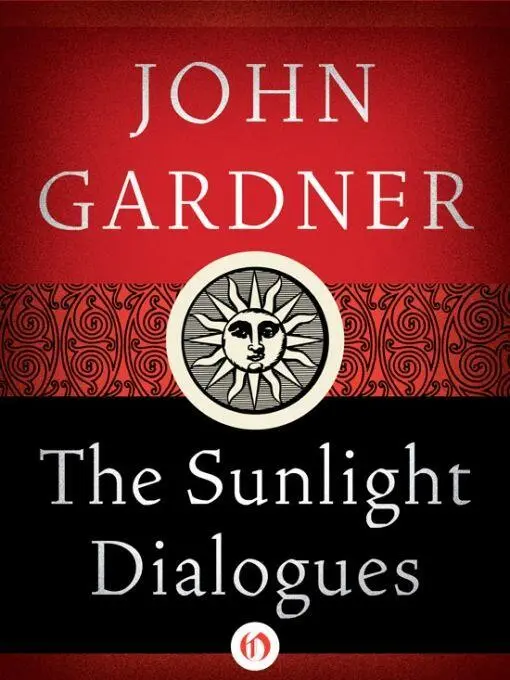
- Название:The Sunlight Dialogues
- Автор:
- Издательство:Open Road Media
- Жанр:
- Год:2010
- ISBN:нет данных
- Рейтинг книги:4 / 5. Голосов: 1
-
Избранное:Добавить в избранное
- Отзывы:
-
Ваша оценка:
The Sunlight Dialogues: краткое содержание, описание и аннотация
Предлагаем к чтению аннотацию, описание, краткое содержание или предисловие (зависит от того, что написал сам автор книги «The Sunlight Dialogues»). Если вы не нашли необходимую информацию о книге — напишите в комментариях, мы постараемся отыскать её.
Beautifully expansive and imbued with exceptional social insight,
is John Gardner’s most ambitious work andestablished him as one of the most important fiction writers in post — World War II America.
The Sunlight Dialogues — читать онлайн бесплатно полную книгу (весь текст) целиком
Ниже представлен текст книги, разбитый по страницам. Система сохранения места последней прочитанной страницы, позволяет с удобством читать онлайн бесплатно книгу «The Sunlight Dialogues», без необходимости каждый раз заново искать на чём Вы остановились. Поставьте закладку, и сможете в любой момент перейти на страницу, на которой закончили чтение.
Интервал:
Закладка:
Hodge nodded. “Salvador,” he said.
The fat woman to Sprague’s left turned to look at Hodge angrily. She turned away again at once and hissed to the woman beside her, “Salvador.”
“They don’t train ’em right,” Sprague said. “Whole town run by graft. Whole durn country run by graft. Dang Democrats must be out of their minds. Put a Baptist cowboy in the White House.”
The angry woman turned her head again. “What you saying about Democrats?”
“I said they’re crazy, ma’am,” Sprague said. He touched his hatbrim. “Ain’t that so, Counsellor?”
Hodge nodded absent-mindedly and started for the steps.
Clumly was at his piled-deep desk, slyly pretending to read the Sunday funnies as if he had nothing on earth to do — as if the crowd in the outer office had nothing whatsoever to do with him. He glanced up then down at the paper quickly, pretending he had not bothered to look up, and for a moment Hodge was — for no real reason, it seemed to him the next moment — furious. What the devil was Clumly up to? But Hodge kept his temper. This was no time for fury. That was one of the things you learned at Law, the ability to choose the time. He said, “They said it was Salvador.”
Clumly nodded, looking up now. His eyes were ice.
“What happened?”
“Who knows? He was here alone, just one other man, at the desk. Sunday and all. Your boy knocked out the man at the desk and tied him up and got the cell door open some way or another — it was shut again when we come in — and Salvador must’ve pulled his gun, only he didn’t have sense to use it. Your boy got hold of it, tipped it up, maybe. Anyway, he was shot up through the chin.” Clumly pointed, tipping his head back. “Come look.”
He got up from the desk and led Hodge to the hallway leading to the cellblock. (It was almost empty now. Two policemen, a Negro, one man in a suit, maybe from the paper.) As soon as the hall door was open Hodge caught the smell. It was like the heavy scent of cow’s blood, the smell that had filled the slaughterhouse at Stony Hill. When he looked, the stuff was everywhere, sticky now, like dark paste — a wide puddle on the floor, stains on the wall, even spots on the ceiling. One of the cops — it was Clarence Pieman — and the Negro called Baltimore, were just beginning the cleaning. Hodge looked, jaw slung forward, and felt, strange to say, nothing. He was intensely aware of the sharp separation of bloodstain and wall, aware of the sharp lines in the tile, the stipple of the gray plaster, the smell; but every trace of the fierce churning of emotion that had sickened him before was gone. He felt, mainly, a keen curiosity more scientific than morbid.
“Poor devil,” he said soberly, shaking his head.
He removed his glasses to polish them, then replaced them and bent forward to look more closely.
Clumly rubbed his hands. He had that vague look again, like a man with grave responsibilities who’s forgotten where he is. “It must have been something,” he said. “He must have stumbled around like a chicken with its head cut off.”
“I was thinking that too,” Hodge said.
“It must have been something for the boy, eh?” Clumly said. “Think of it!” He scowled then, musing, perhaps thinking of something else entirely. “He must have gotten blood all over him. Blood all over the gun, too.” He glanced at Hodge. “Just the same, he took it with him.”
“The gun?”
Clumly nodded, suddenly back to reality and dangerous. His eyes came into focus on Hodge’s jaw and seemed to lock there. At last he put his hand on Hodge’s arm and turned him back to the office.
“Any idea where he went?” Hodge said.
“Vanished like smoke.” He touched his nose. “It’s as if he had somebody out there waiting for him. We’ll find him, of course. No worry about that. Have a seat.”
Hodge lowered himself into the chair by the desk while, behind him, Clumly crossed to the outer office door and talked to one of the men. Hodge’s chest and back and arms were pasted to his shirt. The fat he carried made him sweat more than most men. He only half-listened to the talk in the outer office, trying to adjust in his mind the irreconcilable images — the new man, Salvador, as he’d seen him last, filtering coffee through a piece of screen, and that other image, too intense for ordinary reality, the blood-spattered hallway. The man in the outer office said they had reached Mickey Salvador’s family. Clumly came back, and behind him a short, middle-aged policeman with a pink face, no chin. The man leaned against the desk and crossed his shins and switched on the tape recorder. Clumly began his questions; Hodge answered mechanically.
Not even Clumly was really interested in the questions. Sometimes in the middle of a sentence he would pause to fiddle with the knobs on the police radio beside the tape recorder — reports from the State Police at the roadblocks, or men out talking, beating the bushes, circling in on nothing — and sometimes, before Hodge had answered, Clumly would change his mind and say, “No, skip it.” He turned over some papers. He said abruptly “Funny thing, Will Jr’s coming to see you just when he did.”
“Well it’s not exactly—” Hodge began.
But Clumly stood up; the question was not serious. He went to stand by the window, as though the questioning were over, but he didn’t send his man away. He seemed to have forgotten.
Clumly shook his head, tapping the windowframe and looking out. “Kids,” he said. “They must be something, I guess. That younger one I mean, yours. What’s his name? Luke? I imagine there’s times you’d like to wring his neck.”
“He’s a monkey all right,” Hodge said, on guard.
The man watching the tape recorder had not yet switched it off.
Hodge frowned. He tried to hear what they were saying out by the desk.
“They don’t like authority,” Clumly said. Now he was picking at a scab on the side of his hand. “That’s what it is. All anarchists. They’ve gotten to the size of a man, they think they’re grown-ups.” He laughed. It was like laughter coming out of a stone.
“Luke’s no trouble.” Hodge frowned. He had no choice but to play along, see what it was about and say what was so, give the crazy old fool nothing he could blow up out of all proportion for whatever purpose he had in mind. Hodge felt queasy. Any other time he might have laughed at a policeman’s trying tricks on him, trying to throw him off, if it was that. Any other time he might have enjoyed his own art in the foolish game. But just now it made him cross and impatient. He felt, as he’d felt in his own office earlier, alien, turned to stone and put on display. And there was something more, too; some brute fact nagging at his mind like an itch.
“Now stop it, Will,” Clumly said, swinging around to face him. “Luke’s ‘no trouble’! He’s darn near a Communist, that’s what people say. He’s like your other boy twenty times over — the one up in Buffalo, organizing riots.”
Hodge sat up. “That’s slander, Clumly. One more word of that kind and I’ll have you in court so fast your head will swim.” His fat jaw shook.
Clumly shrank back, opening his hands to show his innocence, but his eyes were still hike bullets, and his whole body had taken on an absurd, crafty look. “Now Will,” he said, “take it easy.” He turned to the man working the machine. “Get in there and type this up. Except the last part, wherever the questions stopped. We don’t need that.”
“Type it all,” Hodge said.
Clumly shrugged, sly as a dragon, still mysterious, and Hodge wondered all at once if perhaps the man was merely confused and trying to keep the confusion out of sight. The other man left with the tape recorder. When the door was closed behind him, Clumly pushed his fingertips into his belt and came over to stand facing Will, squinting. “All right,” he said. “What do you think happened?”
Читать дальшеИнтервал:
Закладка:
Похожие книги на «The Sunlight Dialogues»
Представляем Вашему вниманию похожие книги на «The Sunlight Dialogues» списком для выбора. Мы отобрали схожую по названию и смыслу литературу в надежде предоставить читателям больше вариантов отыскать новые, интересные, ещё непрочитанные произведения.



Обсуждение, отзывы о книге «The Sunlight Dialogues» и просто собственные мнения читателей. Оставьте ваши комментарии, напишите, что Вы думаете о произведении, его смысле или главных героях. Укажите что конкретно понравилось, а что нет, и почему Вы так считаете.