John Gardner - The Sunlight Dialogues
Здесь есть возможность читать онлайн «John Gardner - The Sunlight Dialogues» весь текст электронной книги совершенно бесплатно (целиком полную версию без сокращений). В некоторых случаях можно слушать аудио, скачать через торрент в формате fb2 и присутствует краткое содержание. Год выпуска: 2010, Издательство: Open Road Media, Жанр: Современная проза, на английском языке. Описание произведения, (предисловие) а так же отзывы посетителей доступны на портале библиотеки ЛибКат.
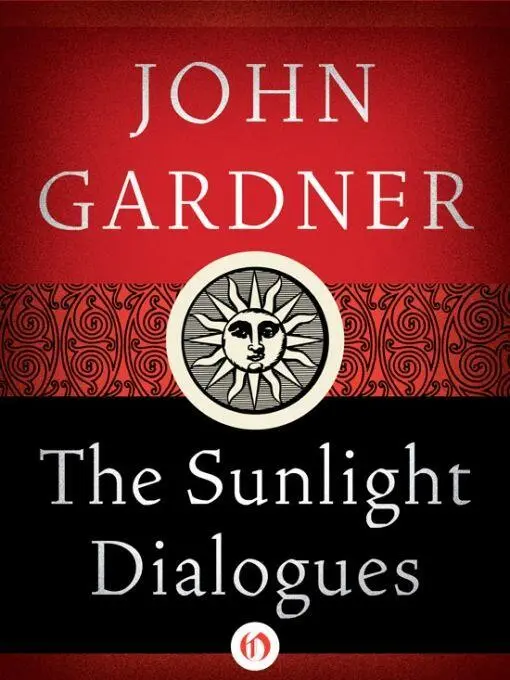
- Название:The Sunlight Dialogues
- Автор:
- Издательство:Open Road Media
- Жанр:
- Год:2010
- ISBN:нет данных
- Рейтинг книги:4 / 5. Голосов: 1
-
Избранное:Добавить в избранное
- Отзывы:
-
Ваша оценка:
The Sunlight Dialogues: краткое содержание, описание и аннотация
Предлагаем к чтению аннотацию, описание, краткое содержание или предисловие (зависит от того, что написал сам автор книги «The Sunlight Dialogues»). Если вы не нашли необходимую информацию о книге — напишите в комментариях, мы постараемся отыскать её.
Beautifully expansive and imbued with exceptional social insight,
is John Gardner’s most ambitious work andestablished him as one of the most important fiction writers in post — World War II America.
The Sunlight Dialogues — читать онлайн бесплатно полную книгу (весь текст) целиком
Ниже представлен текст книги, разбитый по страницам. Система сохранения места последней прочитанной страницы, позволяет с удобством читать онлайн бесплатно книгу «The Sunlight Dialogues», без необходимости каждый раз заново искать на чём Вы остановились. Поставьте закладку, и сможете в любой момент перейти на страницу, на которой закончили чтение.
Интервал:
Закладка:
“Indian Reservation?” Hodge said.
“Yeah!” the young man said with surprising enthusiasm. “I’d appreciate that!” His head bobbed.
He swung the car door open and jumped in, nodding with pleasure, bowing like a Chinaman, and settled the black box comfortably in his lap. Hodge mused. The young man was not an Indian. He was one of those wild young people they have in big cities. “Is that where you were going?” Hodge said.
“Yeah, great!” the young man said, nodding again and grinning and reaching up with a jerk to tip his hat. “I would have been going there if I’d knew.”
Hodge frowned and pulled back onto the road. He stole another quick glance at that hat, the glasses, the metal box. At last Hodge said, “Where are you from?”
“New York,” the young man said. “And San Francisco. All over the place. Things really happening!”
“Mmm,” Hodge said. The boy continued nodding, bobbing his head to some rhythm going on inside it and, after a little while began to whistle. He had a button on his chest beside the trinket. Fun City Needs the Feenjon, it said. The boy smiled, delighted, and leaned toward him and put his finger under the button to turn it so Hodge could read it better, and as Hodge read it again, screwing his mouth toward his right cheek, the boy smiled more broadly still. Then he folded his hands and went back to whistling.
Hodge drove on. There was an excitement in his chest. The boy’s showing up exactly when and where he had seemed portentous — whether portentous of good or bad he could not say. He said, “Excuse me. What are you? That is, are you Amish?” He knew he was not.
The boy nodded with extreme pleasure. “I’m sorry, excuse me. My name’s Freeman.” He reached out with another quick jerk to shake Will Hodge’s hand.
“Ah!” Hodge said. “Yes. My name’s—” For a second he couldn’t remember. “Hodge. Will Hodge. I’m an attorney.”
“Great!” the boy said. “You live around here? And do your practice?”
“Batavia.” He said it with satisfaction, though why he felt so satisfied he could not have explained. The boy’s clownish pleasure in things put a spell on him.
“Great little town! I was in jail there,” the boy said. His hands leaped out to grip imaginary bars and his face filled with horror and amazement. Then he smiled. He bobbed his head again and now he was singing. “Indian Reservation!” he said abruptly. “Great! A visit? Or is that where you do, uh, your thing?”
“Why,” Hodge said, “actually—” It all came flooding back over him, and he felt his jaw go tense. He could feel the young man’s strangely friendly scrutiny, and it made him more tense than ever. As if to make things easier, the boy pulled off the huge black glasses, folded them carefully, and opened the box in his lap to put them away. Inside the box there were compartments covered in red velvet, frayed but still noble, and in the compartments there were objects. There was a carefully shined flute, some brightly colored stones in a plastic bag, some rattlelike things, dried lilypods perhaps, a toothbrush, numerous bits of glass, wire, metal, wood, flower seeds, and plastic. Hodge looked hastily back at the road and jerked the steering wheel to avoid the baked-mud shoulder.
“Excuse me for being so personal,” Freeman said, “but you’re acting — like up-tight. Is that because of me?”
Hodge looked at him in alarm. “No, no,” he said. “Not at all.” They passed bright yellow fields where a week or two ago there had been wheat, and overhead the sky was amazingly blue. The maple trees between the fields and sky were bright green.
“What country!” the boy said. “Psychedelic!” He waved both hands. “I lived in country like this one time, with a friend of mine that’s in Los Angeles now. Kentucky then. But it was different, right”—his hands were describing it. Then, suddenly, he grew still with thought. “Man, you send out bad vibrations. Trouble?”
Hodge felt panicky and angry at the same time. The macadam stretched away ahead of him, straight and blue. It was a startling thing, he was finding out — as Miller and Ed Tank had found out before him — though Hodge didn’t know about that yet. The boy’s queer directness, openness — rudeness it would be in the world Hodge knew — stood outside all the rules he understood. But long before he understood it, Will Hodge felt, perfectly clearly, what it meant: they had dropped — Freeman’s kind — the defenses constructed by centuries of civilization: they did not need them: they had nothing to defend. Only their hats, the clothes on their backs, their toys. Hodge, like any man of sense, might scoff at such notions in the abstract. But there was no resisting that childlike openness except by denying that it was real, and Hodge was not one to deny that the real was real: a cow, a chairleg, the dilated pupil of an eye.
The boy too stared at the road, Hodge knew without looking. “Listening to troubles is one of the special numbers I do,” the boy said. “I can also do a thing where I sit like a toad and mind my business.” When Hodge glanced at him the boy was watching him out of the corner of his eyes, his innocently grinning head tipped forward, meek. His hands and feet seemed to have grown larger.
“Sometimes talk’s no great help,” Hodge said sternly. He watched the yellow fields sliding past, a farmer’s lane with a wooden bridge, a patch of dark woods smoky with fog like the long thin sigh of a dragon, a black-green pond. Like a child, he thought. He’d heard that that was what they were like, though he hadn’t believed it. He remembered the word for them: hippies. Free lovers, he’d heard; yes, like Millie. Except, the boy was all gentleness, not like her. More like a sacrificial lamb or, say, a loyal dog, except that he would take the beating from anybody, not just a master. Like a child, then, that was it. Moving from place to place to duck the draft, maybe, because he wouldn’t kill and wouldn’t fight the Government either. He’d heard they did that. (But the yellow and green land sliding by, so beautiful in the hippie’s eyes, had gophers and gopher-snakes in it, chickens and foxes, cannibalistic fish in every creek, and in a month the bright green trees would be red with death.)
“You have parents?” Hodge said, squinting.
Freeman nodded and suddenly smiled. “They’re beautiful people. Hung up here and there, like anybody, but beautiful.” His head began bobbing again, full of joy.
Hodge drove on, thinking now of his own father, how he’d followed his father through fields and woods, carrying the gun or the bait pail, his child-arm aching from the weight of it and his side aching from walking farther and faster than he could. He was afraid to drop behind. There were wild things out in these woods and swamps, and at night the high hills over his shoulder would furtively change their places.
He thought of the Italian woman mumbling her poem. She’d go on like that for days, the girl had said. A shudder passed through him.
“Life’s strange,” Hodge said grimly.
Freeman agreed. He took off his hat and put it on the box and waited seriously, with his long, violin-shaped nose tilted.
Hodge said, “A woman was murdered in my apartment last night.”
“No!”
“Mm,” Hodge said. But he frowned. That was not the point.
“My father was a Congressman,” he said. “That’s not directly related—” He frowned again. Freeman nodded encouragingly, not pressing. His wide-open eyes were like a doe’s, or like one of the Congressman’s German shepherd cowdogs. “Nevertheless,” said Hodge, “he was a Congressman; good one. He represented — embodied, in fact — almost everything that was, for his time and place—” He winced. He was making a fool of himself with all this talk, he knew well enough. But he said, “Where was I?”
Читать дальшеИнтервал:
Закладка:
Похожие книги на «The Sunlight Dialogues»
Представляем Вашему вниманию похожие книги на «The Sunlight Dialogues» списком для выбора. Мы отобрали схожую по названию и смыслу литературу в надежде предоставить читателям больше вариантов отыскать новые, интересные, ещё непрочитанные произведения.


Обсуждение, отзывы о книге «The Sunlight Dialogues» и просто собственные мнения читателей. Оставьте ваши комментарии, напишите, что Вы думаете о произведении, его смысле или главных героях. Укажите что конкретно понравилось, а что нет, и почему Вы так считаете.