John Gardner - The Sunlight Dialogues
Здесь есть возможность читать онлайн «John Gardner - The Sunlight Dialogues» весь текст электронной книги совершенно бесплатно (целиком полную версию без сокращений). В некоторых случаях можно слушать аудио, скачать через торрент в формате fb2 и присутствует краткое содержание. Год выпуска: 2010, Издательство: Open Road Media, Жанр: Современная проза, на английском языке. Описание произведения, (предисловие) а так же отзывы посетителей доступны на портале библиотеки ЛибКат.
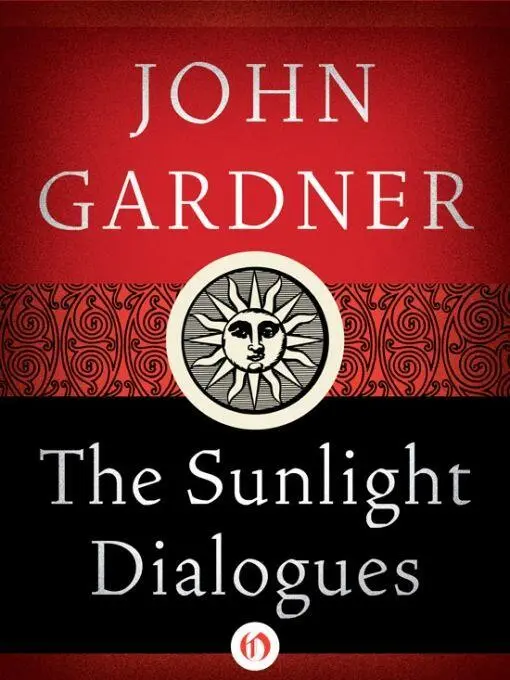
- Название:The Sunlight Dialogues
- Автор:
- Издательство:Open Road Media
- Жанр:
- Год:2010
- ISBN:нет данных
- Рейтинг книги:4 / 5. Голосов: 1
-
Избранное:Добавить в избранное
- Отзывы:
-
Ваша оценка:
The Sunlight Dialogues: краткое содержание, описание и аннотация
Предлагаем к чтению аннотацию, описание, краткое содержание или предисловие (зависит от того, что написал сам автор книги «The Sunlight Dialogues»). Если вы не нашли необходимую информацию о книге — напишите в комментариях, мы постараемся отыскать её.
Beautifully expansive and imbued with exceptional social insight,
is John Gardner’s most ambitious work andestablished him as one of the most important fiction writers in post — World War II America.
The Sunlight Dialogues — читать онлайн бесплатно полную книгу (весь текст) целиком
Ниже представлен текст книги, разбитый по страницам. Система сохранения места последней прочитанной страницы, позволяет с удобством читать онлайн бесплатно книгу «The Sunlight Dialogues», без необходимости каждый раз заново искать на чём Вы остановились. Поставьте закладку, и сможете в любой момент перейти на страницу, на которой закончили чтение.
Интервал:
Закладка:
O friend, my bosom said,
Through thee alone the sky is arched.
Through thee the rose is red;
All things through thee take nobler form,
And look beyond the earth,
The mill-round of our fate appears
A sun-path in thy worth.
Me too thy nobleness has taught
To master my despair;
The fountains of my hidden life
Are through thy friendship fair.
Walter Benson read it again and again, and gradually the world around him was transmuted. All that had been, a moment ago, grim and dangerous and too heavy to bear seemed now mere passing illusion, and what was real was, he thought, the arched sky and the rose and the sun-path, whatever that might be. Tears brimmed up in his eyes.
Something stirred, nearby. He hid the book quickly and glanced around. It was only the Springers’ dog, so he drew out the book again, cautiously, and reread the poem twice, until he’d gotten back his former emotion. His eyes filled once again with tears, and it grieved him to remember what harsh thoughts he had thought about the people he’d passed on his long walk home. He, Walter Benson, was as much a sinner as any of them, he knew. He’d been looking merely at the outer husks, forgetting the inner fountains, as one of his poems said. He read one more time the poem about friendship and suddenly, ardently, Benson wished he had a friend so he could mail the poem to him.
He closed his eyes and gave out a tiny whimper, profoundly at peace with the world, if only for the moment, and two minutes later the pop bottle dropped almost soundlessly from his fingers onto the lawn.
It was dark when Benson awakened. At first he couldn’t tell what it was that had made him wake up. The cold, maybe. Then he saw the car in the driveway. It took him a moment to recognize it. It was the roomer’s car. He remembered the name now: Ollie Nuper. Marguerite and Mr. Nuper were just in the process of opening the door on the back porch — he young and wild-haired and gangly, she old and crippled and fat — and Mr. Nuper had his arm around her, helping her through the door. They turned the back-porch light on. Walter Benson half sat up in the hammock and was just about to shout his greeting when an incredible thing happened. They kissed. He could not believe his eyes, but there was no mistake: they kissed each other as if with youthful passion, she throwing her fat legs apart, he pressing hard against her. Benson felt himself going pale, his hands as cold as ice. I’ll kill them! he thought. They parted then, and Marguerite laughed. Benson was sick with anguish. “It’s an outrage!” he whispered to himself. He meant to leap from the hammock and run up to them, but he continued to sit in complete silence, holding his breath, watching. The back door closed and the kitchen light went on. A moment later, the porch light went off. He whimpered, “Has she no shame?” Then he thought, “I dreamed it! It’s nothing but a dream! I was asleep!” It came to him that he’d said that before. And yet perhaps it really had been a dream. There was no other explanation.
He got out of the hammock without a sound and began to move slowly, furtively, toward the house.
2
It was a night Walter Benson would never forget. Though a professional thief, he was, in point of fact, a perfect innocent, a babe in the woods. He had heard there were people like Ollie Nuper in the world (had heard once of a rich doctor somewhere in Florida who had a huge bedroom done all in red, with paintings of naked people on the walls, and mirrors all around the ceiling) but he had not actually believed it. Who would?
When he reached the back porch the door was locked and the kitchen light was off. They’d gone on into the livingroom. Without a sound, and having not the slightest idea what he really meant to do, Benson opened his jackknife and flipped the doorlatch. He went in, closed the door softly behind him, put the knife away, and stood listening. Mr. Nuper and Marguerite were talking and giggling. They’d been drinking.
“You’re insatiable,” Marguerite was saying. “I never knew such a man!”
Mr. Nuper mumbled something, maybe kissing her or burying his face in her bosom.
Benson curled his lips, but whether with rage or disgust or grief he could not have said. The door to the livingroom was closed. It had no latch, though; he could press it open half an inch and peek in. She was letting Mr. Nuper undress her. She held her fat arms out to the side and had her head tipped up, and Mr. Nuper danced around her like a drunken tailor, unhooking, unbuttoning, unzipping, giving kisses and pats to her bulges as he danced. He was not at all handsome, not at all what one supposes such people ought to be. He had a nose like a sheep’s, with hardly any space from the flesh between his nostrils to the pink of his upper lip. His ears stuck out, his limpid brown eyes were close together, his teeth were full of silver. He was short. His arms and legs were thin and his head was the size of a ten dollar jack-o’-lantern. Benson allowed the door to come shut and leaned against the wall. He ought to have acted immediately. It was too late now, he thought.
When he heard them going upstairs he roused himself and tiptoed into the livingroom where their clothes lay on the rug. He stood at the foot of the stairs rubbing his face with both hands, trying to get his thoughts straightened out, growing more befuddled every minute until finally it seemed to him that he had driven her to it, or worse, that she had endured him all these years only because she’d known nothing any better; he was, beyond any shadow of a doubt, a miserable person, a freak who ought to have been mercifully killed at birth.
They were having a wonderful time up there, making not only the bedsprings but the whole house, as it seemed to Benson, squeak and creak and sway. He went cautiously up the steps and bent his ear toward the door.
“Tell me what you’re doing to me,” Marguerite said.
Benson clapped his hands over his ears and hissed with rage. They didn’t hear him.
It came to him suddenly, with perfect clarity, as though someone right there in the hallway with him had whispered it into his good ear, that even if he himself was partly responsible, it was nevertheless a terrible thing they were doing to him. A terrible crime! He had feelings, didn’t he? And there was his health! They ought to have thought about that! He would kill them! It was what anyone would do! He closed his hand around the jackknife in his pocket. The blade would be too short. But he’d find something. Yes! It was the natural thing! The right thing! He would tear out a post from the banister and go in there and stove their heads in!
But immediately he thought of a great many complications. Nuper was younger and probably stronger than he was, and perhaps, if the whole truth were known, Marguerite was just pretending to enjoy it. Some kind of blackmail, say. Also, his picture would be in the paper if he murdered them, and someone would see it and remember Walter Boyle. Also, it was really his own fault in the first place. His own stupid fault — yes! Tears suddenly welled up into his eyes. Here he was, fifty-six years old, and his whole life was a waste: long, wasted nights sleeping in the Rambler in some unheard-of little town, wasted weeks sleeping in a jail, poring over some newspaper he didn’t care about one bit, and he was getting on in years now — for what? all for what? — and what would they do with no social security coming in? He thought of his father, wasting away on some desert island or some flophouse in Chicago or wherever it was he’d gone when he disappeared, and his poor mother wasting away in the poor folks’ home, and his poor sister wasting away with that brute of a husband the bus driver, who would beat her every Saturday night and walk out on her and the four little children and come back again Tuesday morning, sure as doom. He sat down on the top step to cry but then thought better of it: there was not a sound coming from the bedroom now. The small, familiar pain came over his ticker.
Читать дальшеИнтервал:
Закладка:
Похожие книги на «The Sunlight Dialogues»
Представляем Вашему вниманию похожие книги на «The Sunlight Dialogues» списком для выбора. Мы отобрали схожую по названию и смыслу литературу в надежде предоставить читателям больше вариантов отыскать новые, интересные, ещё непрочитанные произведения.


Обсуждение, отзывы о книге «The Sunlight Dialogues» и просто собственные мнения читателей. Оставьте ваши комментарии, напишите, что Вы думаете о произведении, его смысле или главных героях. Укажите что конкретно понравилось, а что нет, и почему Вы так считаете.