Miljenko Jergovic - The Walnut Mansion
Здесь есть возможность читать онлайн «Miljenko Jergovic - The Walnut Mansion» весь текст электронной книги совершенно бесплатно (целиком полную версию без сокращений). В некоторых случаях можно слушать аудио, скачать через торрент в формате fb2 и присутствует краткое содержание. Год выпуска: 2015, Издательство: Yale University Press, Жанр: Современная проза, на английском языке. Описание произведения, (предисловие) а так же отзывы посетителей доступны на портале библиотеки ЛибКат.
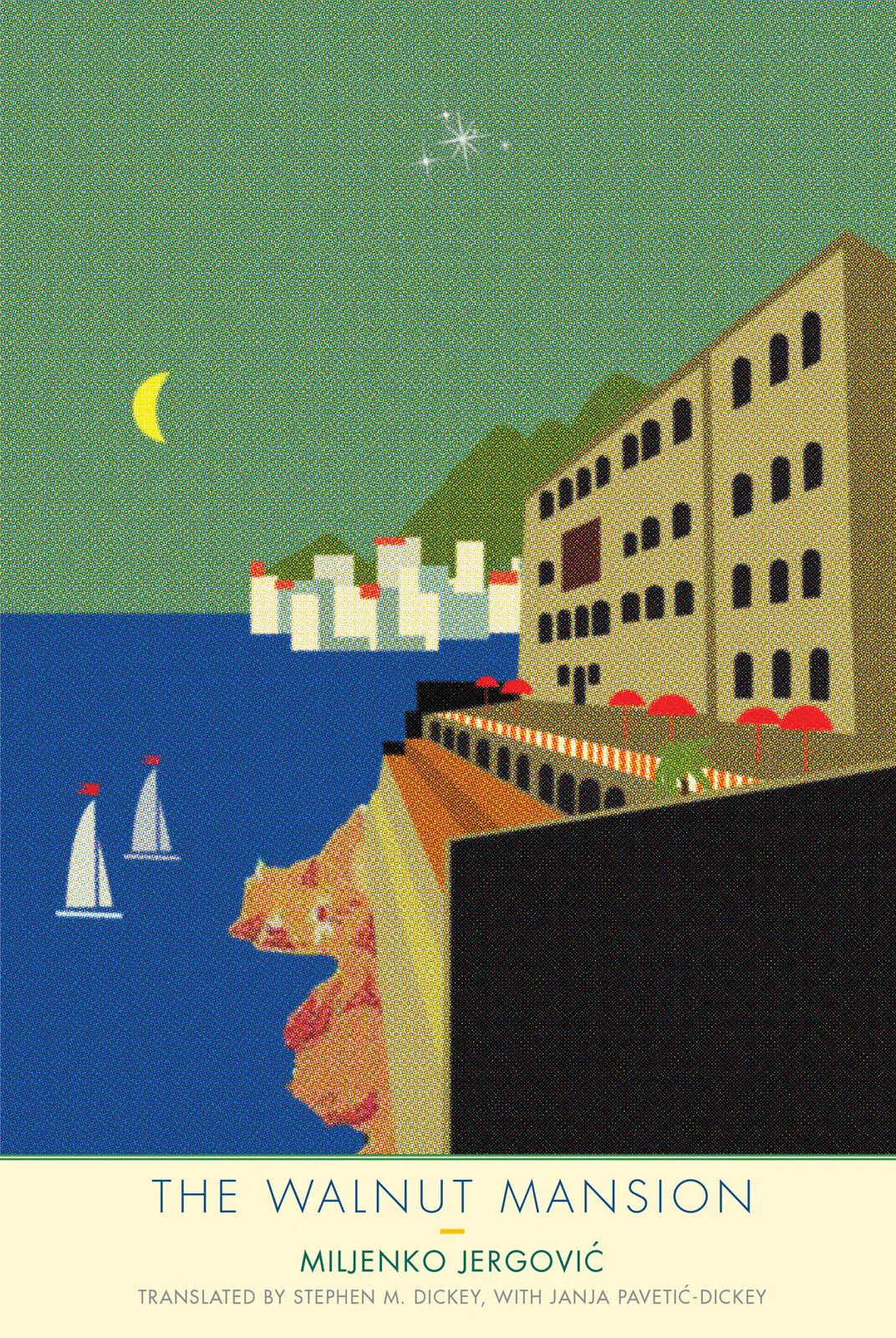
- Название:The Walnut Mansion
- Автор:
- Издательство:Yale University Press
- Жанр:
- Год:2015
- ISBN:нет данных
- Рейтинг книги:3 / 5. Голосов: 1
-
Избранное:Добавить в избранное
- Отзывы:
-
Ваша оценка:
The Walnut Mansion: краткое содержание, описание и аннотация
Предлагаем к чтению аннотацию, описание, краткое содержание или предисловие (зависит от того, что написал сам автор книги «The Walnut Mansion»). Если вы не нашли необходимую информацию о книге — напишите в комментариях, мы постараемся отыскать её.
What is it to live a life whose circumstances are driven by history? Jergovic investigates the experiences of a compelling heroine, Regina Delavale, and her many family members and neighbors. Telling Regina’s story in reverse chronology, the author proceeds from her final days in 2002 to her birth in 1905, encountering along the way such traumas as atrocities committed by Nazi Ustashe Croats and the death of Tito. Lyrically written and unhesitatingly told,
may be read as an allegory of the tragedy of Yugoslavia’s tormented twentieth century.
The Walnut Mansion — читать онлайн бесплатно полную книгу (весь текст) целиком
Ниже представлен текст книги, разбитый по страницам. Система сохранения места последней прочитанной страницы, позволяет с удобством читать онлайн бесплатно книгу «The Walnut Mansion», без необходимости каждый раз заново искать на чём Вы остановились. Поставьте закладку, и сможете в любой момент перейти на страницу, на которой закончили чтение.
Интервал:
Закладка:
Two unusual men thus went through the empty Bosnian countryside, and it was a real pity that there wasn’t a movie camera to film them. The tall one loped ahead; his face was already covered with a pointed beard. A short, hunched one hurried a few steps behind him. The tall one mostly kept silent, while the short one spoke for both of them. If he wasn’t sneezing or moaning, then he babbled on about the meaning and meaninglessness of life, about diseases that fly through the air, and about how it was only a matter of time before you inhaled them. About international relations that had led to that terrible war, about the fact that the proximity of warm seas makes people better, so that Salazar, Franco, and Mussolini could never be like Hitler, and Hitler would have been even worse had he been born in Norway or Denmark. About Winston Churchill, who was living proof that worry and trouble make a person fat (before the war he’d been almost slender, and in the last year he’d become fat as a pig — Klein couldn’t believe his eyes when he saw his picture in the newspaper). About Grandpa Pinto, who was supposed to become a Sarajevo rabbi, but the Jewish market district didn’t want him because he hurried too much and they thought he would try to hurry them. About the tarawih, the longest Muslim prayer, and about wicked priests who, according to his grandfather, had tormented the people with frequent tarawihs. About the fact that he didn’t know at all what kind of prayer that was (nor had his grandfather) and he’d been waiting for years for an opportunity to ask a Muslim what the tarawih was. About the Orthodox, who really overdid their liturgies, which were all longer than the longest Catholic and Muslim prayers. About his own people, who would barricade themselves into the temple and not come out for a whole day. About his sincere wish to be religious, but it didn’t work at all because to be religious a man had to be as naïve as a child and as meticulous as an Old Testament sage (maybe he was somewhat of a child, but he didn’t have anything of the sages in him). About German motors, which were the best in the world, regardless of whether they were put into automobiles, ships, or airplanes — so if Hitler won in the end, it would be because of Germany’s superiority in motors. About the fact that most of the world thought that Germany’s superiority lay in the spirit of Wagner and Goethe, which had nothing to do with reality because German superiority lay in motors. And he would babble on about the Ethiopian emperor Selassie, about the spears that his warriors hurled at Italian airplanes, about desert air being good for asthma, in contrast to jungle air, about his allergy that wouldn’t turn into asthma (although Dr. Weber from Graz had told him that every allergy in the end turns into asthma). About the fact that professional medicine still hadn’t acknowledged the existence of allergies and that you couldn’t find a single word about that condition in medical textbooks (but he knew well that it was the malady of the future and that one day the whole world would suffer from allergies). He also babbled about venereal diseases and the need to have public toilets built in the vicinity of the main city squares, about homosexuals and their depravity, and about how every beauty is meaningless — but why did one have to seek meaning in everything?
Ivo would just listen to him and wonder whether that man had always been like this or whether his garrulity stemmed from nervousness. Or from fear. They say that when one is about to die, his whole life passes before his eyes and he lives his days one more time. Everything is repeated in a single second, in the blink of an eye, and so seventy years of average life fit into a tiny slice of time. It’s packed and pressed like hay when it’s put into bales. Likewise, when someone feels the fear of death, he feels the need to speak and repeat all the words he has ever uttered. Only Klein’s fear lasted a long time. What he said was interesting, although it came in fits and starts, so that his tales couldn’t be remembered, nor could anything be learned from them.
Bosnia looked like empty country all the way to Bihać. They ran into only two or three peasants, who upon meeting them were more afraid of them (probably because of their beards) than Ivo and Klein were afraid that the peasants would turn them in to the police or chop them up with axes. The going was easier at night, not because it was less dangerous — because one could never be sure of that — but because during the day they would grow weary of seeing burned houses and villages, ravaged roads, dead cattle decomposing in ditches, battered army trucks, and discarded bloody uniforms. It gave the impression that it would always be that way or only get worse and that the only thing that would grow again in this land were weeds and wild apple trees, the shoots of which they encountered at every step, as if a wind had blown untold numbers of their seeds everywhere.
But no matter how dead and destitute Bosnia was, you wouldn’t starve there. Every other plant was edible. Every few kilometers there were fallow potato fields. In neglected orchards fruit grew abundantly, like wild vegetation; it bloomed out of season, not according to any calendar or changes in nature, as if it were crazed by the fact that it hadn’t been picked.
“Bosnians believe that nature brings forth its fruit best in the years of the worst war,” Klein said as they were picking overripe pears and swatting away wasps and wild bees at dusk on a height offering a panoramic view of Bihać.
“Bosnians believe in anything and everything,” Ivo responded. “Whatever happens, it turns out they’ve already believed in it. I know them well. A guy named Hilmo was with me for a while, a sailor from Zvornik! He was twenty when he stuck his finger in the sea for the first time and was twenty-one when he sailed on a transoceanic ship. That Hilmo was a good guy, but nothing could happen that he didn’t already know about. If a storm arose, and a storm on the Pacific is something that no living man can imagine, Hilmo would shrewdly conclude that it had been clear earlier that there would be a storm because his ring finger had been itching all day long. And as soon as your ring finger is itching, it can only mean that there’s going to be a storm on the Pacific. If the sea was as smooth as a mill pond, Hilmo would say, of course, I knew it; my left eye didn’t twitch for three days for nothing, and when someone’s left eye twitches, that means that you’ll be able to burn a candle outdoors. Hilmo could explain anything, I mean anything that happened on the ship, with his magic and omens. That annoyed me a little, and I told him it was easy: a storm arises, and he says he knew about it yesterday. So why didn’t he tell us yesterday? Because you didn’t ask. I told him, well, you’ll be hanging from the mast the next time your ring finger itches and you don’t tell me. And I waited in anticipation for the next storm, just so I could watch him squirm. Just imagine me as a sailor waiting for a storm, all for a joke and a prank. That’s youth for you! And you know what happened? The next day we almost drowned. That was the biggest storm I ever experienced at sea. Not far from the shores of Australia. Men wept, prayed to St. Anthony, and no one thought we’d come out of it alive. But Hilmo, you see, knew. That’s a Bosnian for you. There was nothing he hadn’t believed in before it happened. And what benefit do they get from it?!” he asked, pointing with his hand at a burned, dead village, as if that village were the best confirmation that Bosnians didn’t have a lick of sense. They knew their destiny in advance but didn’t do anything to avoid it.
In early evening they lay down for a bit in the attic of one of the more intact houses. Their plan was to sleep until midnight and then continue the journey, bypassing Bihać and continuing on toward Kordun. Ivo found some quilts, and they used them to make beds on bare boards, and all stuffed with pears, they fell asleep like two bears as soon as they lay down.
Читать дальшеИнтервал:
Закладка:
Похожие книги на «The Walnut Mansion»
Представляем Вашему вниманию похожие книги на «The Walnut Mansion» списком для выбора. Мы отобрали схожую по названию и смыслу литературу в надежде предоставить читателям больше вариантов отыскать новые, интересные, ещё непрочитанные произведения.











Обсуждение, отзывы о книге «The Walnut Mansion» и просто собственные мнения читателей. Оставьте ваши комментарии, напишите, что Вы думаете о произведении, его смысле или главных героях. Укажите что конкретно понравилось, а что нет, и почему Вы так считаете.