Miljenko Jergovic - The Walnut Mansion
Здесь есть возможность читать онлайн «Miljenko Jergovic - The Walnut Mansion» весь текст электронной книги совершенно бесплатно (целиком полную версию без сокращений). В некоторых случаях можно слушать аудио, скачать через торрент в формате fb2 и присутствует краткое содержание. Год выпуска: 2015, Издательство: Yale University Press, Жанр: Современная проза, на английском языке. Описание произведения, (предисловие) а так же отзывы посетителей доступны на портале библиотеки ЛибКат.
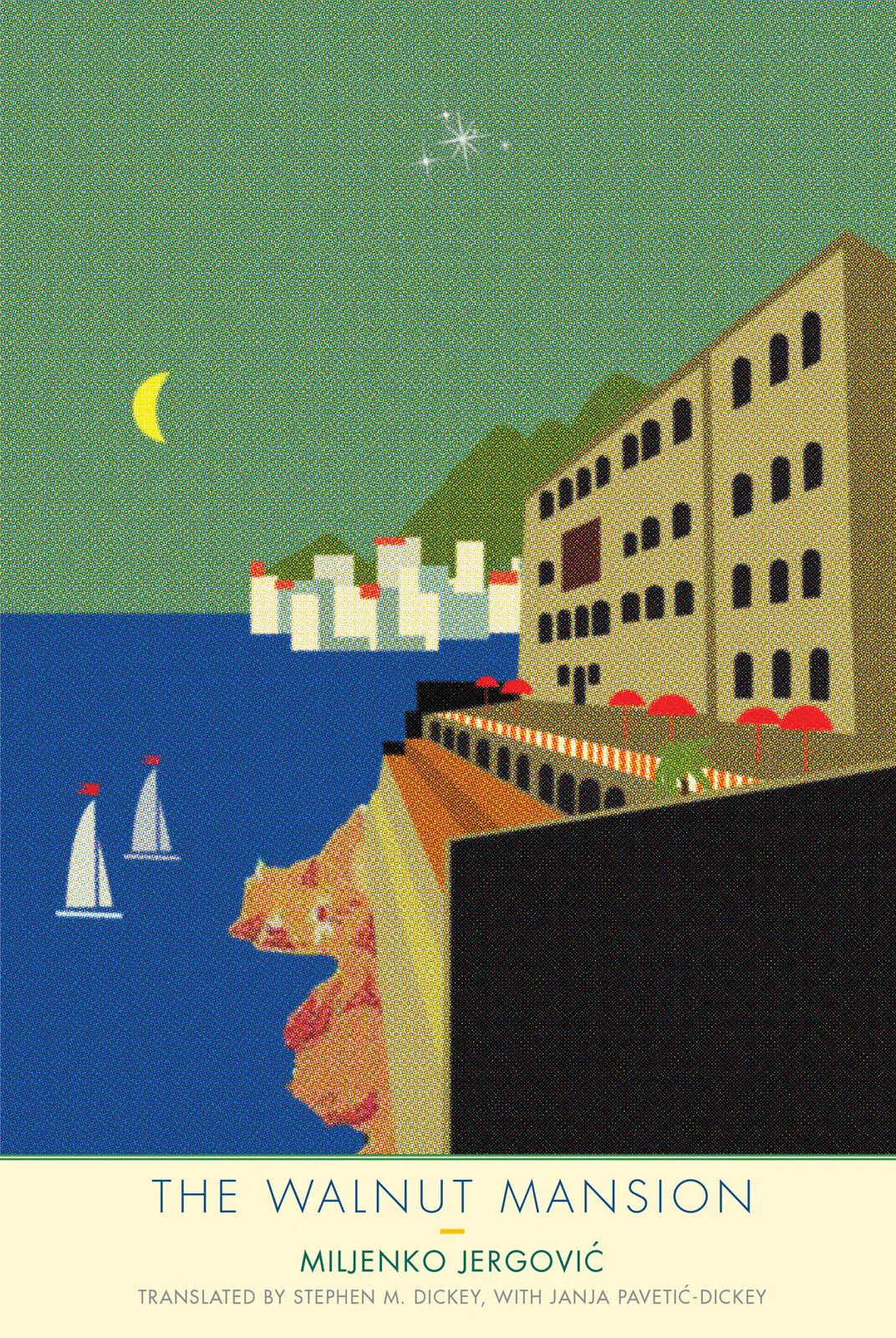
- Название:The Walnut Mansion
- Автор:
- Издательство:Yale University Press
- Жанр:
- Год:2015
- ISBN:нет данных
- Рейтинг книги:3 / 5. Голосов: 1
-
Избранное:Добавить в избранное
- Отзывы:
-
Ваша оценка:
The Walnut Mansion: краткое содержание, описание и аннотация
Предлагаем к чтению аннотацию, описание, краткое содержание или предисловие (зависит от того, что написал сам автор книги «The Walnut Mansion»). Если вы не нашли необходимую информацию о книге — напишите в комментариях, мы постараемся отыскать её.
What is it to live a life whose circumstances are driven by history? Jergovic investigates the experiences of a compelling heroine, Regina Delavale, and her many family members and neighbors. Telling Regina’s story in reverse chronology, the author proceeds from her final days in 2002 to her birth in 1905, encountering along the way such traumas as atrocities committed by Nazi Ustashe Croats and the death of Tito. Lyrically written and unhesitatingly told,
may be read as an allegory of the tragedy of Yugoslavia’s tormented twentieth century.
The Walnut Mansion — читать онлайн бесплатно полную книгу (весь текст) целиком
Ниже представлен текст книги, разбитый по страницам. Система сохранения места последней прочитанной страницы, позволяет с удобством читать онлайн бесплатно книгу «The Walnut Mansion», без необходимости каждый раз заново искать на чём Вы остановились. Поставьте закладку, и сможете в любой момент перейти на страницу, на которой закончили чтение.
Интервал:
Закладка:
It had now been almost four years since the first mentally disturbed officers had arrived at Jagomir, and no one had taken any interest in them. No one had even made any phone calls. The families of the ill partisans didn’t come to visit them either, and so Bepo Sikirić was no exception at all.
But it didn’t matter. Dr. Hoffman didn’t dare violate any of the orders he’d received regarding the partisans. Nor did he have any particular reasons for doing so. The thirty or so of them — twenty of whom had military commissions — could be divided into two groups. The first group consisted of those who saw the enemy at every step and stopped fighting only when they were asleep. In their battles they saved Comrade Tito and Savo Kovačević, forced the Neretva bridgehead and crossed the Sutjeska, changed their names and identities daily, and all behaved the same, without individual features.
The other group consisted of the quiet and peaceful ones. Two of them hadn’t spoken a word since they’d arrived at Jagomir, and nothing apart from their silence indicated that they were mentally ill. And they gladly took part in the springtime cleanings of the park, went to fetch water, and chopped wood. At first Hoffman forbade them from working, fearing that someone might accuse him of humiliating them with menial jobs, especially Major Seid Redža. But then he realized that neither Redža nor Ivan Rukljač (the other one who never spoke and fortunately didn’t have a commission) enjoyed anything besides cleaning the park and going to fetch water. Besides, Hoffman didn’t even believe that either of them was mentally ill. Had it been up to him, he would have sent them home. A man could live and be useful to society even if he didn’t say anything. Redža and Rukljač were living proof that this was true. Sometimes at the end of a workday during summer heat waves, he would sit down with Redža on a bench under the thick treetops, offer him a cigarette, and they would smoke in the peace and quiet, like friends who’d already said everything they had to say to one another. Hoffman didn’t feel like going home because he knew that he would sweat like a pig on his way to Koševsko Brdo, where he lived. It was so pleasant under the old oaks, almost cool, and what sane person would want to go out into the sunlight? If something was bothering him or if he was caught up in all of his fears and sighed a few more times, Redža would give him a hug and smile at him with that wide, self-assured smile from placards that called for volunteers to help construct the Brčko-Banovići railway line. Who would then dare to say that Major Seid Redža was mentally ill?
Different from him and Ivan Rukljač were the Jagomir depressives and suicidal types — that is, a third group, of whom there were six or seven. One had to watch them for days at a time and keep them in isolation so they wouldn’t get their hands on something that they might use to hang themselves or slit their wrists. They loved to talk, especially to Hamdija, because they were terrified of Dr. Hoffman. Because he was the supreme authority, a kind of nuthouse Tito; because he was a Kraut and acted like it; and because he was average height, which for them — mostly Montenegrins and all of them almost six feet tall — was an obvious sign of inferiority. Hamdija made a good impression on them. They called him the “Turkish Archpriest” and didn’t object when he locked all of them up in their rooms. For them he was the acceptable authority to whom they were to submit even if they were fighters and revolutionaries. If it hadn’t been for him, Hoffman would have had a hard time dealing with the depressive element of his partisan unit.
There were also some who did nothing but cry, others who retold tales about the deaths of their sons and daughters, who’d never even existed, and finally there were three of them who were completely oblivious. They had no idea who or what they were; they’d forgotten both the war and their roles in it, as well as Yugoslavia and communism, and were, as Hamdija said, completely peaceful in the absence of their minds. They didn’t bother anyone, nor were they of any use for anything. And you can be damned sure that nothing surprised them.
Bepo Sikirić numbered among the depressives and potential suicides, although he wasn’t in fact downtrodden, nor had he previously exhibited any inclination for suicide. But that was how life was organized at Jagomir: if you weren’t aggressive, then you were a depressive. The fact that you’d never actually been depressive didn’t matter at all because everything revolved around the way life was organized and not around what your illness was.
Along with around twenty civilian patients, not all of whom were even civilians because Franz Hoffman had in his clinic two men who’d gone crazy during the First World War and one non-commissioned officer in the Home Guard who’d been brought to him in 1944, those thirty partisans made up for an unbelievably complex social structure, and its functioning worried the staff at Jagomir for days at a time. Thus, not even Hoffman’s work had a lot to do with medicine and treatment. He could forget most of what he’d learned at the university and rely on the experience he’d gained from head doctor Đuro. Psychoanalytical writings and books, which he’d never ceased to acquire and study, were of no use to him at all. It didn’t matter that after the war Freud’s theories had found their way into the parlors of the most prestigious psychiatrists in Belgrade and Zagreb. He, who read and knew the most about them, didn’t have his own parlor, nor was he in a position to talk at length about his favorite topic. When he would take a week’s vacation, usually in August, he’d lay down his Tidža in the shade under a plum tree in the yard and would play psychoanalyst a little with her, try to hypnotize her, ask her strange questions, and made a mockery of both himself and Sigmund Freud. Actually, he would start out completely serious, and then he would start to realize how little sense any of it made if you did it under a plum tree with your own wife. But no matter how much fun those games were for him and Tidža, in his heart of hearts Hoffman realized more and more that he’d wasted his time because he wasn’t even doing as much as head doctor Đuro had — he prescribed electroshocks and submersion in ice water only rarely. Nor was he utilizing what he believed in and what would tomorrow be the most important psychiatric method throughout the world. At the same time he derived no comfort from the fact that he’d believed in psychoanalysis before others had even heard about it. He had his Jagomir, his little empire that he ruled and with which he eluded all those rebellions and wars and about which no one cared a whit because it didn’t stand in anyone’s way.
“Drink some brandy. There’s no medicine like strong brandy!” he said, trying to bring Regina around, since she couldn’t calm down after seeing Bepo. Hamdija stood at the door and waited for Dr. Hoffman to think of something. He was ready for everything. Even to force-feed the uncooperative colonel, if only his boss concluded that there was no other solution.
“Have a drink, ma’am, please!” he insisted. Regina raised her eyes, and instead of one she saw two old men. He offered her a handkerchief; it smelled of roses. In that smell there was peace, family harmony, and something that had been irrevocably lost in all those wars along with the soul of her Bepo. If she thought about it even for only a moment longer, she would start crying again, and who knew how long it would take for her tears to stop. She blew her nose loudly. That noise was ugly and shameful, but at least she could be certain that she wouldn’t cry any more. The first time she sighed without stopping her sobs. This doesn’t make any sense, she thought, neither sobbing nor burping.
Читать дальшеИнтервал:
Закладка:
Похожие книги на «The Walnut Mansion»
Представляем Вашему вниманию похожие книги на «The Walnut Mansion» списком для выбора. Мы отобрали схожую по названию и смыслу литературу в надежде предоставить читателям больше вариантов отыскать новые, интересные, ещё непрочитанные произведения.







Обсуждение, отзывы о книге «The Walnut Mansion» и просто собственные мнения читателей. Оставьте ваши комментарии, напишите, что Вы думаете о произведении, его смысле или главных героях. Укажите что конкретно понравилось, а что нет, и почему Вы так считаете.