Miljenko Jergovic - The Walnut Mansion
Здесь есть возможность читать онлайн «Miljenko Jergovic - The Walnut Mansion» весь текст электронной книги совершенно бесплатно (целиком полную версию без сокращений). В некоторых случаях можно слушать аудио, скачать через торрент в формате fb2 и присутствует краткое содержание. Год выпуска: 2015, Издательство: Yale University Press, Жанр: Современная проза, на английском языке. Описание произведения, (предисловие) а так же отзывы посетителей доступны на портале библиотеки ЛибКат.
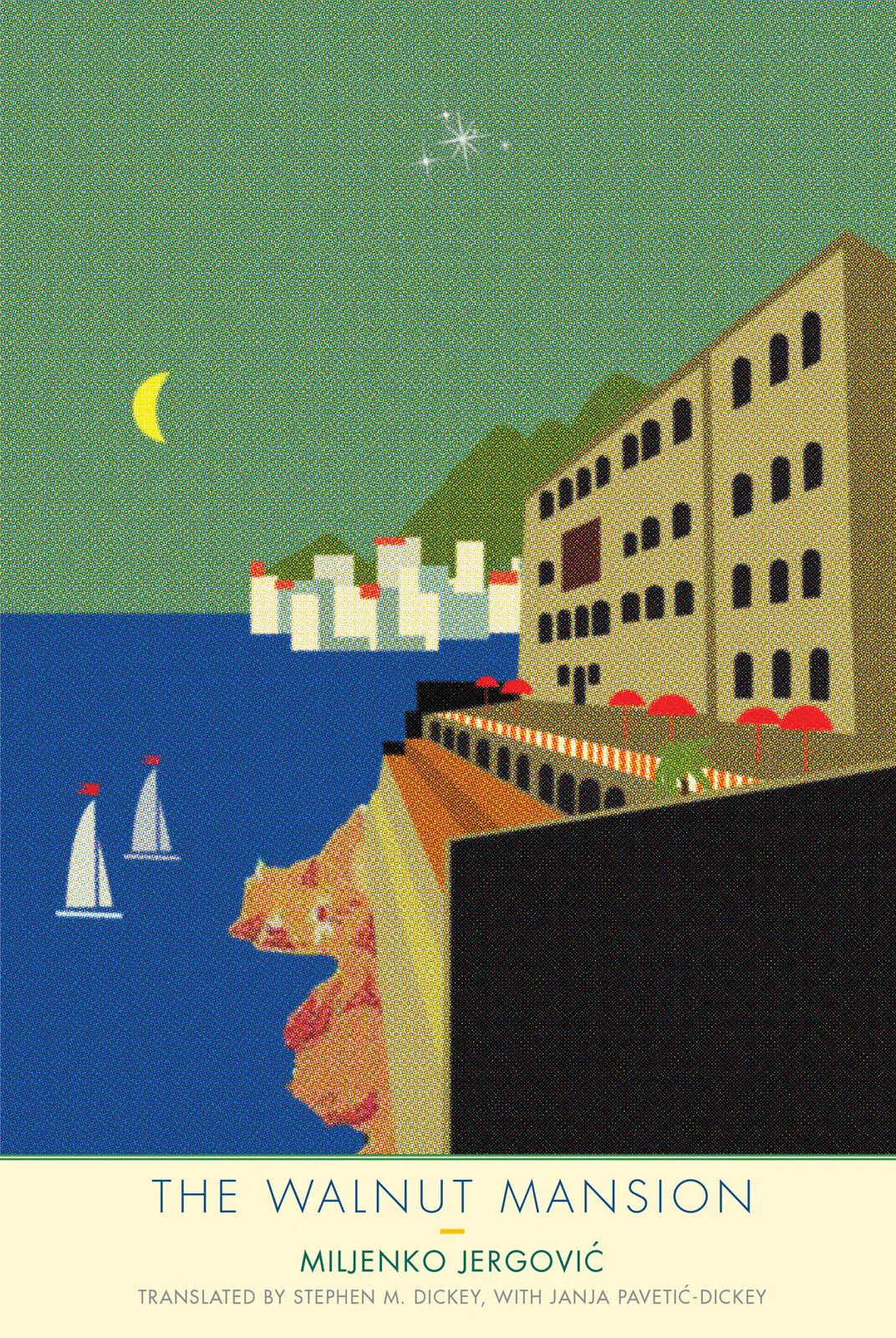
- Название:The Walnut Mansion
- Автор:
- Издательство:Yale University Press
- Жанр:
- Год:2015
- ISBN:нет данных
- Рейтинг книги:3 / 5. Голосов: 1
-
Избранное:Добавить в избранное
- Отзывы:
-
Ваша оценка:
The Walnut Mansion: краткое содержание, описание и аннотация
Предлагаем к чтению аннотацию, описание, краткое содержание или предисловие (зависит от того, что написал сам автор книги «The Walnut Mansion»). Если вы не нашли необходимую информацию о книге — напишите в комментариях, мы постараемся отыскать её.
What is it to live a life whose circumstances are driven by history? Jergovic investigates the experiences of a compelling heroine, Regina Delavale, and her many family members and neighbors. Telling Regina’s story in reverse chronology, the author proceeds from her final days in 2002 to her birth in 1905, encountering along the way such traumas as atrocities committed by Nazi Ustashe Croats and the death of Tito. Lyrically written and unhesitatingly told,
may be read as an allegory of the tragedy of Yugoslavia’s tormented twentieth century.
The Walnut Mansion — читать онлайн бесплатно полную книгу (весь текст) целиком
Ниже представлен текст книги, разбитый по страницам. Система сохранения места последней прочитанной страницы, позволяет с удобством читать онлайн бесплатно книгу «The Walnut Mansion», без необходимости каждый раз заново искать на чём Вы остановились. Поставьте закладку, и сможете в любой момент перейти на страницу, на которой закончили чтение.
Интервал:
Закладка:
Love is the happiness of the poor. The happiness of the rich is made of wealth. And that’s what did in the unfortunate Isadora. She was rich and didn’t think as she was buying the long shawl and loved as poor folk love and wore that shawl so she would be more beautiful for the one who loved her. That’s what Kata thought as she read about the tragic fate of Isadora Duncan, and then two things struck her. It was better to die like her than to live in a world in which no one admires you, in which there are no eyes that will see a miracle in you, that will look at you as at huge groupers taken by trickery, which you see only once in twenty years and whose lives are worth more than the lives of the fishermen on whose tridents they died. And the second thing: you can only be such a woman if God granted that you belong to the beautiful species. If you’re a fish, then he could either create you as a lowly mackerel or sardine or give you the aspect of a heavenly being whose death is the humiliation of its killer. If you’re a woman, then God let you choose for yourself whether you’d be a lowly mackerel or a beautiful grouper. At birth there was no difference between her and Isadora. Kata understood that well. The difference was created by life, which granted to some only that they would bring forth more of God’s creatures, something the church cherished, but which wasn’t really any more important than the work of railway porters. Life granted to other women that they would be actresses and ballerinas whose beauty would be admired by every thinking being. But in order for life to grant you something like that, you had to renounce your faith, your humility, and the prie-dieu that waited for your knees and made you one of hundreds of thousands. Instead of doing that, you waited on heaven even after you realized that there wasn’t any heaven. Just so, out of habit or because it was too late to trade in your life for another. You didn’t renounce what you didn’t believe in, and that was your greatest punishment.
Until one day you read in the newspaper that the most beautiful woman of our time had died, and you realized that you could have saved her if you’d had the strength to save yourself.
She cut out Isadora’s picture from the magazine and put it in the bottom of a box of papers. If there was war or the house burned, that box contained everything with which Kata could claim her right and her children’s right to a new life. And now she’d put something into it that didn’t belong and that in some way— never spoken and so never even molded into a clear thought— meant that she was renouncing them and that they’d become hateful to her. She would still have given her life for them, died once for each child, but she no longer loved them with that pure love of the Blessed Virgin gazing at her infant in a little painting above the altar that was already completely dark from the sighs of a hundred thousand souls that had prayed before it in the last two hundred years. Her renunciation of her own children was Kata’s last and greatest sin. She’d stopped believing in the most touching of all the holy teachings.
The real truth is: Baby Jesus also made a mere mackerel of Mary.
Thus, Kata renounced her offspring, only to have her offspring soon renounce her. There were no words spoken in these renunciations. The children couldn’t have even suspected what had happened, and their mother didn’t learn of their renunciation because she was already dead. Though no one knew anything, the misfortune nevertheless mushroomed with their unspoken feelings, and it would have been easy to follow the fates of all the Sikirićes in line with that. If there hadn’t been that shocking story about the death of Isadora Duncan, published in a Zagreb magazine, if Regina hadn’t left the magazine in the kitchen, and if Kata hadn’t read it, her children would have probably lived and died differently. At this time Darwin’s theory was not yet generally accepted, and the beliefs of the church were entering their greatest crisis in history; almost nothing was known about psychoanalysis, and ideas about historical determinism were concerned only with peoples and states— not with families. But according to all teachings, beliefs, and ideologies, the twentieth century would have passed differently for one family if only the illusion of motherly love had survived.
It would be better if the preceding claim could be made in a more gentle or at least less binding manner because in that way one would avoid the false impression not only of Kata’s strength and greatness, but also the gravity of her final sin (which was more important). But now that her previous sins have been mentioned, it should be clear that this woman wasn’t strong or great and that her soul was full of a little of everything but not much of anything. Completely free of malice, simpleminded, she seemed to have been born at the wrong time. If she’d come into the world a few hundred years earlier, during the Inquisition or the witch trials, she would have been one of those undoubted model women who rendered the agony of the world and her own sex endurable and lent everything a sense of goodness. Maybe she would have ended up as an abbess, a caregiver for lepers and plague victims, because the reliance on the logic and flow of the holy teachings would have given her a strength greater than the strength of real faith. Belief in a fable was, in her case at least but maybe also as a general rule, more powerful than belief in God. People doubt his existence sooner or later because things don’t flow according to some imagined ethical plan, whereas no one can doubt a story. However, since she was born at a time when miracles were no longer born in men’s minds but were created by machines without souls or hearts, there was no benefit in life from belief in a fable. Fate had determined that she would live and die a very confused soul.
She loved her man because that was how it was supposed to be and she didn’t know anything else. Kata didn’t know; maybe some did. But they weren’t her concern. She ran out when women started badmouthing their husbands: some beat their wives; some went out whoring every Friday; some vanished without a trace though they’d said they were just going to Herzegovina for tobacco. . When they started talking like that, and they would start whenever more than two of them got together— during the grape harvest, before a wedding, or after a funeral— it seemed to Kata that every meeting of a man and a woman only brought unhappiness. But it couldn’t be like that, nor should it be! If it was, we should live as if it weren’t. How could those women not know that, and why didn’t they feel pain at least— since they weren’t ashamed— while they were talking about their men like that? She never said an unkind word about her husband. Nor did she have an unkind thought. True, he didn’t beat her or leave the house more than he had to. And he didn’t go to Herzegovina to get tobacco. He sat on a three-legged stool next to the chimney, sorting nails into three wooden boxes and sighing. For twenty years he’d been trying to make sure that the largest were in the first box, the smaller ones in the middle box, and the smallest in the third box. There were many of them— she could have studded her whole house all the way around with them, but even the most languid human being wouldn’t have needed more than two days to put each nail in the right box. Yet he never finished the job.
Only once did she tell him to forget the nails; she would take care of that when she finished her other chores. He looked at her, and a moment— no longer than it took for a swallow to dart through the house— was enough for the thought of offering to help him not to cross her mind ever again. What did she see in those eyes? Certainly not anger. Not even fear. And it couldn’t even be called sorrow. What she saw in the blue eyes of her husband was the same man who would sink when the last nail was in the right box. The man in his eyes was hardly treading water, and the one in the eye of the one in his eye even less, right down to the smallest man one could see, in whose eyes there were at least a thousand more nail collectors, all tinier than particles of flour but marked by the same horror.
Читать дальшеИнтервал:
Закладка:
Похожие книги на «The Walnut Mansion»
Представляем Вашему вниманию похожие книги на «The Walnut Mansion» списком для выбора. Мы отобрали схожую по названию и смыслу литературу в надежде предоставить читателям больше вариантов отыскать новые, интересные, ещё непрочитанные произведения.






Обсуждение, отзывы о книге «The Walnut Mansion» и просто собственные мнения читателей. Оставьте ваши комментарии, напишите, что Вы думаете о произведении, его смысле или главных героях. Укажите что конкретно понравилось, а что нет, и почему Вы так считаете.