Ben Metcalf - Against the Country
Здесь есть возможность читать онлайн «Ben Metcalf - Against the Country» весь текст электронной книги совершенно бесплатно (целиком полную версию без сокращений). В некоторых случаях можно слушать аудио, скачать через торрент в формате fb2 и присутствует краткое содержание. Год выпуска: 2015, Издательство: Random House, Жанр: Современная проза, на английском языке. Описание произведения, (предисловие) а так же отзывы посетителей доступны на портале библиотеки ЛибКат.
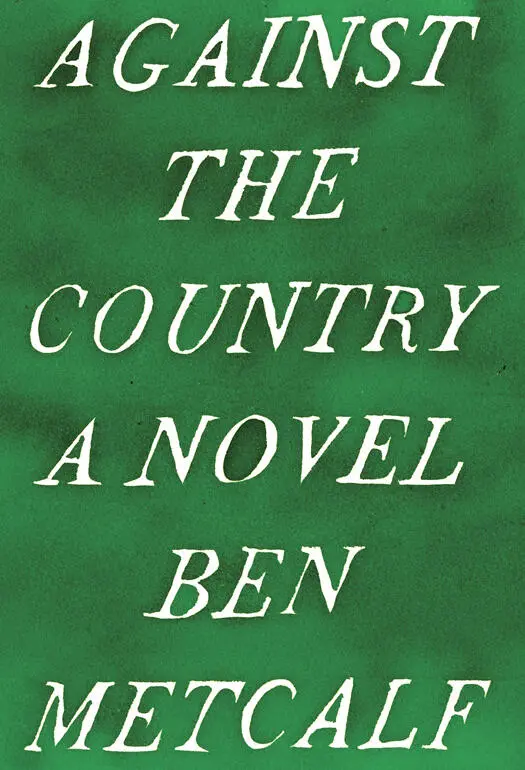
- Название:Against the Country
- Автор:
- Издательство:Random House
- Жанр:
- Год:2015
- ISBN:нет данных
- Рейтинг книги:3 / 5. Голосов: 1
-
Избранное:Добавить в избранное
- Отзывы:
-
Ваша оценка:
Against the Country: краткое содержание, описание и аннотация
Предлагаем к чтению аннотацию, описание, краткое содержание или предисловие (зависит от того, что написал сам автор книги «Against the Country»). Если вы не нашли необходимую информацию о книге — напишите в комментариях, мы постараемся отыскать её.
Equal parts fiery criticism and icy farce,
is the most hilarious sermon one is likely to hear on the subject of our native soil, and the starkest celebration of the language our land produced. The result is a literary tour de force that raises the question: Was there ever a narrator, in all our literature, so precise, so far-reaching, so eloquently misanthropic, as the one encountered here?
Against the Country — читать онлайн бесплатно полную книгу (весь текст) целиком
Ниже представлен текст книги, разбитый по страницам. Система сохранения места последней прочитанной страницы, позволяет с удобством читать онлайн бесплатно книгу «Against the Country», без необходимости каждый раз заново искать на чём Вы остановились. Поставьте закладку, и сможете в любой момент перейти на страницу, на которой закончили чтение.
Интервал:
Закладка:
(My father, forgive me, was a man to toss homegrown insults around, and puppies, but never a factory-stitched ball.)
Malocchio
Stabs, perverted or no, he could stomach and even admire, whether directed at his individualistic fat (now rendered) or at yours. Guesses he would cock an atheistic eye (hole? pearl?) at and pay no further attention to, so long as these could be imagined (by a once imaginative brain, now simple salts and vapors) to be, after the fashion then (which I hear tell is the fashion yet again), “genuine.” A couched anything, easily tolerated in his personal misbehavior, and absolutely prized in the work of those “real” writers he referenced or read out loud to us (through a vicarious vanity of his own, I imagine, or I guess), tended nonetheless to confound him in any doing of ours, as if both doing and doer were akin somehow to that overrun (or was it already a granulated?) beachhead in his spine, which joist (or which column, or which question mark) would shortly go the same fiery way as all the meat that had dared to conceal it, and all the flab that had hidden away all the meat, and all the thinness of skin that might have encouraged, rather than hindered, his turning a hot head around to cast one last melting malocchio upon a stretch of oily back a-blister like a curtain pushed playfully from behind by the company cutup and then caused, by way of a single faulty footlight ( pop! ), too dramatically, if alas too tardo, to immolate.
The killer-log conceit he would dismiss as a Romantic silliness: “The cure for that sort of thing is Ruskin. Ruskin’s really something. You should try Ruskin. ” (SON: I like Ruskin fine. I just think the fun in it all may have eluded him . FATHER: Well, I doubt you’d get anywhere with Ruskin there. Ruskin always thought the problem through . SON: By half, maybe. Bathetic fallacy is more what I say. Wasn’t he the one afraid of pubic hair? FATHER: Well — SON: You know, we ought to have employed a playwright here, if we couldn’t afford the librettist. Sophocles? O’Neill? Synge? FATHER: Well, Ruskin tended to wrestle with his subject. You should probably give Ruskin a try .)
The killer-God idea he would counter with a grunt, or a sniff, or a grunt-sniff, so as to demonstrate by this gesture how ontologically brave he was (and I will allow that he did die bravely: it was only his living that could have done with more panache), which would leave us here with but his “genuine” motivations to sift through, and his by now burnt-up rendition of the erstwhile sun-faded facts, and his eventual homing back in on, as the one worthy topic of talk between us (correct!), not the meanness I had meant when I implied that he both had and had not wished to see us killed by those wedges out in the yard but rather the meantness I had meant when I implied that neither one of us had necessarily meant to mean either.
Meanness, you see, came so easily to the earthly him that I would be shocked if his expirant too did not consider it almost a trivial subject, like breathing might be to those who have never known trouble breathing. (Deep inhale …) Meantness, on the other hand, or lung, gave him regular hiccups, and was a constant bellows to his own Romantic sillinesses, which blew across my childhood as delectably as did all those smelly little zephyrs bearing with them the news, if never quite the word, that a too-proud manse to the east of us (FATHER: Wasn’t Zephyrus the west wind? ), or else a too-ashamed shack nearer by, had the night before been consumed innard-outward by flame (and how unlike what will happen to humans!) on account of its having been occupied by “morons” with no idea how “properly” to “tend” a stove, which attitude presented even when the cause of the fire was clearly electrical (as our novice noses could readily detect and his, a guilded wirer’s, surely must have), and which attitude could not then help but alarm us, given that our father had for years played the stooge to his too-well-tended Franklin (inventor of wood heaters and fire departments alike, the bastard), and had stuffed it so full of tar-drunk pine, and lead-painted boards, and anything else that would hotly and unsafely burn, as to send God knows what future incendiaries up the chimney to clutch at its innards like gargoyles and await their inevitable crack at revanche.
The worst of these Romantic sillinesses (my father’s, I mean, or mean mostly) was a confused New Critic’s conviction that whereas a log might be no more than a log, and a wedge might be no more than a wedge, and a childhood might be no more than a childhood, the same could not be said of “log” and “wedge” and “childhood” and “might” and “be” and “no” and “more” and “than” and “a,” which totems he refused to accept for what they plainly were: descriptive (and therefore only proximate, and therefore ever maddening) occurrences that by eye and ear, or by ear and fingertip (thinking now of the blind), or by eye alone (thinking ever of the deaf), took a measurable, material form while fairly flaunting their refusal to make manifest those allegedly more “real” things, or imagined relationships between said “real” things, they were shaped millennia ago to represent, yes, but then were prophesied (Who did this? Why? ) one day, impossibly, to become.
No, my faithless father (or was he, in this context, being oddly faithful?), unwilling to wait for the needless miracle that would make any scribble or scream of his as “real” as what he had physically done unto the trees, or by his backswings done unto us, sought to mortgage every word he encountered out into the future until it both was, in a legal sense (Romantic approach, early American variant), and was not quite yet , in a logical sense (reasonable approach, late American compromise), half tantamount to its referent not just in these dumb gists but, extrapolating one small step further here, its Tweedledee at least in a fatuous third, by which “log” is universally understood as indicating/becoming , and therefore, what the hey, already being , something more powerful than the mere smudged stand-in for, or even the sharp-breathed reminder of, what corporeal log awaited us at the edge of the corporeal forest, the corporeal snake or spider beneath that log no match, if you think on it enough (or too little), for what venom awaited all of humanity beneath or because of the non-non-noncorporeal word.
Which is only to say that my father held all words, and certainly all words of ours, which seemed real enough to us (and were!), to be capable of a great and ghostly treason if not tackled and pinned down against their connotations by the proper authorities, which by droit du seigneur always meant him, whose own denotations were then left free to roam the countryside bare-assed until they stumbled upon, or transformed themselves into (who can say how this happens?), such gross apparitions as even he could not conscionably have believed in:
… it seems to me not implausible to suggest that Seymour’s enjoyment of foot-trampling is sexual and that his attack on Charlotte is motivated by sexual aggression. Admittedly, this is a suggestion that few Seymour fans, Buddy among them, would care to make …
this shy golem followed, a paragraph later, by the frumious paradox of
I hope, however, that it has not yet become an axiom of Salinger criticism that the author’s intentions may not be separated from the beliefs of his characters.
What a lovely notion, I declare, this apartheid of “author” from “character,” and “intention” from “belief,” and “Salinger” from “criticism,” and “axiom” from “hope,” were words what my father suspected them of being and so ever demanded they be. But words are not demons, not yet, any more than they are seraphim. They are words, and thus wholly earthen vessels, and their morality (for all our faith in that particular vessel) will not alter with what company as they keep. Or are denied: I myself would wish it otherwise, would prefer that I could mean here rather than shuffle words around so that they but appear to mean, would be delighted if words could be arranged so as to be meanness rather than crudely describe and parody the stuff, for I am mean indeed. My father’s actions, by wire and wanting word, made perfect sure of that.
Читать дальшеИнтервал:
Закладка:
Похожие книги на «Against the Country»
Представляем Вашему вниманию похожие книги на «Against the Country» списком для выбора. Мы отобрали схожую по названию и смыслу литературу в надежде предоставить читателям больше вариантов отыскать новые, интересные, ещё непрочитанные произведения.
![John Stieber - Against the Odds - Survival on the Russian Front 1944-1945 [2nd Edition]](/books/405234/john-stieber-against-the-odds-survival-on-the-russian-front-1944-1945-2nd-edition-thumb.webp)
Обсуждение, отзывы о книге «Against the Country» и просто собственные мнения читателей. Оставьте ваши комментарии, напишите, что Вы думаете о произведении, его смысле или главных героях. Укажите что конкретно понравилось, а что нет, и почему Вы так считаете.