Ben Metcalf - Against the Country
Здесь есть возможность читать онлайн «Ben Metcalf - Against the Country» весь текст электронной книги совершенно бесплатно (целиком полную версию без сокращений). В некоторых случаях можно слушать аудио, скачать через торрент в формате fb2 и присутствует краткое содержание. Год выпуска: 2015, Издательство: Random House, Жанр: Современная проза, на английском языке. Описание произведения, (предисловие) а так же отзывы посетителей доступны на портале библиотеки ЛибКат.
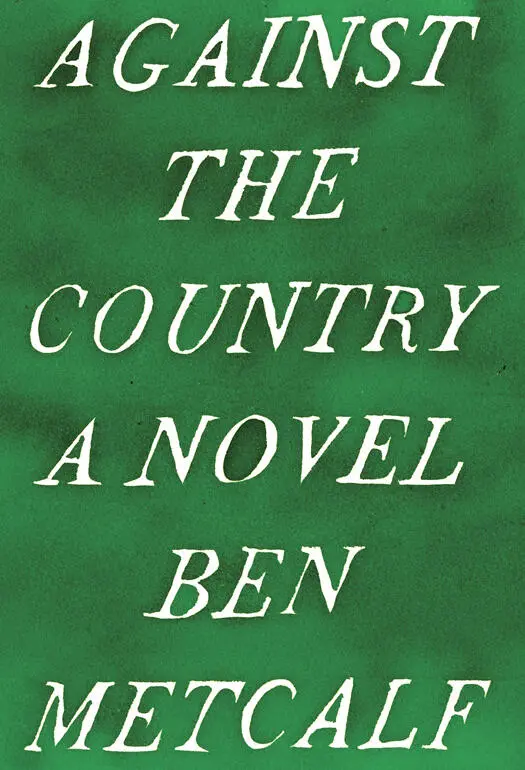
- Название:Against the Country
- Автор:
- Издательство:Random House
- Жанр:
- Год:2015
- ISBN:нет данных
- Рейтинг книги:3 / 5. Голосов: 1
-
Избранное:Добавить в избранное
- Отзывы:
-
Ваша оценка:
Against the Country: краткое содержание, описание и аннотация
Предлагаем к чтению аннотацию, описание, краткое содержание или предисловие (зависит от того, что написал сам автор книги «Against the Country»). Если вы не нашли необходимую информацию о книге — напишите в комментариях, мы постараемся отыскать её.
Equal parts fiery criticism and icy farce,
is the most hilarious sermon one is likely to hear on the subject of our native soil, and the starkest celebration of the language our land produced. The result is a literary tour de force that raises the question: Was there ever a narrator, in all our literature, so precise, so far-reaching, so eloquently misanthropic, as the one encountered here?
Against the Country — читать онлайн бесплатно полную книгу (весь текст) целиком
Ниже представлен текст книги, разбитый по страницам. Система сохранения места последней прочитанной страницы, позволяет с удобством читать онлайн бесплатно книгу «Against the Country», без необходимости каждый раз заново искать на чём Вы остановились. Поставьте закладку, и сможете в любой момент перейти на страницу, на которой закончили чтение.
Интервал:
Закладка:
My father was by then a teacher, the builder in him having so gleefully demolished his spine that some years prior he, or my mother, had resolved that he should seek out and win a certificate, of all things, that would enable him to teach English and mathematics to the delinquents at her recent place of employment, thereafter his , which decision would condemn us all to a belief on his part that he had mastered not only words and numbers now but also psychology , since psychology was what presumably caused all those pimply-dicked offenders to grow agitated by the semi-confident drone of his voice (as we all had), and to question his legendarily cornfed but actually television-gorged machismo (as we all had), and to throw their books up into the air (as I did myself on more than one occasion) and try to make it out of his classroom, whereupon they found themselves tackled by his bulk and inherent hatred of them (a legal maneuver, he was forever at pains to point out, since the courts’ recognition of his right to employ restraint-type violence against a fed-up JD clearly forgave, and by Benthamesque sliding scale even sanctioned, his more extreme and less rational violence against us), after which these potential “runners” were “held down” and “reasoned with” until a “group meeting” could be called to address the “issues” beneath the “acting out” (never his, mind you, the issues or the acting out), which would (for want of imagination, or for want of language, which is anyway the same thing) be boiled down into an unresolved homosexuality (admittedly an overworked theme here, though only insofar as it was there) or, or and , a failure to acknowledge (not merely to recognize but finally to accept ) an adult’s prerogative to dominate a child for whatever reason the adult saw fit to claim. Which is all anyone needs to know about psychology and the law.
This man did not offer up one word to me, that I can retrieve, on the subject of our fugitive poetess, nor had I honestly expected him to do so, since it was really only the boys he knew how to pin down against the earth, or the floorboards, or the nearest flower-patterned chair, until a confession could be publicly extracted, which confession was always given (what choice did we have?) but not once ever meant, so that his wife and daughter and spare son (that one not just recently assaulted) might be availed of the opportunity to watch their man swell with a copper’s pride in the time it took him afterward to realize that he had yet again been swindled. Not out of the confession, rest assured, this time any more than the last, nor out of the thrill of natural brutality he imagined himself entitled to by law, but out of that more precious thing he sought: being not nature’s imprimatur, which anyone could see was promiscuously granted, nor the law’s, every bit as whorishly had, so much as it was our own.
What he wanted we withheld, out of umbrage and by a hard-won personal law. Although any local resistance to his rule could be run out of us in a single session, or half that, we saw how the wider-ranging grievances might forever be detained. We saw how this man, no matter how he felt his neck re-redden when he heard our posthumiliation laughter upstairs, and raged not just at us but at the limits set against him by his status, and his statutes, and his not yet wholly intractable nature, would never permit himself the leniency (or was it really only the industry?) to whip a child of his twice in one day.
Kindness
We cherish the little kindnesses, I suppose, in them that are departed. (My father the teacher might insist upon a “those who” there, and also back in the last paragraph of the eighth part of my third attempt to end all this (not to mention the third paragraph of the eleventh part of my second, nor forgetting the second paragraph of the sixth part of my fifth, or is it now the seventh part of my sixth?), but the builder in him would at least acknowledge that the sentiment is right, and so perhaps also the sound.) I would follow this notion further, except that I think it a hair too late to introduce so fraught a motif as is kindness into what has thus far been an uncomplicated remembrance of the man.
It would not be a lie, exactly, to claim that he showed, concurrent with his spleen, some evidence of remorse after his most recent advances against us, and that he was quick to point out (as I have tried to here) what he thought might be amusing to a captive and terrified audience. It would not be a lie, exactly, to insist that we could eventually discern in his manner a more peaceable curiosity about what we were still refusing to learn in that place, with an emphasis shifted eerily one winter onto our reading, which he seemed almost pleased to know we could do, and which he afterward then encouraged with paperbacks only partially destroyed by the critical termites, and the scholarly silverfish, and those insufferable ABD chickens.
It would not be a lie, exactly, to add that he later then asked what was our opinion of these texts, and did not immediately explode if we conceded that we had avoided them altogether, or had read right over this crucial metaphor or that obvious pun, and could demonstrate no more idea of what went for irony in the 1860s than of what went for decency in our own multifarious decade. It would not be a lie, exactly, in craftsman’s terms, to maintain that his words on the original matter (the irony, I mean, not the decency, nor the time, though these are anyway the same thing, or had better be) were years on illuminating, as one might expect of a good teacher, and were in hindsight mostly constructive, as one might expect of a good builder, and were all the more powerful for their being in the moment so annoying.
Yet I do not think those few forced tutorials with a suddenly bookish father ever helped or learned us up so much as did our incessant slave-soldiery in his war against the trees, nor does his death without honor in the fallout from that war justify a perception now that I could see no worth in its waging then, or that I have failed, after years spent in study of this famous defeat, to locate within it some flaw I might in all decency, or in all irony, or perhaps only given the time, call kindness.
Borogoves
We started in early on our thoughts about why a man might have made so outgrabe a persecution of the borogoves, and it is upon this ancient archive of guesswork (I did not know “outgrabe” to be a verb then, past tense, nor “borogove” to denote a fanciful sort of parrot) that I must base my more modern conclusions here, not to mention any subsequent speculation as to why a father might have resolved to deal so harshly with creatures arguably as alive as he once was and inarguably as dead as he is today.
When he had finally regained, by pubescent or literary trial, the human capacity for speech, my brother gave voice to a charming little need-based theory, which held that we would each of us die of frostbite, if not by the wire or worse, did we not line up at the edge of the forest and present ourselves as ready, if not exactly resolved, to shoulder and drag and roll up into the yard, or to kick and curse at and finally (it was inevitable) collapse and weep upon, what hyperbolically large cylinders of wood our father had cut free from his latest self-satisfied kill, so that we might learn by this drudgery how heat is hard, and comfort a ghost, and paternal protection a myth we had best get over right away. My soon to be allegedly insane sister (spared institutionalization (is that the right term here? what I want, more properly, is “the booby hatch,” though by such I intend no judgment upon them that have repaired there) by a brother’s half-solemn threat to steal her north to stay with a half-frozen him) clove to the proposition, or apologia, that our father meant only to make our backs wide and strong, so that we might not suffer the same as he had, and would not in time (in irony? indecency?) be compelled to despise our own children as we obviously would ourselves, on which new way of thinking my brother and I quickly bet (having crapped out previously on the need-based theory) and stuck to it even when she amended her scheme to include the possibility that because of Frank’s wont to “overdo things,” and owing to his reluctance to “ease off on” any course he believed to run parallel with (if not in fact to be ) nature’s, our backs would likely shatter even sooner than had his.
Читать дальшеИнтервал:
Закладка:
Похожие книги на «Against the Country»
Представляем Вашему вниманию похожие книги на «Against the Country» списком для выбора. Мы отобрали схожую по названию и смыслу литературу в надежде предоставить читателям больше вариантов отыскать новые, интересные, ещё непрочитанные произведения.
![John Stieber - Against the Odds - Survival on the Russian Front 1944-1945 [2nd Edition]](/books/405234/john-stieber-against-the-odds-survival-on-the-russian-front-1944-1945-2nd-edition-thumb.webp)

Обсуждение, отзывы о книге «Against the Country» и просто собственные мнения читателей. Оставьте ваши комментарии, напишите, что Вы думаете о произведении, его смысле или главных героях. Укажите что конкретно понравилось, а что нет, и почему Вы так считаете.