Ben Metcalf - Against the Country
Здесь есть возможность читать онлайн «Ben Metcalf - Against the Country» весь текст электронной книги совершенно бесплатно (целиком полную версию без сокращений). В некоторых случаях можно слушать аудио, скачать через торрент в формате fb2 и присутствует краткое содержание. Год выпуска: 2015, Издательство: Random House, Жанр: Современная проза, на английском языке. Описание произведения, (предисловие) а так же отзывы посетителей доступны на портале библиотеки ЛибКат.
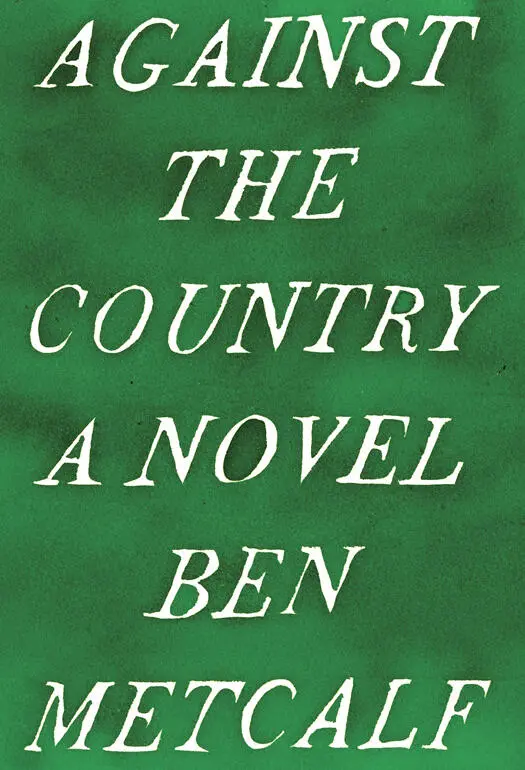
- Название:Against the Country
- Автор:
- Издательство:Random House
- Жанр:
- Год:2015
- ISBN:нет данных
- Рейтинг книги:3 / 5. Голосов: 1
-
Избранное:Добавить в избранное
- Отзывы:
-
Ваша оценка:
Against the Country: краткое содержание, описание и аннотация
Предлагаем к чтению аннотацию, описание, краткое содержание или предисловие (зависит от того, что написал сам автор книги «Against the Country»). Если вы не нашли необходимую информацию о книге — напишите в комментариях, мы постараемся отыскать её.
Equal parts fiery criticism and icy farce,
is the most hilarious sermon one is likely to hear on the subject of our native soil, and the starkest celebration of the language our land produced. The result is a literary tour de force that raises the question: Was there ever a narrator, in all our literature, so precise, so far-reaching, so eloquently misanthropic, as the one encountered here?
Against the Country — читать онлайн бесплатно полную книгу (весь текст) целиком
Ниже представлен текст книги, разбитый по страницам. Система сохранения места последней прочитанной страницы, позволяет с удобством читать онлайн бесплатно книгу «Against the Country», без необходимости каждый раз заново искать на чём Вы остановились. Поставьте закладку, и сможете в любой момент перейти на страницу, на которой закончили чтение.
Интервал:
Закладка:
The ringworm that took up residence on that ankle, just above the hillock of bone, was not technically a worm at all but rather a species of fungus, a cousin no doubt of that vast system below us, which breached the surface here and there to diminish our minds and our spirits, yes, but also, apparently, our ankles. The primary shades of this insult, as realized upon my mother, were purple and green and yellow, made shinier by the application of town ointments meant to dull and destroy them, the awful ring curled around almost to her calf and shin and easily discernable from up in the yard, where we children pretended to make ourselves busy while we wondered whether, or when, the sundress and the sandals would allow for an infection of the opposite leg.
Her husband might have explained that only hippie girls on the communes went out to tend crops with no socks or shoes on, their hips bent painfully like my mother’s always were, their feet planted wide so as to draw attention to the Ur-woman authenticity of their labor. He might have mentioned that the hippie girls caught ringworm too, and a hundred other things just as bad as the venereal diseases they famously acquired in town (which were not anyway unknown in the countryside), and that the copperheads would do far worse to that ankle if given half a chance, and that the spiders were not above setting up shop below a tomato. As far as I know he said nothing, or nothing that was heard. Perhaps he did not mind, really, if the dirt branded his woman in this or that ugly way, so long as she learned from her mark that the land could be infectious and cruel, and to expect no further effort out of him.
Yet should my mother, a woman of high intellect and no small worldliness, not have been able to gather all this and more without her husband’s harsh instruction? should she not have ascertained at once the source of the hideousness on her leg and taken steps to see it subdued, for her children’s sake if not for her own? Was she a stone, then, this woman, or a saint, or a suicide? what was it that sent her back out into those rows, aware, as we all were, that only continued hurt and scarification awaited her there? Was it some latent wish for martyrdom inherent in the Catholicism she had brought with her to Illinois, and now to Virginia, which her father himself had ignored but in his daughter saw strangely flourish? Was it a collapse toward the preordained doom her ostensibly Catholic but secretly Calvinist mother had assumed for herself and all her issue? Had some proud resistance to the obvious, some habit of contrariness for its own sake, sprung up in her after so short a time in that county, trapped as she was among self-destructive hucksters who talked down town but in their own panicked hearts actually longed for it?
I am no stranger to such motivations myself, yet I suspect that my mother’s were simpler still. I believe, or half believe, that she went out into those rows (they could not properly be called fields, nor were they small enough really to be gardens: call them gouges; call them graves) uncovered as she was so as to prove, if only to herself, that any intrusion of the plants into the soil, and any intrusion of the soil into the plants, and any intrusion of the bugs into either, and any intrusion of the bugs or the plants or the soil into her (which, after all, is my ostensible theme here), might eventually be overcome by an intrusion of herself into them. By which I mean only that my mother may at one point have been, despite the preponderance of evidence before her, an optimist.
On Sundays
I suppose a stubborn optimism could have led my mother to seek out God in our new artlessness, as she had in our old one back in town, though a stubborn pessimism seemed just the thing to encourage everybody else out there, and I doubt she got any closer to Him than they did while being forced to bear along the handicap of me. I did, here and there, with a smile toward the pews, and a big show of prayer after Communion, make an effort to aid in her advancement, though while employed at said prayer I might have aped too convincingly the young provincial who feels himself drowned each schoolday and so, on the Sabbath, clutches fast to his waterlogged half plank of faith, asking only that he never be inspired to ferry a shotgun with him to Mass. That I found myself unable to locate the joy in this activity as I did in some others was probably related to the fact that I understood my father to be in no mood, and in no moral position, to whip me for an improper attitude toward the Church, no matter how plaintively his wife cared to prosecute the matter.
This man, our judge and our Zeus, once answered my query about whether he believed in God with a thunderous Hell no! and would never consent to accompany us to services, despite the truth that in order to win his town bride he had promised always to do so. Such an arrangement might have bred strife in lesser couples, but between these two it made for a kind of pact, whereby my father would sleep in on Sundays so as to regain what strength he needed to work his children to death upon their noontime parole from the Lord, at which point my mother would partake of the sleep she had surely earned by ratting us out to the Lord in the first place. I cannot imagine what He got out of this, and we were not anywise the richer for it, but the adults seemed almost pleased with the arrangement, and they pressed on with it until I was nearly grown, by which point whatever idea had caused my mother to believe that there was a God to begin with, and had caused my father to insist that there was none, had worked its way far enough into the wood of their lives that it could no longer rot out the fruit of mine.
How my brother’s or sister’s walk with Jesus was then, or has been ever since, I am unable to say, but my own was not helped along any by my first trip around what our mother had picked, or been forced to settle on, as our new place of worship: a no-frills wood and tin chapel in a failed riverside hamlet in the next county over, Goochland itself being lousy with the descendants of Huguenots and so inhospitable either to Catholic symbology or to Catholic buildings. Catholic people the place did not seem to mind so much, though I suspect this was due less to an understanding of the dispute between the creeds than it was to a thoroughgoing ignorance of it. Certainly no French-named Goochlander I met ever displayed more than a small awareness of what had denied the Catholics a purchase on their land; I myself learned something of it only because I happened to be born on the Feast of Saint Bartholomew, who was relieved of his skin during the first century AD, in Armenia of all places, but whose name would forever be linked with the day in 1572 when the Parisian Huguenots lost their own skins by a refusal to renounce a newer corruption of the spirit in favor of the old.
All this was to the detriment of my mother’s plan, for had the American descendants of these people, misled at least as badly as my own kind were, not been driven by my day to consider all history bunk, and all knowledge of history pretension, and to offer up this attitude as proof of their patriotism when in fact it confirmed only their sloth, I might have been availed of some opportunity to defend my particular Jesus against informed attacks, and to develop an honest affection for what it was I defended, rather than being left to resent the exile of my faith as a poorly dressed schoolgirl will resent the fact that she is not more popular. I might have had means to declaim my way out of a situation in the fall of 1978, wherein I was removed from a classroom, to emboldened snickers, by an administrator who thought herself thoughtful, so that I could watch, by the miracle of television, and with too much time and space given over to what mysterious ablutions I might be required to perform, as if I were a Moslem or a Hindoo, the crowning of a brand-new pope. Mindful of this woman’s curiosity, and probable idiocy, I made a deep bow toward the screen, and did a very large sign of the cross, hoping to satisfy her expectations and also to poke some fun at them, neither of which seemed to get through, after which I indicated with a nod that it was now allowed for me to depart from the television set, and in a condescending silence she walked me back to my classroom, where I sat thereafter in a state of irrelevance and rage.
Читать дальшеИнтервал:
Закладка:
Похожие книги на «Against the Country»
Представляем Вашему вниманию похожие книги на «Against the Country» списком для выбора. Мы отобрали схожую по названию и смыслу литературу в надежде предоставить читателям больше вариантов отыскать новые, интересные, ещё непрочитанные произведения.

![John Stieber - Against the Odds - Survival on the Russian Front 1944-1945 [2nd Edition]](/books/405234/john-stieber-against-the-odds-survival-on-the-russian-front-1944-1945-2nd-edition-thumb.webp)





Обсуждение, отзывы о книге «Against the Country» и просто собственные мнения читателей. Оставьте ваши комментарии, напишите, что Вы думаете о произведении, его смысле или главных героях. Укажите что конкретно понравилось, а что нет, и почему Вы так считаете.