Ben Metcalf - Against the Country
Здесь есть возможность читать онлайн «Ben Metcalf - Against the Country» весь текст электронной книги совершенно бесплатно (целиком полную версию без сокращений). В некоторых случаях можно слушать аудио, скачать через торрент в формате fb2 и присутствует краткое содержание. Год выпуска: 2015, Издательство: Random House, Жанр: Современная проза, на английском языке. Описание произведения, (предисловие) а так же отзывы посетителей доступны на портале библиотеки ЛибКат.
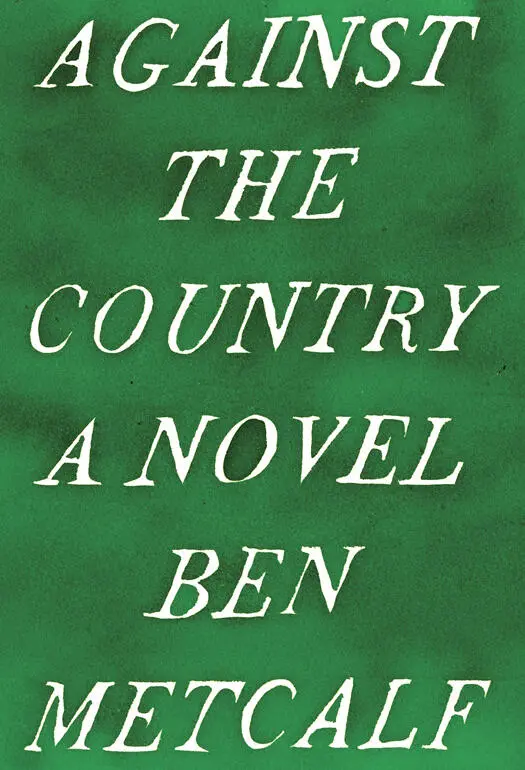
- Название:Against the Country
- Автор:
- Издательство:Random House
- Жанр:
- Год:2015
- ISBN:нет данных
- Рейтинг книги:3 / 5. Голосов: 1
-
Избранное:Добавить в избранное
- Отзывы:
-
Ваша оценка:
Against the Country: краткое содержание, описание и аннотация
Предлагаем к чтению аннотацию, описание, краткое содержание или предисловие (зависит от того, что написал сам автор книги «Against the Country»). Если вы не нашли необходимую информацию о книге — напишите в комментариях, мы постараемся отыскать её.
Equal parts fiery criticism and icy farce,
is the most hilarious sermon one is likely to hear on the subject of our native soil, and the starkest celebration of the language our land produced. The result is a literary tour de force that raises the question: Was there ever a narrator, in all our literature, so precise, so far-reaching, so eloquently misanthropic, as the one encountered here?
Against the Country — читать онлайн бесплатно полную книгу (весь текст) целиком
Ниже представлен текст книги, разбитый по страницам. Система сохранения места последней прочитанной страницы, позволяет с удобством читать онлайн бесплатно книгу «Against the Country», без необходимости каждый раз заново искать на чём Вы остановились. Поставьте закладку, и сможете в любой момент перейти на страницу, на которой закончили чтение.
Интервал:
Закладка:
Enough with my clumsy dance around the matter of skin: I did, in fact, notice that my schoolbus driver was not colorless but brown, and I did notice that the teacher who misconstrued the act of circumcision was not colorless but pink, and I did notice that the principal who refused to rid us of this woman’s inanity was also pink, and I did notice that the teacher who continually threatened to “go blerk” on her students was brown, and I did notice that the math teacher who had supposedly beaten the boy in the hallway (I was not there) was brown, and I did notice that the supposedly beaten boy who had supposedly raped the girl (again, I was not there) was pink, and I did notice that the gym teacher who yelled “Mix it up down there” was brown, and I did notice that the boy I did harm to because he had insulted my mother was pink, and I did notice that the teacher who then refused to see my mother on account of my being “in jail” was brown, and I did notice that the pill smugglers who tried to make a mule out of me were in every case pink, and I did notice that the young man who passed me my first marijuana cigarette (I thank him, I curse him) was pink, and I did notice that the fat boy with whom I battled on the bus was brown, and I did notice that each day in that place was a loud reminder that I was under threat by either and each of these shades.
Enough with the pretense that a bouncing back and forth between “brown” and “pink” will suffice here. The boy who brought his pistol to the party was the color of a ghost, or so I was told. The girl whose hair I did my best to aerate was a delicious sort of red-tinged yellow, though I would not think to call her orange. The gentleman who explained what his penis needed to see before it would consent to inflate was the color of well-steeped tea, with milk, and cinnamon freckles. The damsels whose names I reluctantly invoked a few pages back were, in order, shyly tanned cow leather, supermarket honey, and a white rose petal bruised by the sun to absolute perfection. The Ronnies I knew were, respectively, mahogany and young pine.
Enough with this new little game, which allows me to pretend I saw so many tints out there that in the end I saw none at all, so freethinking was I at twelve or thirteen. Enough with the implication that I paid no mind when these people constantly referred to themselves, and to one another, as “black,” or “white,” or to some dignity-starved variant thereof, and that I made no use of this simple accounting system myself when recording the state of my pregnant friend (white, frightened, beaten), or of the boy who had achieved the impregnation (black, frightened, gone), or of the father who had lashed out at this circumstance with his fists (white, frightened, stupid), or of the suburbanite who had allowed a single taste of intercourse to transform him into a straw-chewing braggart (white, frightened, stupid), or of the boy whose penis had peeked out over the top of his trousers in an attempt to make my acquaintance (white, frightened, not necessarily stupid), or of all those children who believed that AIDS was less to be feared than “the her -pess,” and that despite these diseases the sine qua non of adulthood was always going to be “humping,” and whatever harm went along with that (black, white, most of them stupid, all of them doomed).
Enough with the implication that in my urge to assimilate and survive in that place I had never succumbed, for a week or two (or a month, or a year), to that style of thought which combines the mysteries of menstruation and lactation into a single, willful act of iniquity (apparently by way of the humping), and considers it a kindness to think the blacks no better off, really, than when they were slaves and did not have to do for themselves , and takes as gospel truth a moron’s worry that her daughter’s titties will droop if sucked on too much, and is somehow able to work the algebra by which a young boy’s masturbatory adventures are worth far more to an older boy who demands to hear about them than they could possibly be to the masturbator himself.
Enough! Imagine a child in that bind, as often I do, and then saddle him with what idea of success a pair of unsuccessful parents have carried with them out of town, where good grades attract scorn, yes, but tend also to pay off in the long run and are not always taken for signs of arrogance or homosexuality. Give this child to understand that any deviation from his goal of good grades will be met at home with penalties he would gladly trade in for an everyday whipping, and by this method cause him to think his schoolbooks great and impossible charms. In the meantime, sit him on a schoolbus and make him wait.
Make him wait while the policemen who have followed his bus in anticipation of a scheduled fight there pull up behind its idling hull, and find their unhurried way around to its door, and lumber up its steps, and sidle among the children as if cops were the protagonists here, not the boys who have been fighting, nor the driver who will likely finger the bullied victim as the culprit, nor the former town child who had hoped that this brief cessation of movement might allow him a moment to study a suddenly readable page. Make him wait while the new girl starts to cry as the bus nears the field-bound loneliness of a home in every way superior to his own, and let him glance at the page while she refuses, as usual, to disembark. Make him wait, unable to think at all of the page, while that obese boy in back finds his mournful way up toward the exit, the dark stain at his crotch proof that the rutty roads have yet again bested his kidneys, his head hung low while he passes, as if to say, “I know, I know.”
Now:
Steal this waiting child’s books one afternoon under the cover of “play” (the game being never to give them back, though he begs and explains that he has a test the next morning), and push him off the bus and into his driveway with the driver’s full collusion (she will, in fact, fold the bus’s doors on him as he tries to reboard and fight for his property), and leave him standing in a storm of red dust and derision while his future recedes. Allow him more patience than he has heretofore shown, and grant him the knowledge that his schoolbus will disappear down a nearby road for fifteen minutes or so, then return with no intention to stop, only to show him through the windows a familiar tension in the driver’s pursed lips and raised eyebrows, and a mockery of faces fanned out behind her, and a book or two held up in display of what has been lost.
Now:
Permit this child access to his father’s shotguns and ask what you think he might do.
Sanctuary
My aim here is not merely to describe how at the age of thirteen or so a frightened and pissed-off white boy held up his mostly black schoolbus with a shotgun, though he did surely do such a thing; nor is it to overstate the worth of those stolen books, for they were of appallingly poor quality either as didactic tools or as objets d’art; nor do I have anything more than a sporting interest, really, in the argument that a child should be held blameless for his sins simply because he has been beaten on the bus, and beaten at school, and beaten at home, and has finally decided to set a few boundaries.
The crime itself is almost too plain to recount. I stood at the end of the driveway, where the dirt ended, or rather jumped out along the road toward Richmond. (Evidence, I suppose, that since losing town we had been trying always to regain it.) My brother, half hoping to see me kill someone, stood off to the right and behind me, his muteness relieved now and then by bursts of laughter. I took a step forward as the bus neared, the gun not fixed on anyone but only pointed downward, its long eye cradled in the nook of my arm. The wheels stopped shy of where I had expected them to, and a tenth or eleventh grader was sent out, probably by lot, to lay the books on the asphalt (or was it the gravel?), after which he walked backward, slowly, his arms raised, until he reached the door and scrambled up those stairs to what he might have believed was sanctuary.
Читать дальшеИнтервал:
Закладка:
Похожие книги на «Against the Country»
Представляем Вашему вниманию похожие книги на «Against the Country» списком для выбора. Мы отобрали схожую по названию и смыслу литературу в надежде предоставить читателям больше вариантов отыскать новые, интересные, ещё непрочитанные произведения.
![John Stieber - Against the Odds - Survival on the Russian Front 1944-1945 [2nd Edition]](/books/405234/john-stieber-against-the-odds-survival-on-the-russian-front-1944-1945-2nd-edition-thumb.webp)





Обсуждение, отзывы о книге «Against the Country» и просто собственные мнения читателей. Оставьте ваши комментарии, напишите, что Вы думаете о произведении, его смысле или главных героях. Укажите что конкретно понравилось, а что нет, и почему Вы так считаете.