Charles Lewinsky - Melnitz
Здесь есть возможность читать онлайн «Charles Lewinsky - Melnitz» весь текст электронной книги совершенно бесплатно (целиком полную версию без сокращений). В некоторых случаях можно слушать аудио, скачать через торрент в формате fb2 и присутствует краткое содержание. Год выпуска: 2015, Издательство: Atlantic Books, Жанр: Современная проза, на английском языке. Описание произведения, (предисловие) а так же отзывы посетителей доступны на портале библиотеки ЛибКат.
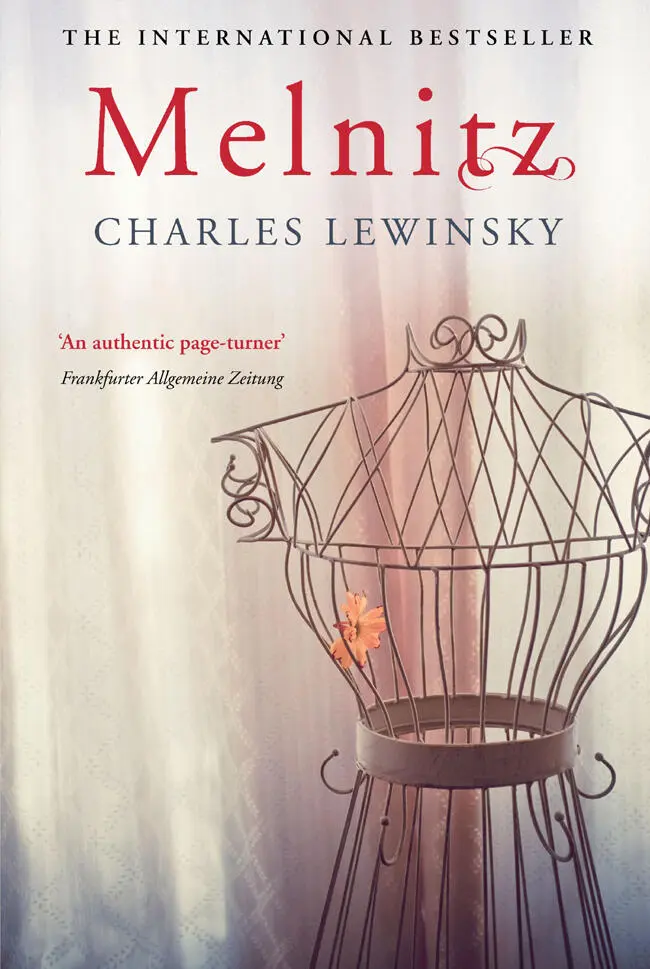
- Название:Melnitz
- Автор:
- Издательство:Atlantic Books
- Жанр:
- Год:2015
- ISBN:нет данных
- Рейтинг книги:4 / 5. Голосов: 1
-
Избранное:Добавить в избранное
- Отзывы:
-
Ваша оценка:
Melnitz: краткое содержание, описание и аннотация
Предлагаем к чтению аннотацию, описание, краткое содержание или предисловие (зависит от того, что написал сам автор книги «Melnitz»). Если вы не нашли необходимую информацию о книге — напишите в комментариях, мы постараемся отыскать её.
Melnitz — читать онлайн бесплатно полную книгу (весь текст) целиком
Ниже представлен текст книги, разбитый по страницам. Система сохранения места последней прочитанной страницы, позволяет с удобством читать онлайн бесплатно книгу «Melnitz», без необходимости каждый раз заново искать на чём Вы остановились. Поставьте закладку, и сможете в любой момент перейти на страницу, на которой закончили чтение.
Интервал:
Закладка:
Pinchas, who took part in the shiur of the Talmud-Torah Association twice a week, had the feeling that he knew a thousand arguments against such blasphemous talk, but not a single one came to mind. If he could have led this debate in the familiar evening classroom, protected by the bulwark of a shelf full of ancient tomes… But here, in the bright light of the lakeside promenade, under the fresh green of the trees, here, where a disobliging-looking nanny in a starched blue and white blouse led two little girls in pink by the hand, where an old lady was scattering cake-crumbs into the water from a greasy paper bag, for swans and ducks to dispute over with belligerent gulls, here, where a teacher had assembled his whole class around him so that he could name all the peaks of the alpine panorama, clearly visible today thanks to the föhn air — here he felt helpless. Debating the nuances of a word, the finer points of the interpretation of a law — that he was used to. But someone simply wanting to tear down the whole intellectual edifice on which so many generations of scholars and their pupils had taken such trouble — that left him speechless. He walked along in silence beside Dr Stern, who kept dancing with excitement at the abundance of his own self-confidence.
Their path led them past the improvised geography lesson, where the teacher was just saying, ‘Over there, still shrouded in fog, you will see the Grosse Mythe and the Kleine Mythe.’ Dr Stern chuckled, a rich man winning the lottery on top of everything. ‘You see, my dear friend,’ he said, wiping his moustache with the back of his hand, ‘this bold pedagogue has just summed up my whole argument in the most concise form. We humans come up with myths, big ones and small ones, we claim they are as solid as fortresses, and mask our own doubts with a fog of traditions and rituals.’
‘It’s easy to believe in nothing at all.’ Pinchas felt unfamiliar fury welling up in him.
‘On the contrary, my friend.’ Dr Stern had also been expecting this sentence, like a practised dancer taking his partner’s hand without looking at the end of a complicated figure. ‘Believing in nothing is difficult! What is easy is to swallow down without resistance the mush of ideas, pre-chewed a thousand times, of previous generations. It is easy to bend the knee obediently, to cross yourself, put on the tefillin, jump over a burning pyre at midnight, or whatever strange rituals our forefathers came up with in the name of their self-invented deities. It is easy to accept holy scriptures as God-given, to accept the premises of a religion uncritically and use one’s intelligence only to draw constant new conclusions from it. We Jews are true masters in the art of gnawing our way through the finest ramifications of supposedly divine laws, like woodworm in a long-dead tree. Night after night we study medieval commentaries, just to understand debates pursued fifteen hundred years ago, we talk ourselves blue in the face about the rituals of sacrificial services in a temple destroyed two thousand years ago. We waste our intelligence because we lack the courage to question ancient fairy-tales. Fairy-tales, yes indeed! But in fact: he who does not wish to think must believe.’ He was so pleased with that last sentence that he performed a little dance on the spot. Two elderly ladies peered at him disapprovingly from under their parasols.
‘You know what strikes me?’ Pinchas asked and felt rising up in him the combative anticipation that emerges from the sense of a watertight argument. ‘You know what even strikes me a lot about you? You still say “we”. “We Jews.” So for all your protests you are still part of it.
‘Let’s say: I don’t exclude myself from it. Or only as long as the concept refers to the community of a people and not of a faith. But otherwise… In this connection I can tell you a funny story.’ He pointed to one of the wooden benches that the Beautification Society had set up along the promenade. ‘The sun will do me good, after all those long hours in the Congress Room.’ He carefully wiped a trace of pollen off the green painted slats, made himself comfortable in the middle of the seat, his arms spread out on the back, and when Pinchas continued to hesitate, tapped invitingly on the narrow free space beside him. ‘Sit down next to me, my dear friend! I promise you, you will enjoy yourself royally.’
Pinchas sat down. What option did he have? His interlocutor, that much was clear to him, was not one of those people who can be deterred from telling a story once they have started it.
‘This is already…’ Dr Stern began, and adopted that artificially reflective face that loquacious people often put on in order to give often-repeated stories the appearance of spontaneous authenticity. ‘In fact, more than ten years ago now. How time passes! It was clear to me at last, once and for all, that I could no longer reconcile it with my conscience, telling my little flock… A lovely term, isn’t it?’ he interrupted himself, and even that interruption seemed to be part of his manuscript. ‘Little flock. It so accurately describes the submissive lack of criticism with which even thoroughly intelligent people credulously trot along with the herd of their religion, always encircled by the barking dogs of the punishments of hell and eternal damnation. As I say, it was clear to me that I would be being unfaithful to myself if I went on interpreting laws to my congregation that I no longer believed in myself — even though the interpretations themselves were still entirely correct. Utterly meaningless, like all religious mumbo-jumbo, but correct. If you consider: a God who is concerned in all seriousness with the question of whether the pitum is broken off an essrog, such a detail-obsessed heavenly trifler, can only be an invention of humanity! Only we humans are stupid enough to glue our view of the world together from mere trivia.’
‘And your view of the world, Dr Stern?’
The free-thinker heard the irritable undertone and seemed to be pleased, a conjuror who has directed his audience’s attention exactly where he wants it. ‘I deal with the main issue, and flatter myself that I have thus achieved something greater than all those regulation-obsessed Talmud greats. With one exception. Does the name Elisha ben Abuyah mean anything to you?’
Pinchas nodded. ‘Acher,’ he said. ‘The Other.’
‘Very good.’ Dr Stern nodded to him with schoolmasterly condescension. ‘Excellent. That is how he is always referred to in the scriptures. “The Other.” And why? Because he was not even granted that name after he, the great teacher of the Law, had reached the only possible conclusion: that there is in fact no God. And do you know how he lost his faith?’
Pinchas had studied the relevant passage of the Talmud not long before. It concerned a boy ordered by his father to fetch eggs from the nest, but first to chase away the mother bird, as it is written: ‘You shall let the mother fly and take only the young, that you may thrive and that you may long endure’ — the same reward that the Torah promises for the keeping of the Commandment to honour one’s father and mother. In spite of that twofold promise, the boy fell and broke his neck. And that is supposed to have been the moment when Elisha ben Abuyah became an apostate.
‘You cannot use that argument,’ Pinchas said, ‘if you bear in mind what Rashi says about the passage “that you may long endure”…’
‘I’m impressed.’ Dr Stern applauded ironically, and Pinchas could have slapped him. ‘So you know that passage from kiddushim. But I like the explanation that Talmud gives in the treatise of Khagiga — 14b, if you want to look it up — much better.’
‘I know that passage too,’ said Pinchas, but Dr Stern had closed his eyes as if to remember better, and recited, almost singing, as one does during a lecture. ‘Ben Asai, ben Soma, Elisha ben Abuyah and Rabbi Akiba meditated long enough over the glory of God until they could glimpse the uppermost sphere. Ben Asai died. Ben Soma lost his reason. Elisha ben Abuyah fell from faith. And only Rabbi Akiba…’
Читать дальшеИнтервал:
Закладка:
Похожие книги на «Melnitz»
Представляем Вашему вниманию похожие книги на «Melnitz» списком для выбора. Мы отобрали схожую по названию и смыслу литературу в надежде предоставить читателям больше вариантов отыскать новые, интересные, ещё непрочитанные произведения.







Обсуждение, отзывы о книге «Melnitz» и просто собственные мнения читателей. Оставьте ваши комментарии, напишите, что Вы думаете о произведении, его смысле или главных героях. Укажите что конкретно понравилось, а что нет, и почему Вы так считаете.