Charles Lewinsky - Melnitz
Здесь есть возможность читать онлайн «Charles Lewinsky - Melnitz» весь текст электронной книги совершенно бесплатно (целиком полную версию без сокращений). В некоторых случаях можно слушать аудио, скачать через торрент в формате fb2 и присутствует краткое содержание. Год выпуска: 2015, Издательство: Atlantic Books, Жанр: Современная проза, на английском языке. Описание произведения, (предисловие) а так же отзывы посетителей доступны на портале библиотеки ЛибКат.
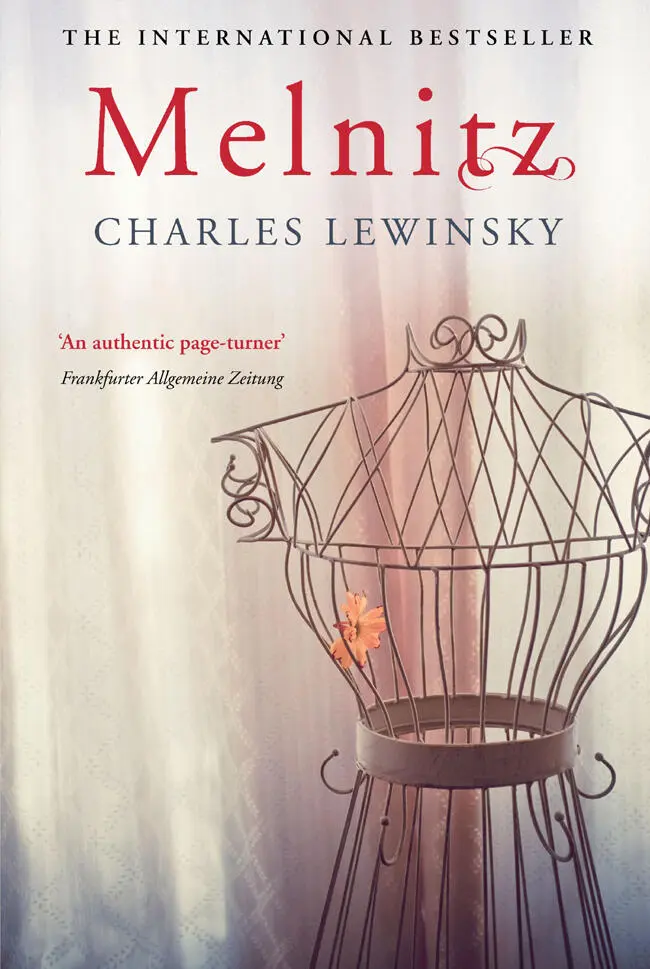
- Название:Melnitz
- Автор:
- Издательство:Atlantic Books
- Жанр:
- Год:2015
- ISBN:нет данных
- Рейтинг книги:4 / 5. Голосов: 1
-
Избранное:Добавить в избранное
- Отзывы:
-
Ваша оценка:
Melnitz: краткое содержание, описание и аннотация
Предлагаем к чтению аннотацию, описание, краткое содержание или предисловие (зависит от того, что написал сам автор книги «Melnitz»). Если вы не нашли необходимую информацию о книге — напишите в комментариях, мы постараемся отыскать её.
Melnitz — читать онлайн бесплатно полную книгу (весь текст) целиком
Ниже представлен текст книги, разбитый по страницам. Система сохранения места последней прочитанной страницы, позволяет с удобством читать онлайн бесплатно книгу «Melnitz», без необходимости каждый раз заново искать на чём Вы остановились. Поставьте закладку, и сможете в любой момент перейти на страницу, на которой закончили чтение.
Интервал:
Закладка:
There are things that cannot be explained without rudeness. A wine is kosher when it is produced by a Jew, and treyf when it is not. But how can one explain that to a drunken goy without insulting him?
It was Salomon who saved the situation, and saved it, indeed, with a gematria. And Janki had expressly asked him not to bother anyone with his chochmes.
‘Listen, Herr Rauhut,’ he said. ‘Let me explain something to you about this matter. Wine, the Hebrew word for wine, of course, has a numerical value of seventy-five.’
‘Numerical value?’
‘According to our tradition, each letter corresponds to a number. So “the wine” has a value of seventy-five. And do you know what word has exactly the same value? Ganavcha, your thief.’
Rauhut looked at him uncomprehendingly.
‘And what is that trying to teach us? That wine is your thief. And what is it stealing from you? Your intelligence and your manners.’
‘Hahaha,’ laughed Director Strähle. ‘Very good. I’ll have to remember that.’
When even Herr Schnegg nodded appreciatively, the others even joined in the laughter. No one likes drunken guests who disturb the polite insignificance of dinner-table conversations.
Herr Rauhut was so busy thinking about the problem of numerical values and thieves that he completely forgot his original question. He emptied his glass in one go and held it out to the hired servant to be refilled. ‘But it’s good, this kosher wine of yours,’ he said, too loudly. His wife coughed.
Apart from that small event, the dinner went as perfectly as Janki had wished. No one noticed that Chanele spoke little, and kept looking anxiously across at her oldest son.
The evening would also have ended perfectly. But then the ladies withdrew to the drawing-room, Arthur said goodnight to everyone and disappeared with great relief to his room, the hired servants cleared the table and cashed up their tips. Then the gentlemen filled their brandy glasses and after thorough ritual sniffing and turning-around-in-the-fingers they lit the cigars that Janki handed around. Except François, who smoked a Russian cigarette in his almost real amber holder, and Salomon, who played in his pocket with his tobacco tin, because Janki had forbidden him to take snuff on the grounds that it was too rustic.
Then, inevitably, they turned to politics.
18
‘What would interest me,’ Councillor Bugmann said, opening the two bottom buttons of waistcoat with a groan of pleasure, ‘what would even interest me very much, Monsieur Meijer: what do you actually think in puncto puncti of the popular initiative on which we will all be voting this summer?’
‘An entirely superfluous innovation.’ Herr Schnegg pulled a face as if someone had tipped vinegar into his brandy. ‘Popular initiative! Even just the word! Making laws by collecting signatures from the rabble for any old ideas! What do we have a government for?’
That is pro… prog… progress.’ It took Editor Rauhut three goes to clamber over all the consonantal hurdles, which didn’t stop him from attempting another verbal mountain range. ‘The further elaboration of the democratic rights of the… of the people.’
‘The rabble,’ Herr Schnegg repeated. Director Strähle rubbed earnestly at a non-existent stain on his shirt front. As a hotel manager he made it a principle never to involve himself in political discussions.
‘I don’t mean the popular initiative per se . This instrument of the decision-making process has been introduced, and we will have to live with it, nolens volens .’ If his wife had been there, she would have known by these sentences that Bugmann too had had a great deal to drink. Where he was concerned, this always found expression in the Latin phrases of his student days floating to the surface. ‘I mean the concrete case on which the people will have to vote in August. Article 25 bis.’
Salomon Meijer leaned forward and rested his hands on the table as if he were about to stand up. He began to drum very gently with his fingers, a musician who hadn’t quite made up his mind which key was suitable for a particular occasion.
‘25 bis,’ Bugmann repeated with an expressive gesture, as if he wanted to write the paragraph in the air with the glowing tip of his cigar. ‘A complement to the state constitution which might be of special interest to our host, who has entertained us so handsomely today. Please, Monsieur Meijer, tell us your opinion on the matter!’
This challenge was very unwelcome to Janki. He organised these ‘goyish evenings’ precisely to demonstrate, through natural social intercourse, that he had been accepted here in the town as an equal among equals, and that such important people as Herr Schnegg or Herr Bugmann simply saw him as the successful businessman, one of their own, or at least no longer primarily as a Jew. To this end he was prepared to listen to Director Strähle’s genial boasts, let Herr Rauhut drink expensive cognac like water and talk happily about any subject they wanted to. Almost any subject. But why did Bugmann have to start on about this wretched people’s initiative which, under cover of animal-protection legislation, sought to add an anti-Semitic article to the federal constitution and forbid the slaughtering of animals according to the Jewish rite?
‘I have no opinion on the matter,’ he said, attempting to evade the issue. ‘After all, I am still a guest in this beautiful country. As a citizen of France…’
‘ Quo usque tandem? ’ Bugmann interrupted. ‘How long do you plan to wait before you become one of us in terms of your papers as well? I have told you often enough before, Monsieur Meijer: people like you, people who promote our economy, are most welcome in the citizens’ register. For myself, I would always be willing…’
‘Citizens’ register,’ said Rauhut, drawing all the syllables together into a single one, ‘such a word does not exist.’ He nodded with satisfaction a number of time, as if he had just solved a big problem.
‘We like being French, Herr Councillor.’ François smiled so politely that his contradiction seemed like a compliment. ‘In France égalité is just a word. A Captain Dreyfus has just been appointed to the General Staff. That same Dreyfus family also exists in Endingen. Do you think one of them could enjoy a similar career?’
‘In principle, yes.’
‘In principle perhaps, Herr Councillor,’ said François, again with his friendly smile. ‘But not in the Aargau.’
‘Another drop of cognac?’ Janki swiftly intervened. But only Rauhut held out his glass.
‘Whether you be Swiss or French,’ Bugmann insisted, ‘you must have an opinion on the matter. You as a Jew…’
An old voice began to giggle. Uncle Melnitz was suddenly crouching with them at the table, right beside Janki. With his bony fingers, on which the skin sat loosely like an oversized glove, he had gripped a cigar and was bringing it to his wrinkled mouth. ‘Come on, Janki!’ he said, and with every word smoke rose up between his teeth as if a fire raged deep within him. ‘Come on! Tell him your opinion. You as a Jew. Yes. Or did you think that ludicrous tie would make you an honorary goy?’
‘Now,’ Janki turned around, ‘of course we can consider the problem from two sides. On the one hand…’
‘On the one hand…’ Melnitz mimicked.
‘On the one hand, of course, I quite understand the desire to cause an animal as little pain as possible. But on the other…’
‘On the other…’ parroted Melnitz.
‘… our religious laws require us…’
‘I too have signed,’ Herr Ziltener said all of a sudden. He had sat in his seat almost mutely for the whole evening, giving only given very curt answers to direct questions, so his unexpected intervention now seemed very loud. ‘You may dismiss me if you wish, but I have a right to my conviction.’ He held his brandy glass between the palms of his hands as a farmer might hold his warming cup of coffee on a cold day. He seemed to have said what he wanted to say, but after a pause he added, ‘My wife loves animals too.’ It was the first time in his life that Ziltener had found an opinion of his wife’s worth mentioning.
Читать дальшеИнтервал:
Закладка:
Похожие книги на «Melnitz»
Представляем Вашему вниманию похожие книги на «Melnitz» списком для выбора. Мы отобрали схожую по названию и смыслу литературу в надежде предоставить читателям больше вариантов отыскать новые, интересные, ещё непрочитанные произведения.












Обсуждение, отзывы о книге «Melnitz» и просто собственные мнения читателей. Оставьте ваши комментарии, напишите, что Вы думаете о произведении, его смысле или главных героях. Укажите что конкретно понравилось, а что нет, и почему Вы так считаете.