Charles Lewinsky - Melnitz
Здесь есть возможность читать онлайн «Charles Lewinsky - Melnitz» весь текст электронной книги совершенно бесплатно (целиком полную версию без сокращений). В некоторых случаях можно слушать аудио, скачать через торрент в формате fb2 и присутствует краткое содержание. Год выпуска: 2015, Издательство: Atlantic Books, Жанр: Современная проза, на английском языке. Описание произведения, (предисловие) а так же отзывы посетителей доступны на портале библиотеки ЛибКат.
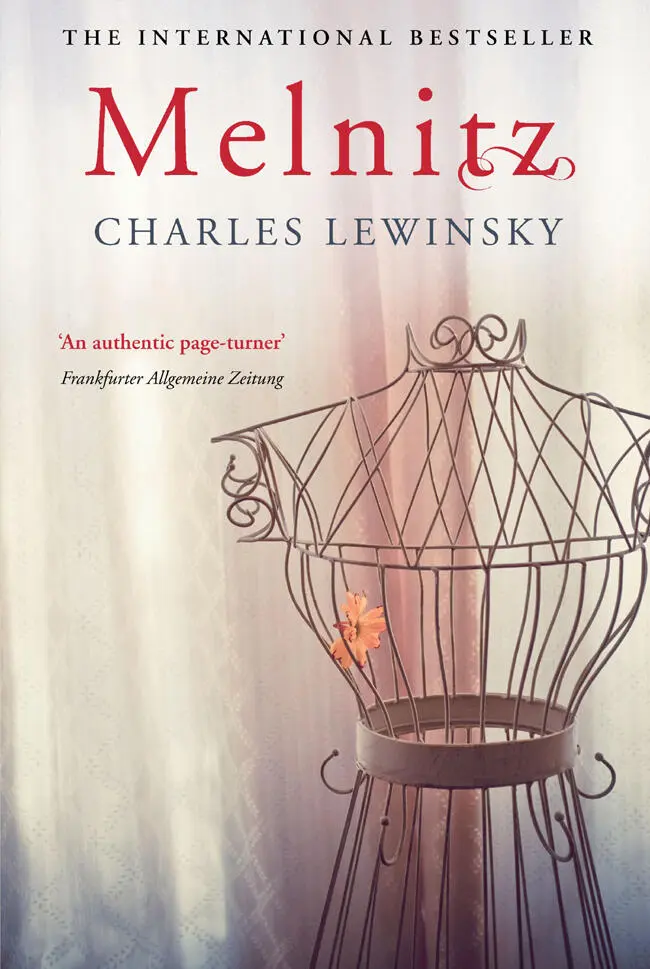
- Название:Melnitz
- Автор:
- Издательство:Atlantic Books
- Жанр:
- Год:2015
- ISBN:нет данных
- Рейтинг книги:4 / 5. Голосов: 1
-
Избранное:Добавить в избранное
- Отзывы:
-
Ваша оценка:
Melnitz: краткое содержание, описание и аннотация
Предлагаем к чтению аннотацию, описание, краткое содержание или предисловие (зависит от того, что написал сам автор книги «Melnitz»). Если вы не нашли необходимую информацию о книге — напишите в комментариях, мы постараемся отыскать её.
Melnitz — читать онлайн бесплатно полную книгу (весь текст) целиком
Ниже представлен текст книги, разбитый по страницам. Система сохранения места последней прочитанной страницы, позволяет с удобством читать онлайн бесплатно книгу «Melnitz», без необходимости каждый раз заново искать на чём Вы остановились. Поставьте закладку, и сможете в любой момент перейти на страницу, на которой закончили чтение.
Интервал:
Закладка:
There was nothing unusual about the flat itself either, except that they had lots of books. But that could also have been because Herr Rosenthal was a teacher. The only striking thing was that beside every inside door there was an odd capsule with a Hebrew sign on it. Böhni knew what Hebrew looked like; in the caricatures in the Front the German letters were sometimes written with thin vertical lines and broad horizontal bars so that you knew straight away: Jews. Herr Rosenthal, who couldn’t stop being a teacher even in his leisure time, noticed him glancing at the doorposts and went off on a complicated explanation of which Böhni understood only that there were Bible quotations in the capsules. He was reminded of the Lord’s Prayer that hung in the kitchen at home in Flaach, with angels printed in four colours hovering around it. He wasn’t happy with the parallel.
‘Flowers? You really didn’t need to,’ said Lea, and to Hillel, ‘So, this is your friend.’ That was the moment when Hillel started to look for the word that best describes a non-friend and non-enemy.
The visit took place on the day after Shavuot, the Feast of Weeks. That was sensible, because it meant that Lea didn’t have to cook anything extra; there was still enough left of the cheesecake that goes with the feast. She prepared it exactly according to the recipe of the legendary Grandmother Pomeranz from Endingen, and got even better results than Hinda.
Böhni also had to listen to a lecture on the subject of the Feast of Weeks. Hillel rolled his eyes at his father’s mania for teaching, but his father refused to be put off by such reactions. As he often did at the Strickhof during theory classes, Böhni only listened with half an ear, but still grasped that Herr Rosenthal didn’t know much about agriculture. He claimed, for example, that the first wheat of the year had been brought into the temple as a sacrifice on this day, and that was plainly nonsense: in May the wheat isn’t nearly ready to be harvested. Although… Maybe down in Palestine it was different. He would have to ask Rosenthal afterwards.
Also left over from the Feast of Weeks was an opened bottle of wine on the dresser, also from Palestine, and Herr Rosenthal poured each of them a little glass. The wine was as sweet as syrup, and Böhni would have preferred a beer.
Hillel’s mother wanted to hear something about his family and how he liked school, but he just gave taciturn answers, not out of shyness, but just because he wasn’t used to people talking so much over dinner. Apart from that, the cheesecake was really particularly good.
As long as there was anything to eat on the table things went well, but eventually the plates were cleared away, Lea filled up everyone’s tea again and they made conversation. In this household that meant: Hillel’s father delivered a monologue, while everyone else got to make tiny interventions. Perhaps he had got used to that in school, where doubtless no one was allowed to interrupt his lectures on trigonometry or the calculation of probability, but in all likelihood chattiness was just his way. Sometimes, if he developed a thought too long-windedly, his wife nudged him under the table and reminded him with a look that they had a visitor. But that only made things worse, because then Herr Rosenthal would try to create the appearance of a conversation with questions. Böhni felt as if he was taking an exam. He soon started sweating, as if he had to tell Kudi Lampertz the correct proportion of phosphate and potassium in fertiliser for feed corn.
Before dinner, Herr Rosenthal had read the evening edition of the Neue Zürcher Zeitung — he did that every day and finished precisely to coincide with the meal — and now he was arguing about something called the Peel Commission that Böhni had never heard of. It had apparently delivered some kind of report that he didn’t know about either. ‘And this is a report about which, ‘said Herr Rosenthal, ‘we might, to put it very cautiously, be very much in two minds.’
‘I don’t think Böhni’s interested in this,’ Hillel tried to rein in his father.
‘Why not? He’s an intelligent young man. So, what is your opinion on the subject?’
As he sometimes had to do in class, Böhni first tried to talk around the subject. So he said very carefully that he thought Herr Rosenthal was completely right, but then there were two sides to every question.
He wasn’t getting away that easily, Herr Rosenthal insisted, he must surely be interested in politics. Böhni could confirm that at least with a good conscience, after all, he read the Front every day, even though a whole year’s subscription cost eighteen francs, a lot of money for a small farmer’s son from the wine-growing country.
That was what he thought, Herr Rosenthal nodded, he noticed it again and again, even in school, that young people today were much more interested in these things than they had been even a few years previously. But now Herr Böhni should not duck the question, but freely express his opinion. ‘So, what is your view of the work of Lord Peel?’
‘Of who?’
He was the leader of the commission, Frau Rosenthal helped him, that had now presented a plan for the division of the mandated territories.
Mandated territories. What was that again?
‘Could we please talk about something else?’ asked Hillel and glared furiously at his father.
Herr Rosenthal paid him as little attention as he would have an unruly pupil in class. He would be very interested, he went on, to know Herr Böhni’s opinion about this planned division. It was always very instructive to learn how an unprejudiced and neutral observer saw a subject.
Hillel was no help at all to anyone. He had folded his hands behind his head, rocked his chair back and forth and looked up at the ceiling as if to say, ‘I’m not even here.’
Böhni finally rescued himself with a method that always worked with Kudi Lampertz as well. The subject struck him as difficult, he said, really complicated, so he would be grateful if Herr Rosenthal could explain it to him very precisely once more, if that wasn’t too much trouble.
It wasn’t too much trouble for Herr Rosenthal at all. Quite the contrary, he nodded encouragingly to Böhni — if you don’t ask, you won’t learn — and launched into his next monologue.
In Palestine, he explained, an uprising by the Arab population against the Jewish settlers had been under way for a year. There had been repeated shootings and attacks, and also many people killed, as he was sure Herr Böhni must be aware. Now the British Government, which had been administrating Palestine since the end of the Great War, as everybody knew — ‘Aha!’ thought Böhni — had finally set up a commission that was to make proposals for bringing peace to the region. And this commission had now put forward a proposal for a division of the territory, with a very small Jewish state in the North West and a corridor from Jaffa to Jerusalem, which was to remain under British control. According to this plan the whole of the rest would go to Transjordan, which brought it under the sway of King Abdullah.
‘What’s your opinion, Herr Böhni? Should one accept such a plan?’
Böhni would have liked to give him the right answer, just to stop having all these questions fired at him. But he didn’t know what Herr Rosenthal wanted to hear. So he said very carefully that at first glance that all sounded very reasonable.
That was an unfortunate move. It was extremely unreasonable, Herr Rosenthal thundered, as could be proven with reference to a thousand historical examples. Founding a state in such a small territory was pure suicide, above all when that small territory was itself divided by a foreign corridor, and one could only hope that the World Congress in the Stadttheater…
Читать дальшеИнтервал:
Закладка:
Похожие книги на «Melnitz»
Представляем Вашему вниманию похожие книги на «Melnitz» списком для выбора. Мы отобрали схожую по названию и смыслу литературу в надежде предоставить читателям больше вариантов отыскать новые, интересные, ещё непрочитанные произведения.







Обсуждение, отзывы о книге «Melnitz» и просто собственные мнения читателей. Оставьте ваши комментарии, напишите, что Вы думаете о произведении, его смысле или главных героях. Укажите что конкретно понравилось, а что нет, и почему Вы так считаете.