Elise Blackwell - The Lower Quarter
Здесь есть возможность читать онлайн «Elise Blackwell - The Lower Quarter» весь текст электронной книги совершенно бесплатно (целиком полную версию без сокращений). В некоторых случаях можно слушать аудио, скачать через торрент в формате fb2 и присутствует краткое содержание. Год выпуска: 2015, Издательство: Unbridled Books, Жанр: Современная проза, на английском языке. Описание произведения, (предисловие) а так же отзывы посетителей доступны на портале библиотеки ЛибКат.
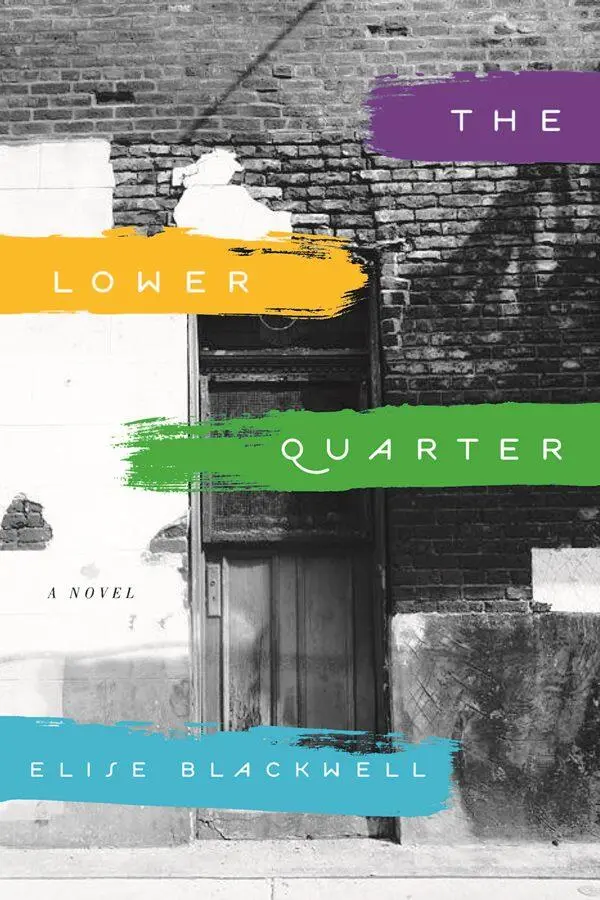
- Название:The Lower Quarter
- Автор:
- Издательство:Unbridled Books
- Жанр:
- Год:2015
- ISBN:нет данных
- Рейтинг книги:4 / 5. Голосов: 1
-
Избранное:Добавить в избранное
- Отзывы:
-
Ваша оценка:
The Lower Quarter: краткое содержание, описание и аннотация
Предлагаем к чтению аннотацию, описание, краткое содержание или предисловие (зависит от того, что написал сам автор книги «The Lower Quarter»). Если вы не нашли необходимую информацию о книге — напишите в комментариях, мы постараемся отыскать её.
An acquaintance, Clay Fontenot, who has enabled a wide variety of personal violations in his life, some of which he has enjoyed, is the scion of a powerful New Orleans family.
And Marion is an artist and masseuse from the Quarter who has returned after Katrina to rebuild her life.
When Eli, a convicted art thief, is sent to find the missing painting, all of their stories weave together in the slightly deranged halls of the Quarter.
The Lower Quarter — читать онлайн бесплатно полную книгу (весь текст) целиком
Ниже представлен текст книги, разбитый по страницам. Система сохранения места последней прочитанной страницы, позволяет с удобством читать онлайн бесплатно книгу «The Lower Quarter», без необходимости каждый раз заново искать на чём Вы остановились. Поставьте закладку, и сможете в любой момент перейти на страницу, на которой закончили чтение.
Интервал:
Закладка:
Another idea angled in: If a wealthy man did have unusual and expensive tastes, who better than the vile Czech to put you in touch with the people whom you wanted to know, such as someone who could shorten the wait for an unusual product, move you to the top of the list, assist your supplier in increasing his supply of materials? Perhaps the interest in human leather spoke of an ongoing connection between his father and Ladislav or had sparked a renewal of an old friendship of convenience.
Expecting his father home soon, at least potentially, Clay returned appearances to what they had been. An hour later, in the guest suite, in the bathroom where Marion had first changed into her absurd dominatrix costume, already looking more like someone who should be taken over his knee than someone who should be wearing leather, Clay stripped off his shirt. Standing before the mirror, he ran his hands up the smooth skin of his abdomen. Yes, he had to agree: it was the most beautiful skin on the human body. On someone like him, it was his only unblemished beauty. He wanted to show it to Johanna, to have her gaze upon it outside a moment of terror.
He felt his stomach harden, a defense against the nausea of memory. He’d visited the place Ladislav had managed before, naively thinking it was simply an establishment of high-end hookers — good-looking and clean and well paid. Twice he’d visited just to get laid before explaining to the vile Czech his particular interests, inquiring whether there might be some girl in town into that sort of thing and how much an hour or two with her might cost.
He wept now, first over his own stupidity and then over his guilt, for which he knew he had to make reparation.
Eli
The phone conversation he’d had with Ted left Eli smarting. What at first felt like anger, Eli recognized as injured pride. He’d learned that distinction even before prison: People often show hurt as anger. It was important to tease out those feelings, to know which came first and yielded the other, to be honest with yourself even when that meant embarrassment, meant acknowledging shame. Ted had put him in his place, and it was a low place indeed.
To Eli’s question about whom they were seeking the missing Van Mieghem for, Ted had just said, “The collector it belongs to.” When Eli pushed, Ted said, “There are no provenance issues. The three paintings have been in the man’s family since well before the war. Ownership is clean.”
“Have the two found been returned to him?” Eli ventured.
Ted gave him an unelaborated yes. “And he’d like the third one returned to him as well.”
Eli pushed once more, hinting for a name or some piece of identifying information.
“Look, Eli, you’re paid to do the finding. Your job description ends there.”
The tone of voice stung Eli, if only because Ted had previously always talked as though they were partners or buddies, even though they both knew that wasn’t the case at all.
So now Eli acknowledged the sting to his pride, reminded himself of his place in this particular hierarchy, told himself he was lucky to have what he had. Ted had more power than he did, including the power to return him to jail to serve out the final two years of his sentence. That was how things had always stood behind the friendly demeanor, so maybe it was better to keep that fact in plain sight. To lose sight of it could be to make a mistake; Eli did not want to go back to jail, ever.
What mattered to his investigation was to determine whether Ted was simply pulling rank (maybe he was tired and didn’t want to have the conversation Eli was trying to have) or whether there was some more nefarious reason Ted wouldn’t reveal any information about their client. Probably it came down to confidentiality, Eli decided, which was fair enough, even something he could respect.
Still, his last conversation with Johanna nagged at him. More disturbing, he knew that he had to investigate Johanna more thoroughly. What he hoped most was that his investigation would prove that she had nothing to do with the missing painting or the dead man. He even admitted to himself that he hoped this was true in part because then he could ask her to dinner, see what might be between them outside his current quest. If she had no interest in the painting, then her interest in him — however faint it might be — was personal. He stared at this unlikelihood and began the work he at least had to scratch at.
Even armed with her unusual full name and also searching alternative spellings and common typing errors, Eli could find scant digital evidence of Johanna’s life. Nothing from Croatia or Poland — the two countries people had told him she was from. Nothing from the rest of the Balkans, as far as he could tell, or from Belgium. And only a handful of items from Louisiana. One was a passing mention in an auction report, naming her as the restorer of a work that had sold through Felicia Pontalba’s outfit. Three were standard, incomplete listings of local businesses.
There was one more: a photograph taken at a society party called Sazeracs in September. In the sprawling backyard of a fancy Garden District home stood a semicircle of people — all smiling save the tall blond wearing a dark green dress, who glared just under the camera with what appeared to be contempt. Though a search of her name had yielded the pre-Katrina photograph from the Times-Picayune society page, and though several others in the semicircle were named, Johanna’s name did not appear in the caption. One name did strike Eli as familiar: Fontenot.
It took him a moment to place it: the last name of one of the collectors on the list Felicia had sent him. The former ambassador to Belgium. It was not Gerard Fontenot identified in the photograph but rather a Clayton Fontenot, a thin young man with fine light hair, angular in a pale gray suit that wasn’t properly tailored. Unlike the other men in the picture, young and old, he wore a thin, straight tie rather than the bow tie that had apparently been obligatory at this particular function. He and Johanna stood next to each other, but, unlike the arm-wrapping merrymakers on either side of them, they did not touch.
Eli experienced a sensation very much like nausea, except that it settled in his throat and again, as it had with Johanna at the bar, in the center of his forehead, a couple of inches over the bridge of his nose. He moved the meeting with Gerard Fontenot to the top of his list.
One of his tasks would be to assess Fontenot as a collector. In personality tests, a majority of collectors — but by no means all — score in ways similar to artists themselves. They are more likely to act on intuition than empirical knowledge, for instance, and more likely to be open-minded and to engage in novelty-seeking, even risky behaviors.
Of course people collect art out of a variety of motivations, from a simple calculation to diversify investment types to a desire to possess what no one else does or can. For some, collecting is a lifestyle, an all-consuming subculture. Other collectors simply use their acquisitions for social access or to show off. Many — an encouraging number, really — collect out of love. But Eli had seen enough of life to know that love can be perverted as well as altruistic.
Most legal collectors in Fontenot’s economic bracket were “show-ers”—people who wanted to own a piece of cultural history but were willing to share it. But Eli could turn up no evidence that Fontenot had ever opened a museum wing or anything of the kind and only two instances when he had lent a painting to a museum for show. It was possible he had done so anonymously on other occasions, but Eli had noticed that people either sign their names or they don’t. That Fontenot had taken credit twice suggested that he would always take credit, unless he’d experienced some sort of negative result from that, such as a spike in loan requests. A possibility, though Eli — being yet another intuition-reliant artist — discounted it. Former artist, he corrected himself.
Читать дальшеИнтервал:
Закладка:
Похожие книги на «The Lower Quarter»
Представляем Вашему вниманию похожие книги на «The Lower Quarter» списком для выбора. Мы отобрали схожую по названию и смыслу литературу в надежде предоставить читателям больше вариантов отыскать новые, интересные, ещё непрочитанные произведения.





Обсуждение, отзывы о книге «The Lower Quarter» и просто собственные мнения читателей. Оставьте ваши комментарии, напишите, что Вы думаете о произведении, его смысле или главных героях. Укажите что конкретно понравилось, а что нет, и почему Вы так считаете.