Jesse Goolsby - I'd Walk with My Friends If I Could Find Them
Здесь есть возможность читать онлайн «Jesse Goolsby - I'd Walk with My Friends If I Could Find Them» весь текст электронной книги совершенно бесплатно (целиком полную версию без сокращений). В некоторых случаях можно слушать аудио, скачать через торрент в формате fb2 и присутствует краткое содержание. Год выпуска: 2015, Издательство: Houghton Mifflin Harcourt, Жанр: Современная проза, на английском языке. Описание произведения, (предисловие) а так же отзывы посетителей доступны на портале библиотеки ЛибКат.
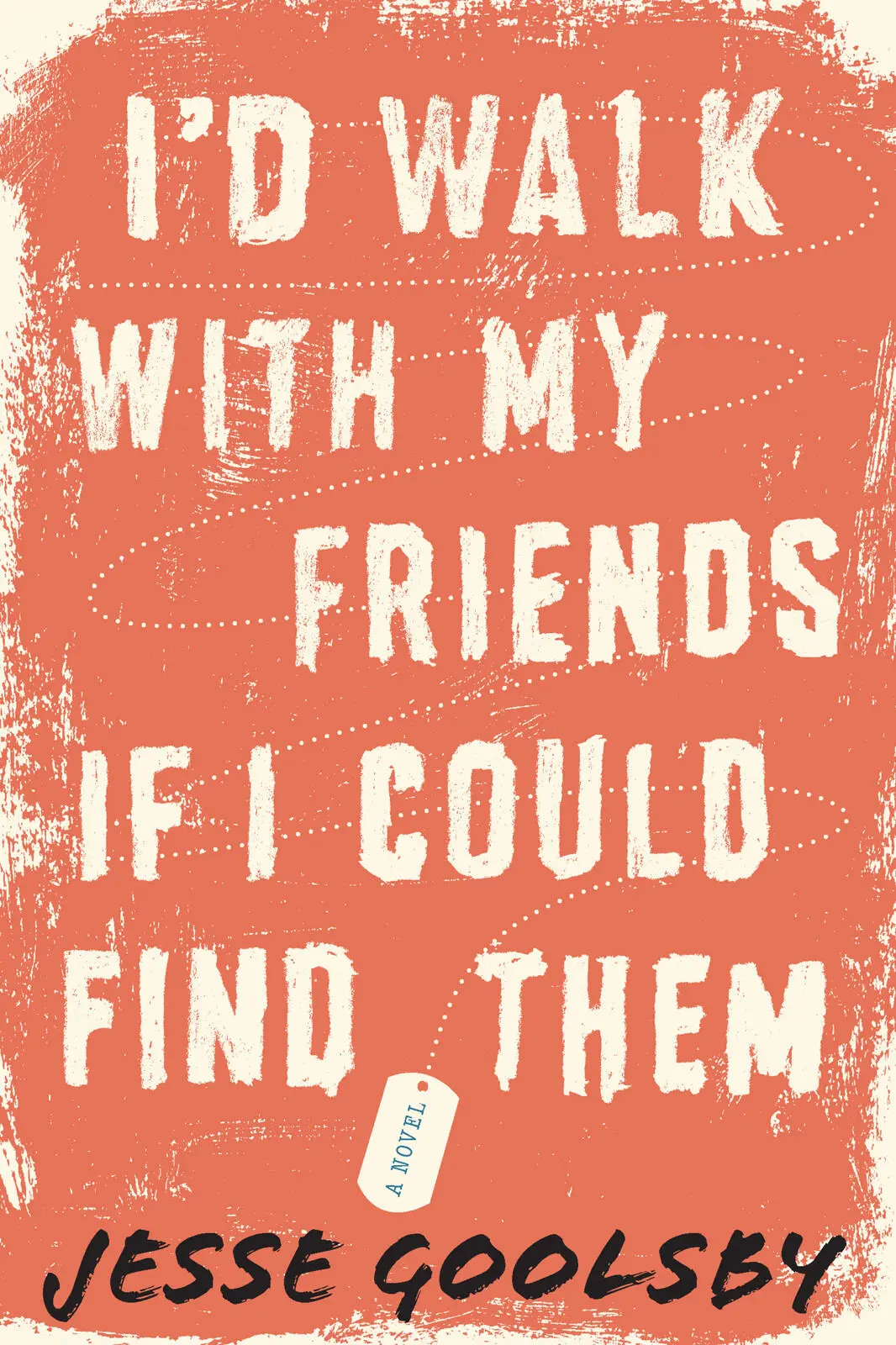
- Название:I'd Walk with My Friends If I Could Find Them
- Автор:
- Издательство:Houghton Mifflin Harcourt
- Жанр:
- Год:2015
- ISBN:нет данных
- Рейтинг книги:3 / 5. Голосов: 1
-
Избранное:Добавить в избранное
- Отзывы:
-
Ваша оценка:
I'd Walk with My Friends If I Could Find Them: краткое содержание, описание и аннотация
Предлагаем к чтению аннотацию, описание, краткое содержание или предисловие (зависит от того, что написал сам автор книги «I'd Walk with My Friends If I Could Find Them»). Если вы не нашли необходимую информацию о книге — напишите в комментариях, мы постараемся отыскать её.
Wintric Ellis joins the army as soon as he graduates from high school, saying goodbye to his girlfriend, Kristen, and to the backwoods California town whose borders have always been the limits of his horizon. Deployed for two years in Afghanistan in a directionless war, he struggles to find his bearings in a place where allies could at any second turn out to be foes. Two career soldiers, Dax and Torres, take Wintric under their wing. Together, these three men face an impossible choice: risk death or commit a harrowing act of war. The aftershocks echo long after each returns home to a transfigured world, where his own children may fear to touch him and his nightmares still hold sway.
Jesse Goolsby casts backward and forward in time to track these unforgettable characters from childhood to parenthood, from redwood forests to open desert roads to the streets of Kabul. Hailed by Robert Olen Butler as a “major literary event,” I’d Walk with My Friends If I Could Find Them is a work of disarming eloquence and heart-wrenching wisdom, and a debut novel from a writer to watch.
I'd Walk with My Friends If I Could Find Them — читать онлайн бесплатно полную книгу (весь текст) целиком
Ниже представлен текст книги, разбитый по страницам. Система сохранения места последней прочитанной страницы, позволяет с удобством читать онлайн бесплатно книгу «I'd Walk with My Friends If I Could Find Them», без необходимости каждый раз заново искать на чём Вы остановились. Поставьте закладку, и сможете в любой момент перейти на страницу, на которой закончили чтение.
Интервал:
Закладка:
“You’ve been home two weeks. You’re getting out. I’m not trying to pile on here, but you’re somewhere else. I’ll give you space, but you have to talk to me. Your kids miss you. You’re not playing with them. Be their dad.”
Armando inspects a thin space between the molding and the ceiling. The work is shoddy, and the separation spells trouble elsewhere for a house this new.
“It’s a big deal. I’m speaking to you,” she says, and he hears her.
“Everything’s always a big deal. Relax.”
“Promise me that much. You’ll tell me.”
Armando nods along, the single physical movement he can muster, and when he doesn’t respond Anna reaches out and takes his hands in hers. He looks at his wife, her hair still pinned up nicely for church. He knows she wants to heal something in him, and as they sit there together he wonders if she is disappointed that he is whole.
An hour later Armando lounges on his front porch bench, reading old Calvin and Hobbes comics. An incredibly warm day for November. He watches the Front Range of the Rockies to the west, late-afternoon thunderheads instead of snow-filled clouds cresting the peaks. He considers waking the girls from their naps and heading up to Gold Camp Road, or for an ice cream at Michelle’s downtown, or maybe for a stroll around the Broadmoor’s pond, but he listens to the quiet peace in the air and closes his eyes and smells the almost-rain and stays put.
He’ll have to start applying for civilian jobs soon if he wants a smooth transition from military to civilian work, but he doesn’t yet know what jobs to apply for, where his skills align, what he would do if he had a choice. He has an army veteran friend making good money on the motivational speaker circuit. He’s told Armando there’s a place for him, that you keep the speeches to smaller venues, a twenty-five-minute routine — two war stories, wear your uniform, and include the words honor, courage, and sacrifice, and you’re set.
“There’s no scam here,” his friend tells him. “You tell the truth. The emotional truth. The World War Two, Korean, Vietnam, even Gulf War One folks want to know. They want to compare stories. People leave motivated. They appreciate service. They want to hear from someone that’s been there. The story is the hero. You’re just the teller. Up to a grand a speech for the truth. No one’s doing this. No one. If we don’t tell our stories, someone else will.”
Not shy in front of crowds, Armando has thought about the offer, but when he considers which stories to dress up, he invariably returns to the checkpoint girl. But instead of a girl — it can’t be a girl — it has morphed into a man, a bearded man, two bearded men in a tiny hatchback, two bearded men in a tiny hatchback yelling “Allahu akbar,” and in the story he doesn’t shoot, it is a story about witness, he was there but as witness to honor, courage, sacrifice. Even as he forms the new scenes, the new characters, he knows he’ll never tell either story. Even in debrief that day in Afghanistan, he, Big Dax, Wintric, and the LT had different answers to the same questions: “How many times did you yell to her to stop?” “Who shot first, second, third?” “How far was she?” “Why didn’t you aim for her legs?” “When did she drop the ball?” “Was it possible she was pleading for help?” “Is it true you argued among yourselves about who had hit her?”
The first droplets hit the front yard, and Armando wonders how long he’ll consider himself a soldier, how long he’ll want to. He’s told Anna that he won’t shave for a month after he gets out, but what that means he isn’t yet sure. The rain is pounding now, and a crack of thunder sounds a few miles south. He sees the familiar bevy of antennas on top of Cheyenne Mountain — the nuclear war — proof mountain. Thank you, Cheyenne Mountain. His father’s new wife used to work in the mountain, the stepmother he has come home to, unbearably kind and supportive. Disgustingly humble and already a confidant of Anna’s. This woman with years in the mountain, but she can’t talk about the mountain. Easy questions: “How many people do we have in there?” “Are we still tracking Russian nukes?” Armando has served at Fort Carson for years, not two miles from Cheyenne Mountain, and he knows nothing about it, save the nuclear war — proof claim, the antennas, the fact that he now knows someone who has worked there, and some unsubstantiated claims by his father. Years ago his father told him two things about the mountain: (1) that Russia’s nuclear aim was so poor that living next door to it was the perfect place to be, and God help anyone around the Durango area if things started rocking, and (2) that the microwave was invented inside the mountain. Whenever Armando’s father would heat up popcorn, he’d tap the microwave door and say, “Thank you, Cheyenne Mountain.” That’s what Armando hears now on his front porch, “Thank you, Cheyenne Mountain,” and the rain pounding, the antennas, the same antennas he watched blinking at night as a child, and he flashes back to when he was sixteen years old, popcorn popping on their Friday family movie night, each of them arguing for a different film and Armando’s mother finally deciding what to watch and all of them settling in. His mother on the couch, his mother on the couch post-transplant, saltines and 7Up, a trombone, the rain even harder now, punishing, his father on the baseball field taking him in his arms, the open-casket viewing the night before the burial, his fascination with his mother’s shaved face, her funeral, singing “Because I Have Been Given Much,” a three-mile-long car procession, the bishop’s promise that they would all be together again in heaven and his father laughing, months of his father’s madness, hiding the lighters in his sock drawer, his sister’s move to their aunt’s in Cortez, Marie to Arizona, a friend signing up for the army, Armando going along, the papers in front of him in the recruiting office, the path forward, out, his signature, signatures, his name, signing, black ink, his name.
Six minutes into the downpour Armando sees minirivers along the street’s gutters and pools forming in his uneven front yard. The Front Range is already clearing and he guesses the rain will stop soon, and it’s a good thing, because the yard can’t take much more water. Already he knows they’ll have to move from this place, maybe only from this poorly constructed house, maybe to a whole new city, but he’s certain this isn’t the place he wants to come home to, this isn’t the place he wants his kids to come home to, and although he has no way of knowing now, he’s right.
In a couple years he’ll move his family about forty miles north to Castle Rock, where they’ll enjoy a better view of the Rockies and a properly graded front yard, a home where his kids will grow and fight, where he’ll watch the Broncos lose a Super Bowl, where, decades from now and wheelchair-bound, Armando will turn to hiding bottles of whiskey in boxes of Christmas decorations, a home where he’ll write a letter inviting his estranged daughter Mia home and one July day, overcome with emotion, he’ll welcome Mia and her daughter back into his life. But right now Armando sits and watches the shallow front-yard pond creep outward, and although the sky has now cleared above him, the rain continues to fall.
That evening Camila and Mia play in the home’s fenced back yard. The moon already hugs the southeast sky, and things get heated between the girls after Camila trips Mia and tugs on her leg, pulling her around the still drying yard. Mia screams, but Camila keeps yanking.
“Easy,” Armando says. He stares at his kids. They ignore him. He realizes that they’re starting to look more and more like Anna.
Читать дальшеИнтервал:
Закладка:
Похожие книги на «I'd Walk with My Friends If I Could Find Them»
Представляем Вашему вниманию похожие книги на «I'd Walk with My Friends If I Could Find Them» списком для выбора. Мы отобрали схожую по названию и смыслу литературу в надежде предоставить читателям больше вариантов отыскать новые, интересные, ещё непрочитанные произведения.








Обсуждение, отзывы о книге «I'd Walk with My Friends If I Could Find Them» и просто собственные мнения читателей. Оставьте ваши комментарии, напишите, что Вы думаете о произведении, его смысле или главных героях. Укажите что конкретно понравилось, а что нет, и почему Вы так считаете.