Saïd Sayrafiezadeh - New American Stories
Здесь есть возможность читать онлайн «Saïd Sayrafiezadeh - New American Stories» весь текст электронной книги совершенно бесплатно (целиком полную версию без сокращений). В некоторых случаях можно слушать аудио, скачать через торрент в формате fb2 и присутствует краткое содержание. Год выпуска: 2015, Издательство: Vintage, Жанр: Современная проза, на английском языке. Описание произведения, (предисловие) а так же отзывы посетителей доступны на портале библиотеки ЛибКат.
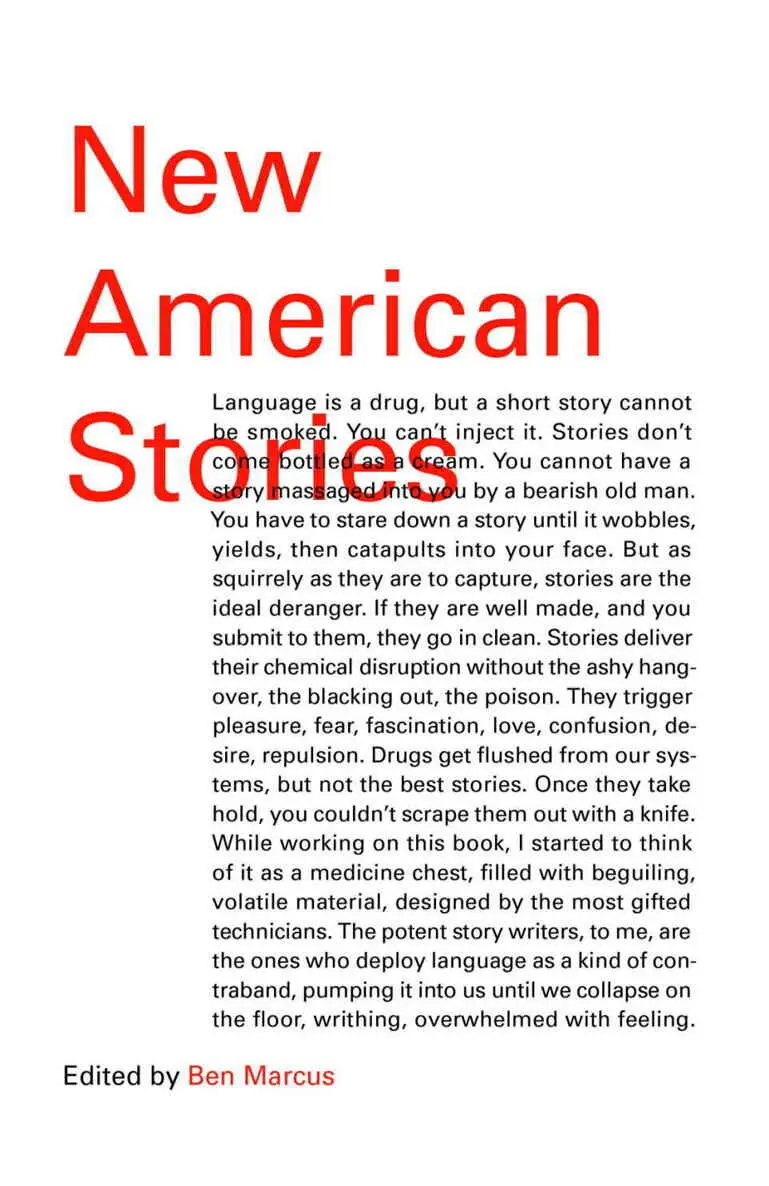
- Название:New American Stories
- Автор:
- Издательство:Vintage
- Жанр:
- Год:2015
- ISBN:нет данных
- Рейтинг книги:3 / 5. Голосов: 1
-
Избранное:Добавить в избранное
- Отзывы:
-
Ваша оценка:
New American Stories: краткое содержание, описание и аннотация
Предлагаем к чтению аннотацию, описание, краткое содержание или предисловие (зависит от того, что написал сам автор книги «New American Stories»). Если вы не нашли необходимую информацию о книге — напишите в комментариях, мы постараемся отыскать её.
In
, the beautiful, the strange, the melancholy, and the sublime all comingle to show the vast range of the American short story. In this remarkable anthology, Ben Marcus has corralled a vital and artistically singular crowd of contemporary fiction writers. Collected here are practitioners of deep realism, mind-blowing experimentalism, and every hybrid in between. Luminaries and cult authors stand side by side with the most compelling new literary voices. Nothing less than the American short story renaissance distilled down to its most relevant, daring, and unforgettable works,
puts on wide display the true art of an American idiom.
New American Stories — читать онлайн бесплатно полную книгу (весь текст) целиком
Ниже представлен текст книги, разбитый по страницам. Система сохранения места последней прочитанной страницы, позволяет с удобством читать онлайн бесплатно книгу «New American Stories», без необходимости каждый раз заново искать на чём Вы остановились. Поставьте закладку, и сможете в любой момент перейти на страницу, на которой закончили чтение.
Интервал:
Закладка:
I let the door close behind me. The bartender, a small old black man, raised his eyebrows, and I said, “Scotch rocks, Red Label.” Talking, I felt discourteous. The piano played in the gloom of the farthest corner. I recognized the melody as a Mexican traditional called “Maria Elena.” I couldn’t see the musician at all. In front of the piano a big tenor saxophone rested upright on a stand. With no one around to play it, it seemed like just another of the personalities here: the invisible pianist, the disenchanted old bartender, the big glamorous blonde, the shipwrecked, solitary saxophone. And the man who’d walked here through the snow…And as soon as the name of the song popped into my head I thought I heard a voice say, “Her name is Maria Elena.” The scene had a moonlit, black-and-white quality. Ten feet away, at her table, the blond woman waited, her shoulders back, her face raised. She lifted one hand and beckoned me with her fingers. She was weeping. The lines of her tears sparkled on her cheeks. “I am a prisoner here,” she said. I took the chair across from her and watched her cry. I sat upright, one hand on the table’s surface and the other around my drink. I felt the ecstasy of a dancer, but I kept still.
WHIT
My name would mean nothing to you, but there’s a very good chance you’re familiar with my work. Among the many TV ads I wrote and directed, you’ll remember one in particular.
In this animated thirty-second spot, you see a brown bear chasing a gray rabbit. They come one after the other over a hill toward the view — the rabbit is cornered, he’s crying, the bear comes to him — the rabbit reaches into his waistcoat pocket and pulls out a dollar bill and gives it to the bear. The bear looks at this gift, sits down, stares into space. The music stops, there’s no sound, nothing is said, and, right there, the little narrative ends, on a note of complete uncertainty. It’s an advertisement for a banking chain. It sounds ridiculous, I know, but that’s only if you haven’t seen it. If you’ve seen it, the way it was rendered, then you know that it was a very unusual advertisement. Because it referred, really, to nothing at all, and yet it was actually very moving.
Advertisements don’t try to get you to fork over your dough by tugging irrelevantly at your heartstrings, not as a rule. But this one broke the rules, and it worked. It brought the bank many new customers. And it excited a lot of commentary and won several awards — every award I ever won, in fact, I won for that ad. It ran in both halves of the twenty-second Super Bowl, and people still remember it.
You don’t get awards personally. They go to the team. To the agency. But your name attaches to the project as a matter of workplace lore—“Whit did that one.” (And that would be me, Bill Whitman.) “Yes, the one with the rabbit and the bear was Whit’s.”
Credit goes first of all to the banking firm who let this strange message go out to potential customers, who sought to start a relationship with a gesture so cryptic. It was better than cryptic — mysterious, untranslatable. I think it pointed to orderly financial exchange as the basis of harmony. Money tames the beast. Money is peace. Money is civilization. The end of the story is money.
I won’t mention the name of the bank. If you don’t remember the name, then it wasn’t such a good ad after all.
If you watched any prime-time television in the 1980s, you’ve almost certainly seen several other ads I wrote or directed or both. I crawled out of my twenties leaving behind a couple of short, unhappy marriages, and then I found Elaine. Twenty-five years last June, and two daughters. Have I loved my wife? We’ve gotten along. We’ve never felt like congratulating ourselves.
I’m just shy of sixty-three. Elaine’s fifty-two but seems older. Not in her looks but in her attitude of complacency. She lacks fire. Seems interested mainly in our two girls. She keeps in close contact with them. They’re both grown. They’re harmless citizens. They aren’t beautiful or clever.
Before the girls started grade school, we left New York and headed west in stages, a year in Denver (too much winter), another in Phoenix (too hot), and finally San Diego. San Diego. What a wonderful city. It’s a bit more crowded each year, but still. Completely wonderful. Never regretted coming here, not for an instant. And financially it all worked out. If we’d stayed in New York I’d have made a lot more money, but we’d have needed a lot more, too.
Last night Elaine and I lay in bed watching TV, and I asked her what she remembered. Not much. Less than I. We have a very small TV that sits on a dresser across the room. Keeping it going provides an excuse for lying awake in bed.
I note that I’ve lived longer in the past, now, than I can expect to live in the future. I have more to remember than I have to look forward to. Memory fades, not much of the past stays, and I wouldn’t mind forgetting a lot more of it.
Once in a while, I lie there as the television runs, and I read something wild and ancient from one of several collections of folktales I own. Apples that summon sea maidens, eggs that fulfill any wish, and pears that make people grow long noses that fall off again. Then sometimes I get up and don my robe and go out into our quiet neighborhood looking for a magic thread, a magic sword, a magic horse.
THE COUNTRY by Joy Williams
I attend a meeting called Come and See! The group gathers weekly at the Episcopal church in one of the many, many rooms available there but in the way these things are it’s wide open to everyone — atheists, Buddhists, addicts, depressives, everyone. The discussion that evening concerned the old reliable: Why Are We Here? And one woman, Jeanette it was, offered that she never knew what her purpose was until recently. She discovered her purpose was to be there with the dying in their final moments. Right there, in attendance. Strangers for the most part. No one she knew particularly well. She found that she loved this new role. It was wonderful, it was amazing to be present for that moment of transport. It was such an honor being there and she believed she provided reassurance. And she shared with us the story of this one old girl who was actively dying — that was her phrase, actively dying —and at one point the old girl looked at Jeanette and said, “Am I still here?” and when she was told yes, yes, she was, the dying woman said, “Darn.”
“She was so cute,” Jeanette said.
My fellow travelers in Come and See! listened to this with equanimity. Jeanette was as happy as I’d ever seen her — she doesn’t come every week — and enthusiastic as she shared with us how positive and comforting it is to witness the final voyage. She’s affiliated with the church somehow, she studied chaplaincy services or something, so she has a certain amount of access to these situations; that is, she’s not doing this illegally or inappropriately or anything.
I sincerely cannot remember the circumstances that brought me to Come and See! for the first time and why I continue to attend. I seldom speak and never share. I sit erect but with my eyes downcast, focusing on a large paper clip that has rested in a groove between two tiles for months. Surely the chairs must be folded and stacked or rearranged for other functions and the floor swept or mopped on occasion, but the paper clip remains.
Beside me, Harold — he’s sixty-three and the father of two-year-old triplets — says, “I believe we are here for the future, to build a better future,” blandly cutting off any communal amplification of Jeanette’s deathbed theme.
My eyes lowered, I stare at the paper clip. I dislike Harold. Triplets, for god’s sakes. One day I will no longer come here and listen to these wretched things.
Читать дальшеИнтервал:
Закладка:
Похожие книги на «New American Stories»
Представляем Вашему вниманию похожие книги на «New American Stories» списком для выбора. Мы отобрали схожую по названию и смыслу литературу в надежде предоставить читателям больше вариантов отыскать новые, интересные, ещё непрочитанные произведения.






![Женя Джентбаев - neo futura [stories]](/books/692472/zhenya-dzhentbaev-neo-futura-stories-thumb.webp)

Обсуждение, отзывы о книге «New American Stories» и просто собственные мнения читателей. Оставьте ваши комментарии, напишите, что Вы думаете о произведении, его смысле или главных героях. Укажите что конкретно понравилось, а что нет, и почему Вы так считаете.