Saïd Sayrafiezadeh - New American Stories
Здесь есть возможность читать онлайн «Saïd Sayrafiezadeh - New American Stories» весь текст электронной книги совершенно бесплатно (целиком полную версию без сокращений). В некоторых случаях можно слушать аудио, скачать через торрент в формате fb2 и присутствует краткое содержание. Год выпуска: 2015, Издательство: Vintage, Жанр: Современная проза, на английском языке. Описание произведения, (предисловие) а так же отзывы посетителей доступны на портале библиотеки ЛибКат.
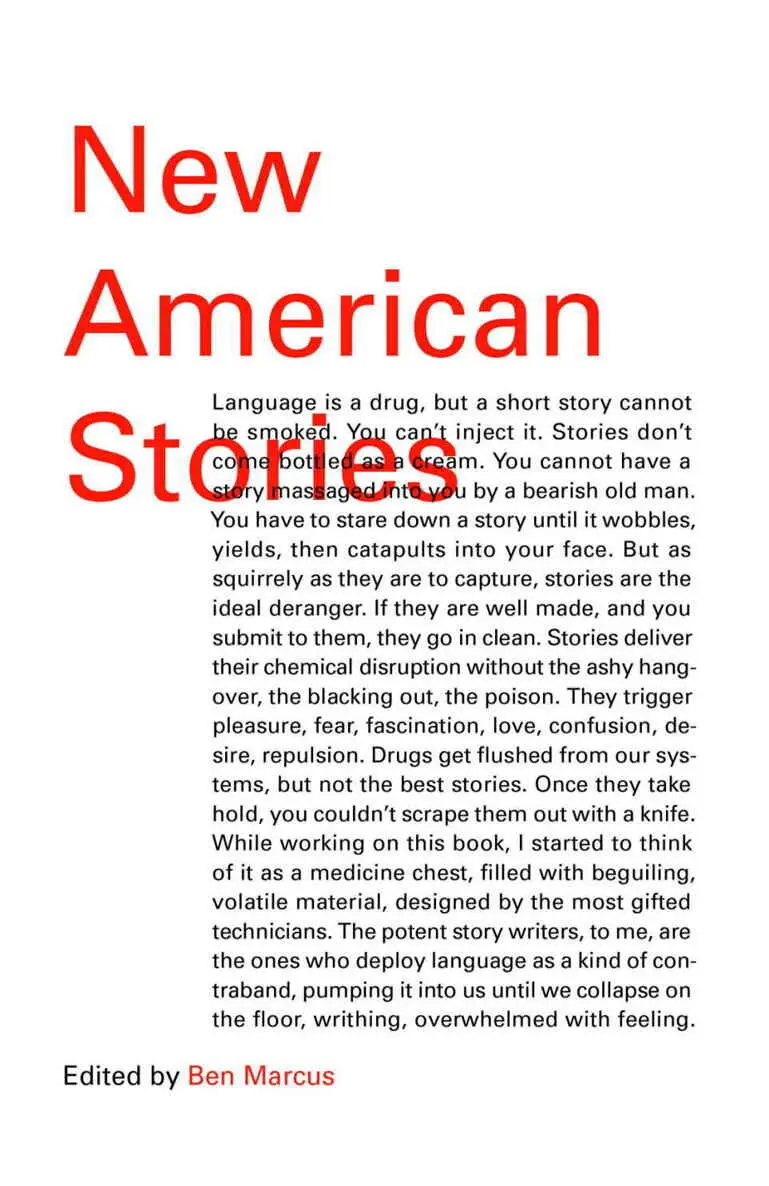
- Название:New American Stories
- Автор:
- Издательство:Vintage
- Жанр:
- Год:2015
- ISBN:нет данных
- Рейтинг книги:3 / 5. Голосов: 1
-
Избранное:Добавить в избранное
- Отзывы:
-
Ваша оценка:
New American Stories: краткое содержание, описание и аннотация
Предлагаем к чтению аннотацию, описание, краткое содержание или предисловие (зависит от того, что написал сам автор книги «New American Stories»). Если вы не нашли необходимую информацию о книге — напишите в комментариях, мы постараемся отыскать её.
In
, the beautiful, the strange, the melancholy, and the sublime all comingle to show the vast range of the American short story. In this remarkable anthology, Ben Marcus has corralled a vital and artistically singular crowd of contemporary fiction writers. Collected here are practitioners of deep realism, mind-blowing experimentalism, and every hybrid in between. Luminaries and cult authors stand side by side with the most compelling new literary voices. Nothing less than the American short story renaissance distilled down to its most relevant, daring, and unforgettable works,
puts on wide display the true art of an American idiom.
New American Stories — читать онлайн бесплатно полную книгу (весь текст) целиком
Ниже представлен текст книги, разбитый по страницам. Система сохранения места последней прочитанной страницы, позволяет с удобством читать онлайн бесплатно книгу «New American Stories», без необходимости каждый раз заново искать на чём Вы остановились. Поставьте закладку, и сможете в любой момент перейти на страницу, на которой закончили чтение.
Интервал:
Закладка:
As for having told so many lies to the man she’d married — that was one of the things she laughed about. She seemed to assume that anybody else would have done the same. In addition to her bogus employment and her imaginary studies in real estate, she’d endowed herself with a religious soul and joined a nonexistent church. Thanks to all her fabrications, William Donald Mason had died a proud and happy husband.
And, just as he’d been surprised by his sudden intimacy with the condemned killer, my friend felt very close to the widow, because they were talking to each other about life and death while she displayed her nakedness before him, sitting on the stool with her red spike-heeled pumps planted wide apart on the floor. I asked him if they’d ended up making love, and he said no, but he’d wanted to, he certainly had, and he was convinced that the naked widow had felt the same, though you weren’t allowed to touch the girls in those places, and this dialogue, in fact both of them — the death-row interview and the interview with the naked widow — had taken place through glass partitions made to withstand any kind of passionate assault.
At the time, the idea of telling her what he wanted had seemed terrible. Now he regretted his shyness. In the play, as he described it for me, the second act would end differently.
Before long, we wandered into a discussion of the difference between repentance and regret. You repent the things you’ve done, and regret the chances you let get away. Then, as sometimes happens in a San Diego café—more often than you’d think — we were interrupted by a beautiful young woman selling roses.
ORPHAN
The lunch with Tom Ellis took place a couple of years ago. I don’t suppose he ever wrote the play; it was just a notion he was telling me about. It came to mind today because this afternoon I attended the memorial service of an artist friend of mine, a painter named Tony Fido, who once told me about a similar experience.
Tony found a cell phone on the ground near his home in National City, just south of here. He told me about this the last time I saw him, a couple of months before he disappeared, or went out of communication. First he went out of communication, then he was deceased. But when he told me this story there was no hint of any of that.
Tony noticed the cell phone lying under an oleander bush as he walked around his neighborhood. He picked it up and continued his stroll, and before long felt it vibrating in his pocket. When he answered, he found himself talking to the wife of the owner — the owner’s widow, actually, who explained that she’d been calling the number every thirty minutes or so since her husband’s death, not twenty-four hours before.
Her husband had been killed the previous afternoon in an accident at the intersection where Tony had found the cell phone. An old woman in a Cadillac had run him down. At the moment of impact, the device had been torn from his hand.
The police said that they hadn’t noticed any phone around the scene. It hadn’t been among the belongings she’d collected at the morgue. “I knew he lost it right there,” she told Tony, “because he was talking to me at the very second when it happened.”
Tony offered to get in his car and deliver the phone to her personally, and she gave him her address in Lemon Grove, nine miles distant. When he got there he discovered that the woman was only twenty-two and quite attractive, and that she and her husband had been going through a divorce.
At this point in the telling, I think I knew where his story was headed.
“She came after me. I told her, ‘You’re either from Heaven or from Hell.’ It turned out she was from Hell.”
Whenever he talked, Tony kept his hands moving — grabbing and rearranging small things on the tabletop — while his head rocked from side to side and back and forth. Sometimes he referred to a “force of rhythm” in his paintings. He often spoke of “motion” in the work.
I didn’t know much about Tony’s background. He was in his late forties but seemed younger. I met him at the Balboa Park museum, where he appeared at my shoulder while I looked at an Edward Hopper painting of a Cape Cod gas station. He offered his critique, which was lengthy, meticulous, and scathing — and which was focused on technique, only on technique — and spoke of his contempt for all painters, and finished by saying, “I wish Picasso was alive. I’d challenge him — he could do one of mine and I could do one of his.”
“You’re a painter yourself.”
“A better painter than this guy,” he said of Edward Hopper.
“Well, whose work would you say is any good?”
“The only painter I admire is God. He’s my biggest influence.”
We began having coffee together two or three times a month, always, I have to admit, at Tony’s initiation. Usually I drove to his lively, disheveled Hispanic neighborhood to see him, there in National City. I like primitive art, and I like folktales, so I enjoyed visiting his rambling old home, where he lived surrounded by his paintings, like an orphan king in a cluttered castle.
The house had been in his family since 1939. For a while, it was a boardinghouse — a dozen bedrooms, each with its own sink. “Damn place has a jinx or whammy: First, Spiro — Spiro watched it till he died. Mom watched it till she died. My sister watched it till she died. Now I’ll be here till I die,” he said, hosting me shirtless, his hairy torso dabbed all over with paint. Talking so fast I could rarely follow, he did seem deranged. But blessed, decidedly so, with a self-deprecating and self-orienting humor that the genuinely mad seem to have misplaced. What to make of somebody like that? “Richards in the Washington Post, ” he once said, “compared me to Melville.” I have no idea who Richards was. Or who Spiro was.
Tony never tired of his voluble explanations, his self-exegesis — the works almost coded, as if to fool or distract the unworthy. They weren’t the child drawings of your usual schizophrenic outsider artist, but efforts a little more skillful, on the order of tattoo art, oil on canvases around four by six feet in size, crowded with images but highly organized, all on biblical themes, mostly dire and apocalyptic, and all with the titles printed neatly right on them. One of his works, for instance — three panels depicting the end of the world and the advent of Heaven — was called “Mystery Babylon Mother of Harlots Revelation 17:1–7.”
This period when I was seeing a bit of Tony Fido coincided with an era in the world of my unconscious, an era when I was troubled by the dreams I had at night. They were long and epic, detailed and violent and colorful. They were exhausting. I couldn’t account for them. The only medication I took was something to bring down my blood pressure, and it wasn’t new. I made sure I didn’t take food just before going to bed. I avoided sleeping on my back, steered clear of disturbing novels and TV shows. For a month, maybe six weeks, I dreaded sleep. Once, I dreamed of Tony — I defended him against an angry mob, keeping the seething throng at bay with a butcher knife. Often, I woke up short of breath, shaking, my heartbeat rattling my ribs, and I cured my nerves with a solitary walk, no matter the hour. And once — maybe the night I dreamed about Tony, I don’t remember — I went walking and had the kind of moment or visitation I treasure, when the flow of life twists and untwists, all in a blink — think of a taut ribbon flashing: I heard a young man’s voice in the parking lot of the Mormon church in the dark night telling someone, “I didn’t bark. That wasn’t me. I didn’t bark.”
I never found out how things turned out between Tony and the freshly widowed twenty-two-year-old. I’m pretty sure it went no further, and there was no second encounter, certainly no ongoing affair — because he more than once complained, “I can’t find a woman, none. I’m under some kind of a damn spell.” He believed in spells and whammies and such, in angels and mermaids, omens, sorcery, wind-borne voices, in messages and patterns. All through his house were scattered twigs and feathers possessing a mysterious significance, rocks that had spoken to him, stumps of driftwood whose faces he recognized. And, in any direction, his canvases, like windows opening onto lightning and smoke, ranks of crimson demons and flying angels, gravestones on fire, and scrolls, chalices, torches, swords.
Читать дальшеИнтервал:
Закладка:
Похожие книги на «New American Stories»
Представляем Вашему вниманию похожие книги на «New American Stories» списком для выбора. Мы отобрали схожую по названию и смыслу литературу в надежде предоставить читателям больше вариантов отыскать новые, интересные, ещё непрочитанные произведения.



![Женя Джентбаев - neo futura [stories]](/books/692472/zhenya-dzhentbaev-neo-futura-stories-thumb.webp)

Обсуждение, отзывы о книге «New American Stories» и просто собственные мнения читателей. Оставьте ваши комментарии, напишите, что Вы думаете о произведении, его смысле или главных героях. Укажите что конкретно понравилось, а что нет, и почему Вы так считаете.