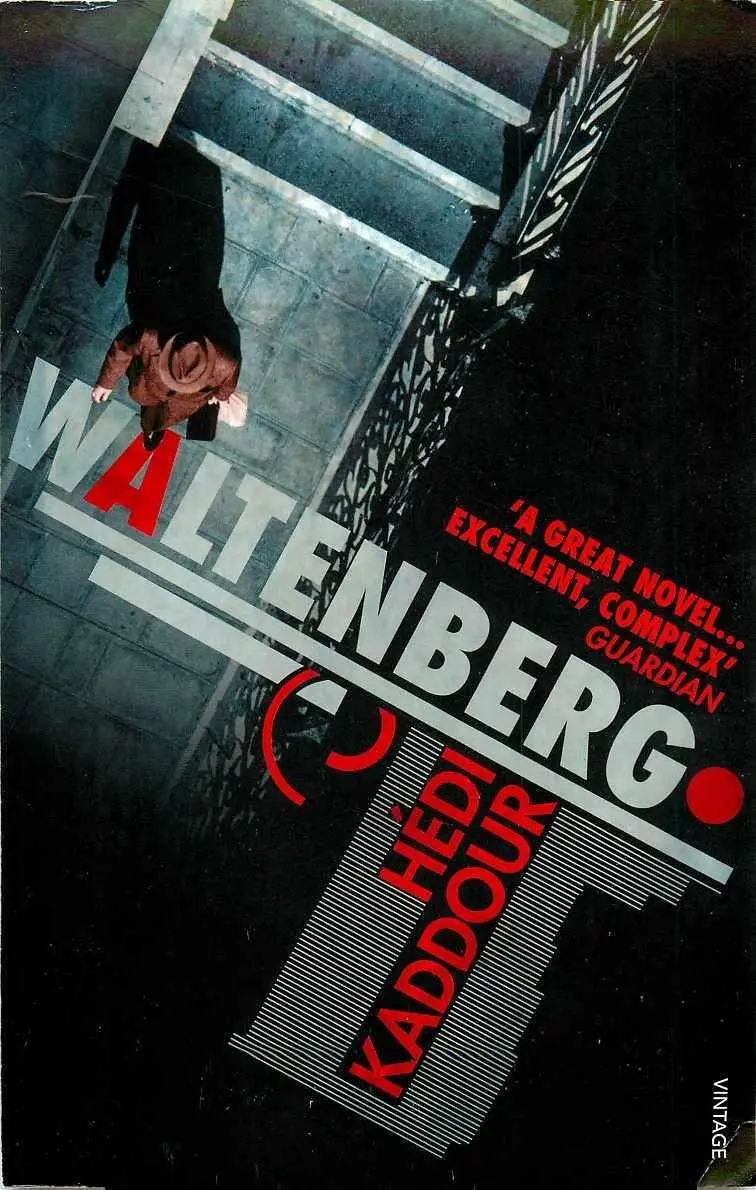
Hedi Kaddour - Waltenberg
Здесь есть возможность читать онлайн «Hedi Kaddour - Waltenberg» весь текст электронной книги совершенно бесплатно (целиком полную версию без сокращений). В некоторых случаях можно слушать аудио, скачать через торрент в формате fb2 и присутствует краткое содержание. Год выпуска: 2009, Издательство: Vintage, Жанр: Современная проза, на английском языке. Описание произведения, (предисловие) а так же отзывы посетителей доступны на портале библиотеки ЛибКат.
- Название:Waltenberg
- Автор:
- Издательство:Vintage
- Жанр:
- Год:2009
- ISBN:нет данных
- Рейтинг книги:3 / 5. Голосов: 1
-
Избранное:Добавить в избранное
- Отзывы:
-
Ваша оценка:
Waltenberg: краткое содержание, описание и аннотация
Предлагаем к чтению аннотацию, описание, краткое содержание или предисловие (зависит от того, что написал сам автор книги «Waltenberg»). Если вы не нашли необходимую информацию о книге — напишите в комментариях, мы постараемся отыскать её.
Waltenberg
Waltenberg — читать онлайн бесплатно полную книгу (весь текст) целиком
Ниже представлен текст книги, разбитый по страницам. Система сохранения места последней прочитанной страницы, позволяет с удобством читать онлайн бесплатно книгу «Waltenberg», без необходимости каждый раз заново искать на чём Вы остановились. Поставьте закладку, и сможете в любой момент перейти на страницу, на которой закончили чтение.
Интервал:
Закладка:
The earth quakes, no one is going to kill Hans, it’s not done, anyway it’s a dream, dream another dream, think of the things you love.
Eighty thousand dead and two weeks later, on 22 September, came Saint-Rémy.
‘Captain Gramont wouldn’t listen, Lieutenant Fournier and Lieutenant Imbert wept because they could see the Captain was leading us to our deaths,’ Private Angla told Jacques Rivière.
In Rivière’s view, Alain-Fournier did not attack a dressing-station. The wood at Saint-Rémy is also known as Knights’ Wood.
In his ditch at Monfaubert Hans is afraid and ashamed, he looks at Johann, his partially severed head, the blood has flowed copiously from Johann’s neck.
The dressing-station attacked at a run, the orders of a captain who says:
‘I’ve got the black-rot right through me.’
‘A French war crime,’ say the Germans, ‘those responsible were shot.’
‘Not a dressing-station but a cart carrying stretchers,’ is the response on the French side.
‘A fine, a great, a just war,’ writes Henri Alban Fournier to Isabelle just before he was killed.
And to Pauline:
‘We must not think anything that cuts the ground from under our feet.’
A dressing-station attacked by French forces: a report by Commandant Uecker, officer commanding the German 2nd Medical Corps:
‘At Saint-Rémy, a group of French infantry led by two officers killed eight stretcher-bearers and shot the three wounded men being treated in the dressing-station.’
On 24 November 1914, to a German military court, Private Meerländer:
‘On 22 September, I saw French soldiers killing the wounded men on our stretchers, our men surrounded the Frenchmen and shot them all.’
‘Untrue,’ say the officials of the Association of the Friends of Jacques Rivière and Alain-Foumier, ‘it is simply not true that Alain-Fournier was shot for attacking a field dressing-station, and anyway it wasn’t a dressing-station ambulance but a cart carrying a few stretchers.’
Chapter 2. 1914, The Lake
In which the intensity of the French cavalry charge reaches new heights.
In which the achievement of President Poincaré is compared with that of the Pieds Nickelés.
In which we learn how Lena Hotspur fell in love with Hans Kappler.
In which questions are asked about the true death of Alain-Fournier.
In which Hans and Lena suddenly hear cracking coming from the lake on which they are skating.
It engulfs us, we organise: all falls down,
We reorganise: then we too all fall down,
Rainer Maria Rilke, Duino Elegies, VIIIMonfaubert, 4 September 1914
Seven hundred paces a minute, Monfaubert, dragoons at full gallop, six hundred rounds in the same minute is the rhythm of the Spandau machine gun, two machine-gun posts at least have begun to open up but not until well after the start of the charge, where have these Frenchmen come from? The dragoons gallop on.
In close formation, the front line of riders six abreast per troop, three troops, less than thirty paces now from the objective, going at a tremendous lick, lashed by the devil himself. The machine-gun fire intensifies, shaking their tripods, cutting clear swathes through the horsemen who are closing fast. A few Germans, flat helmets with red flash, run hither and thither, rush forward, fall back, work the bolts of their rifles, hardly bother to take aim, fire at will, no time for concerted volleys.
Some dragoons ride into the crossfire from the machine guns and are shot in the back, the tide of dragoons is already on the enemy, a fusion of fear and furious voices lacerated by gunshots, lance thrusts, sabre blows, many riders have kept the curving sabre of 1882, despite the official ruling requiring the use of the straight sabre, the curved sabre is two-edged, cut and thrust, magnificent strokes, the point for the first shock, then slash with sharp blade to follow-up.
In the mêlée, the sabres rain down on a nest of machine-gunners, on heads not wearing helmets, on rifles held up to parry the blows, kill in order to live, screams from the Germans or perhaps the horsemen, no one can say, the advance continues, the breakthrough continues with bare steel, shock, speed, men leap forward or take avoiding action, we must achieve the breakthrough, strike at their very heart or else go down in the attempt.
Lena, Hans is no longer keen on the idea of horse rides at twilight, he is with her in autumn in a house with a garden, together they peruse catalogues of flowers and vegetables to plant in beds in the spring, they examine the packets of seeds, they open them, Hans laughs and jumbles up sweet peas and cress, broad beans, gladioli, pansies and spinach, she smacks his hand, they fool around trying to sort them all out again, they go outside, into the garden, it is morning, they walk a little way, the sun is still a pleasant red disc, a hazy round plate.
Lena is not dead, he is not going to die, why did they ever separate? That’s not the way life should go. One night she simply stopped snuggling up with her back against his belly.
It was all so cosy, before. They’d hold each other’s hand to turn the pages of a magazine, the advertisements, fashions even, was there a case for wearing divided skirts? Please, ladies, let us remain feminine, let us permit the elegance of the foot to intimate the slenderness of the leg which is discreetly encased in the bottom of a long skirt. Hans raised the hem of her skirt and kissed her leg in the Hotel Waldhaus in Waltenberg in 1913.
There is a vehicle in the middle of the German bivouac at Monfaubert now under attack by the dragoons. A voice rises above the battle, an Offizier who shouts orders, regroups his men. He stands on the running-board of a car. He directs his men to fire in groups, by bearings, in volleys: restore order, order is the better half of life.
The Offizier knows all about warfare, he is an old colonial hand, he was at Waterberg in Namibia, seven years ago already, Prussian troops against the Hereros, all the rebellious native tribes were driven back into the steppes of Omaheke, pursued from waterhole to waterhole.
And when there were no more wells, the savages dug holes fifteen metres deep looking for water. German patrols found large numbers of skeletons around holes which were dry, the Herero people were estimated to number eighty thousand, and of them fifteen per cent survived, that was in 1907, the beginning of the century, all forgotten. The starkness of the final tally is to be explained, in diplomatic circles, by the relative inexperience of the Reich in colonial affairs. ‘The cries of the dying,’ wrote Oberleutnant Graf Schweinitz, ‘and the ravings of the crazed rang out in the sublime silence of the infinite.’ With mounting success, the Offizier on his running-board is heard and obeyed.
The subaltern leading the 2nd troop of French dragoons breaks off from the target and redirects his men against the car from which the orders are being issued, a horse is hit and its rider is pitched over its neck and put out of action, the rest thunder by. Some dragoons are now surrounded by Prussians, the Prussians fire at them, shoot each other, shoot dragoons, the dragoons surround the car, ‘the mounted attack with drawn swords, which alone gives decisive results, is the principal modus operandi of the cavalry’, later there are voices, wouldn’t it have been better to attack on foot, with carbines? smaller losses, and the enemy well and truly put on the rack. Perhaps, but less panache that way. Before the attack, one of the French officers even shouted out ‘You can’t stop me dying in the saddle!’
The first priority now is to cut down the burly Prussian who is shouting the orders. In front of the car, a Feldwebel in a flat-topped steel helmet has picked up a lance, covers his officer, a dragoon runs his mount to the left of the lance, the Feldwebel turns the lance against the dragoon who lies flat on his horse’s neck to pass under the point but receives a terrible thrust, at the same instant his sword connects with the Prussian’s chest, another dragoon rides by, a thump in the ribs, falls on his back, brought down at point-blank range by a Prussian.
Читать дальшеИнтервал:
Закладка:
Похожие книги на «Waltenberg»
Представляем Вашему вниманию похожие книги на «Waltenberg» списком для выбора. Мы отобрали схожую по названию и смыслу литературу в надежде предоставить читателям больше вариантов отыскать новые, интересные, ещё непрочитанные произведения.








Обсуждение, отзывы о книге «Waltenberg» и просто собственные мнения читателей. Оставьте ваши комментарии, напишите, что Вы думаете о произведении, его смысле или главных героях. Укажите что конкретно понравилось, а что нет, и почему Вы так считаете.