Chimamanda Adichie - Americanah
Здесь есть возможность читать онлайн «Chimamanda Adichie - Americanah» весь текст электронной книги совершенно бесплатно (целиком полную версию без сокращений). В некоторых случаях можно слушать аудио, скачать через торрент в формате fb2 и присутствует краткое содержание. Год выпуска: 2013, Издательство: Knopf, Жанр: Современная проза, на английском языке. Описание произведения, (предисловие) а так же отзывы посетителей доступны на портале библиотеки ЛибКат.
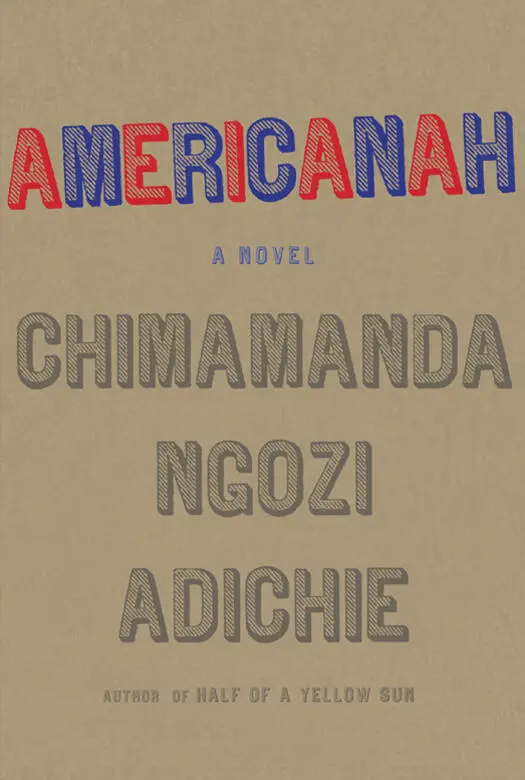
- Название:Americanah
- Автор:
- Издательство:Knopf
- Жанр:
- Год:2013
- ISBN:нет данных
- Рейтинг книги:4 / 5. Голосов: 1
-
Избранное:Добавить в избранное
- Отзывы:
-
Ваша оценка:
Americanah: краткое содержание, описание и аннотация
Предлагаем к чтению аннотацию, описание, краткое содержание или предисловие (зависит от того, что написал сам автор книги «Americanah»). Если вы не нашли необходимую информацию о книге — напишите в комментариях, мы постараемся отыскать её.
, a dazzling new novel: a story of love and race centered around a young man and woman from Nigeria who face difficult choices and challenges in the countries they come to call home.
As teenagers in a Lagos secondary school, Ifemelu and Obinze fall in love. Their Nigeria is under military dictatorship, and people are leaving the country if they can. Ifemelu — beautiful, self-assured — departs for America to study. She suffers defeats and triumphs, finds and loses relationships and friendships, all the while feeling the weight of something she never thought of back home: race. Obinze — the quiet, thoughtful son of a professor — had hoped to join her, but post-9/11 America will not let him in, and he plunges into a dangerous, undocumented life in London.
Years later, Obinze is a wealthy man in a newly democratic Nigeria, while Ifemelu has achieved success as a writer of an eye-opening blog about race in America. But when Ifemelu returns to Nigeria, and she and Obinze reignite their shared passion — for their homeland and for each other — they will face the toughest decisions of their lives.
Fearless, gripping, at once darkly funny and tender, spanning three continents and numerous lives,
is a richly told story set in today’s globalized world: Chimamanda Ngozi Adichie’s most powerful and astonishing novel yet.
Americanah — читать онлайн бесплатно полную книгу (весь текст) целиком
Ниже представлен текст книги, разбитый по страницам. Система сохранения места последней прочитанной страницы, позволяет с удобством читать онлайн бесплатно книгу «Americanah», без необходимости каждый раз заново искать на чём Вы остановились. Поставьте закладку, и сможете в любой момент перейти на страницу, на которой закончили чтение.
Интервал:
Закладка:
“I want to help my mom out. Things are tight at home,” she said, a trace of a non-British accent underlining her words.
“She’s with us, yeah,” one of the Angolans said, impatiently, as though Obinze had dared to question what they had already told him.
“Show him your details, Cleo,” the other Angolan said.
His calling her Cleo rang false: Obinze sensed this from the way he said it, and from the way she heard it, the slight surprise on her face. It was a forced intimacy; the Angolan had never called her Cleo before. Perhaps he had never even called her anything before. Obinze wondered how the Angolans knew her. Did they have a list of young women with European Union passports who needed money? Cleotilde pushed at her hair, a mass of tight coils, and adjusted her glasses, as though first preparing herself before she presented her passport and license. Obinze examined them. He would have thought her younger than twenty-three.
“Can I have your number?” Obinze asked.
“Just call us for anything,” the Angolans said, almost at the same time. But Obinze wrote his number on a napkin and pushed it across to her. The Angolans gave him a sly look. Later, on the phone, she told him that she had been living in London for six years and was saving money to go to fashion school, even though the Angolans had told him she lived in Portugal.
“Would you like to meet?” he asked. “It will be much easier if we try to get to know each other a little.”
“Yes,” she said without hesitation.
They ate fish and chips in a pub, a thin crust of grime on the sides of the wood table, while she talked about her love of fashion and asked him about Nigerian traditional dress. She seemed a little more mature; he noticed the shimmer on her cheeks, the more defined curl of her hair, and knew she had made an effort with her appearance.
“What will you do after you get your papers?” she asked him. “Will you bring your girlfriend from Nigeria?”
He was touched by her obviousness. “I don’t have a girlfriend.”
“I’ve never been to Africa. I’d love to go.” She said “Africa” wistfully, like an admiring foreigner, loading the word with exotic excitement. Her black Angolan father had left her white Portuguese mother when she was only three years old, she told him, and she had not seen him since, nor had she ever been to Angola. She said this with a shrug and a cynical raise of her eyebrows, as though it had not bothered her, an effort so out of character, so jarring, that it showed him just how deeply it did bother her. There were difficulties in her life that he wanted to know more about, parts of her thick shapely body that he longed to touch, but he was wary of complicating things. He would wait until after the marriage, until the business side of their relationship was finished. She seemed to understand this without their talking about it. And so as they met and talked in the following weeks, sometimes practicing how they would answer questions during their immigration interview and other times just talking about football, there was, between them, the growing urgency of restrained desire. It was there in their standing close to each other, not touching, as they waited at the tube station, in their teasing each other about his support of Arsenal and her support of Manchester United, in their lingering gazes. After he had paid the Angolans two thousand pounds in cash, she told him that they had given her only five hundred pounds.
“I’m just telling you. I know you don’t have any more money. I want to do this for you,” she said.
She was looking at him, her eyes liquid with things unsaid, and she made him feel whole again, made him remember how starved he was for something simple and pure. He wanted to kiss her, her upper lip pinker and shinier with lip gloss than the lower, to hold her, to tell her how deeply, irrepressibly grateful he was. She would never stir his cauldron of worries, never wave her power in his face. One Eastern European woman, Iloba had told him, had asked the Nigerian man, an hour before their court wedding, to give her a thousand pounds extra or she would walk away. In panic, the man had begun to call all his friends, to raise the money.
“Man, we gave you a good deal” was all one of the Angolans said when Obinze asked how much they had given Cleotilde, in that tone of theirs, the tone of people who knew how much they were needed. It was they, after all, who took him to a lawyer’s office, a low-voiced Nigerian in a swivel chair, sliding backwards to reach a file cabinet as he said, “You can still get married even though your visa is expired. In fact, getting married is now your only choice.” It was they who provided water and gas bills, going back six months, with his name and a Newcastle address, they who found a man who would “sort out” his driving license, a man cryptically called Brown. Obinze met Brown at the train station in Barking; he stood near the gate as agreed, amid the bustle of people, looking around and waiting for his phone to ring because Brown had refused to give him a phone number.
“Are you waiting for somebody?” Brown stood there, a slight man, his winter hat pulled down to his eyebrows.
“Yes. I’m Obinze,” he said, feeling like a character in a spy novel who had to speak in silly code. Brown led him to a quiet corner, handed over an envelope, and there it was, his license, with his photo and the genuine, slightly worn look of something owned for a year. A slight plastic card, but it weighed down his pocket. A few days later, he walked with it into a London building which, from the outside, looked like a church, steepled and grave, but inside was shabby, harried, knotted with people. Signs were scrawled on whiteboards: BIRTHS AND DEATHS THIS WAY. MARRIAGE REGISTRATION THIS WAY. Obinze, his expression carefully frozen in neutrality, handed the license over to the registrar behind the desk.
A woman was walking towards the door, talking loudly to her companion. “Look how crowded this place is. It’s all sham marriages, all of them, now that Blunkett is after them.”
Perhaps she had come to register a death, and her words merely the lonely lashings-out of grief, but he felt the familiar tightening of panic in his chest. The registrar was examining his license, taking too long. The seconds lengthened and curdled. All sham marriages, all of them rang in Obinze’s head. Finally the registrar looked up and pushed across a form.
“Getting married, are we? Congratulations!” The words came out with the mechanical good cheer of frequent repetition.
“Thank you,” Obinze said, and tried to unfreeze his face.
Behind the desk, a whiteboard was propped on a wall, venues and dates of intended marriages written on it in blue; a name at the bottom caught his eye. Okoli Okafor and Crystal Smith . Okoli Okafor was his classmate from secondary school and university, a quiet boy who had been teased for having a surname for a first name, who later joined a vicious cult in university, and then left Nigeria during one of the long strikes. Now here he was, a ghost of a name, about to get married in England. Perhaps it was also a marriage for papers. Okoli Okafor. Everyone called him Okoli Paparazzi in university. On the day Princess Diana died, a group of students had gathered before a lecture, talking about what they had heard on the radio that morning, repeating “paparazzi” over and over, all sounding knowing and cocksure, until, in a lull, Okoli Okafor quietly asked, “But who exactly are the paparazzi? Are they motorcyclists?” and instantly earned himself the nickname Okoli Paparazzi.
The memory, clear as a light beam, took Obinze back to a time when he still believed the universe would bend according to his will. Melancholy descended on him as he left the building. Once, during his final year in the university, the year that people danced in the streets because General Abacha had died, his mother had said, “One day, I will look up and all the people I know will be dead or abroad.” She had spoken wearily, as they sat in the living room, eating boiled corn and ube. He sensed, in her voice, the sadness of defeat, as though her friends who were leaving for teaching positions in Canada and America had confirmed to her a great personal failure. For a moment he felt as if he, too, had betrayed her by having his own plan: to get a postgraduate degree in America, to work in America, to live in America. It was a plan he had had for a long time. Of course he knew how unreasonable the American embassy could be — the vice chancellor, of all people, had once been refused a visa to attend a conference — but he had never doubted his plan. He would wonder, later, why he had been so sure. Perhaps it was because he had never simply wanted to go abroad , as many others did; some people were now going to South Africa, which amused him. It had always been America, only America. A longing nurtured and nursed over many years. The advertisement on NTA for Andrew Checking Out , which he had watched as a child, had given shape to his longings. “Men, I’m checkin’ out,” the character Andrew had said, staring cockily at the camera. “No good roads, no light, no water. Men, you can’t even get a bottle of soft drink!” While Andrew was checking out, General Buhari’s soldiers were flogging adults in the streets, lecturers were striking for better pay, and his mother had decided that he could no longer have Fanta whenever he wanted but only on Sundays, with permission. And so, America became a place where bottles and bottles of Fanta were to be had, without permission. He would stand in front of the mirror and repeat Andrew’s words: “Men, I’m checkin’ out!” Later, seeking out magazines and books and films and secondhand stories about America, his longing took on a minor mystical quality and America became where he was destined to be. He saw himself walking the streets of Harlem, discussing the merits of Mark Twain with his American friends, gazing at Mount Rushmore. Days after he graduated from university, bloated with knowledge about America, he applied for a visa at the American embassy in Lagos.
Читать дальшеИнтервал:
Закладка:
Похожие книги на «Americanah»
Представляем Вашему вниманию похожие книги на «Americanah» списком для выбора. Мы отобрали схожую по названию и смыслу литературу в надежде предоставить читателям больше вариантов отыскать новые, интересные, ещё непрочитанные произведения.






Обсуждение, отзывы о книге «Americanah» и просто собственные мнения читателей. Оставьте ваши комментарии, напишите, что Вы думаете о произведении, его смысле или главных героях. Укажите что конкретно понравилось, а что нет, и почему Вы так считаете.