Chimamanda Adichie - Americanah
Здесь есть возможность читать онлайн «Chimamanda Adichie - Americanah» весь текст электронной книги совершенно бесплатно (целиком полную версию без сокращений). В некоторых случаях можно слушать аудио, скачать через торрент в формате fb2 и присутствует краткое содержание. Год выпуска: 2013, Издательство: Knopf, Жанр: Современная проза, на английском языке. Описание произведения, (предисловие) а так же отзывы посетителей доступны на портале библиотеки ЛибКат.
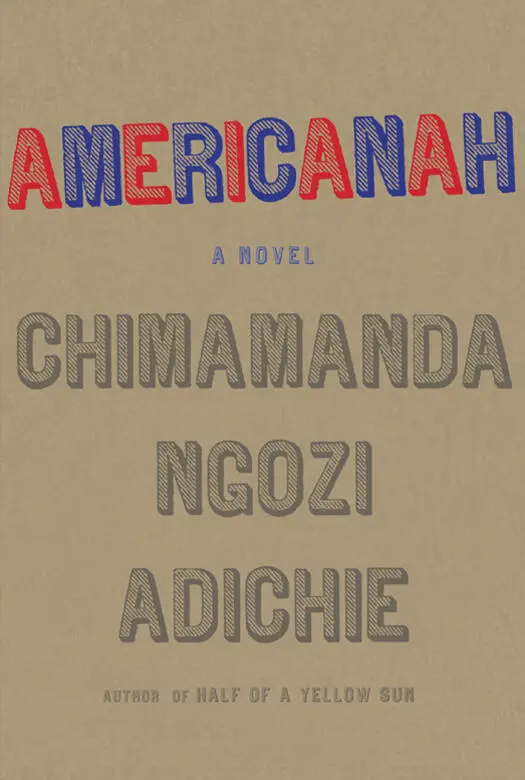
- Название:Americanah
- Автор:
- Издательство:Knopf
- Жанр:
- Год:2013
- ISBN:нет данных
- Рейтинг книги:4 / 5. Голосов: 1
-
Избранное:Добавить в избранное
- Отзывы:
-
Ваша оценка:
Americanah: краткое содержание, описание и аннотация
Предлагаем к чтению аннотацию, описание, краткое содержание или предисловие (зависит от того, что написал сам автор книги «Americanah»). Если вы не нашли необходимую информацию о книге — напишите в комментариях, мы постараемся отыскать её.
, a dazzling new novel: a story of love and race centered around a young man and woman from Nigeria who face difficult choices and challenges in the countries they come to call home.
As teenagers in a Lagos secondary school, Ifemelu and Obinze fall in love. Their Nigeria is under military dictatorship, and people are leaving the country if they can. Ifemelu — beautiful, self-assured — departs for America to study. She suffers defeats and triumphs, finds and loses relationships and friendships, all the while feeling the weight of something she never thought of back home: race. Obinze — the quiet, thoughtful son of a professor — had hoped to join her, but post-9/11 America will not let him in, and he plunges into a dangerous, undocumented life in London.
Years later, Obinze is a wealthy man in a newly democratic Nigeria, while Ifemelu has achieved success as a writer of an eye-opening blog about race in America. But when Ifemelu returns to Nigeria, and she and Obinze reignite their shared passion — for their homeland and for each other — they will face the toughest decisions of their lives.
Fearless, gripping, at once darkly funny and tender, spanning three continents and numerous lives,
is a richly told story set in today’s globalized world: Chimamanda Ngozi Adichie’s most powerful and astonishing novel yet.
Americanah — читать онлайн бесплатно полную книгу (весь текст) целиком
Ниже представлен текст книги, разбитый по страницам. Система сохранения места последней прочитанной страницы, позволяет с удобством читать онлайн бесплатно книгу «Americanah», без необходимости каждый раз заново искать на чём Вы остановились. Поставьте закладку, и сможете в любой момент перейти на страницу, на которой закончили чтение.
Интервал:
Закладка:
“I was planning to come and find you, by the way.” He was looking at her, as though absorbing her details, memorizing her, for when he would tell the story of their meeting.
“Really?”
“So my guy The Zed and I were talking the other day and you came up and he said he’d heard you were living in Baltimore and since I was close by could I just find you and see that you were okay and tell him what you look like now.”
A numbness spread swiftly through her. She mumbled, “Oh, you’re still in touch?”
“Yes. We got back in touch when he moved to England last year.”
England! Obinze was in England. She had created the distance, ignoring him, changing her e-mail address and phone number, and yet she felt deeply betrayed by this news. Changes had been made in his life that she did not know about. He was in England. Only a few months ago, she and Curt had gone to England for the Glastonbury Festival, and later spent two days in London. Obinze might have been there. She might have run into him as she walked down Oxford Street.
“So what happened now? Honestly, I couldn’t believe it when he said you guys were not in touch. Ahn-ahn! All of us were just waiting for the wedding invitation card o!” Kayode said.
Ifemelu shrugged. There were things scattered inside of her that she needed to gather together.
“So how have you been? How is life?” Kayode asked.
“Fine,” she said coldly. “I’m waiting for my boyfriend to pick me up. Actually, I think that’s him.”
There was, in Kayode’s demeanor, a withdrawal of spirit, a pulling back of his army of warmth, because he sensed very well that she had made the choice to shut him out. She was already walking away. Over her shoulder, she said to him, “Take care.” She was supposed to exchange phone numbers, talk for longer, behave in all the expected ways. But emotions were rioting inside her. And she found Kayode guilty for knowing about Obinze, for bringing Obinze back.
“I just ran into an old friend from Nigeria. I haven’t seen him since high school,” she told Curt.
“Oh, really? That’s nice. He live here?”
“In D.C.”
Curt was watching her, expecting more. He would want to ask Kayode to have drinks with them, want to be friends with her friend, want to be as gracious as he always was. And this, his expectant expression, irritated her. She wanted silence. Even the radio was bothering her. What would Kayode tell Obinze? That she was dating a handsome white man in a BMW coupe, her hair an Afro, a red flower tucked behind her ear. What would Obinze make of this? What was he doing in England? A clear memory came to her, of a sunny day — the sun was always shining in her memories of him and she distrusted this — when his friend Okwudiba brought a videocassette to his house, and Obinze said, “A British film? Waste of time.” To him, only American films were worth watching. And now he was in England.
Curt was looking at her. “Seeing him upset you?”
“No.”
“Was he like a boyfriend or something?”
“No,” she said, looking out of the window.
Later that day she would send an e-mail to Obinze’s Hotmail address: Ceiling, I don’t even know how to start. I ran into Kayode today at the mall. Saying sorry for my silence sounds stupid even to me but I am so sorry and I feel so stupid. I will tell you everything that happened. I have missed you and I miss you . And he would not reply.
“I booked the Swedish massage for you,” Curt said.
“Thank you,” she said. Then, in a lower voice, she added, to make up for her peevishness, “You are such a sweetheart.”
“I don’t want to be a sweetheart. I want to be the fucking love of your life,” Curt said with a force that startled her.
Part 3
CHAPTER 23
In London, night came too soon, it hung in the morning air like a threat, and then in the afternoon a blue-gray dusk descended, and the Victorian buildings all wore a mournful air. In those first weeks, the cold startled Obinze with its weightless menace, drying his nostrils, deepening his anxieties, making him urinate too often. He would walk fast on the pavement, turned tightly into himself, hands deep in the coat his cousin had lent him, a gray wool coat whose sleeves nearly swallowed his fingers. Sometimes he would stop outside a tube station, often by a flower or a newspaper vendor, and watch the people brushing past him. They walked so quickly, these people, as though they had an urgent destination, a purpose to their lives, while he did not. His eyes would follow them, with a lost longing, and he would think: You can work, you are legal, you are visible, and you don’t even know how fortunate you are .
It was at a tube station that he met the Angolans who would arrange his marriage, exactly two years and three days after he arrived in England; he kept count.
“We’ll talk in the car,” one of them had said earlier over the phone. Their old model black Mercedes was fussily maintained, the floor mats wavy from vacuuming, the leather seats shiny with polish. The two men looked alike, with thick eyebrows that almost touched, although they had told him they were just friends, and they were dressed alike, too, in leather jackets and long gold chains. Their tabletop haircuts that sat on their heads like tall hats surprised him, but perhaps it was part of their hip image, to have retro haircuts. They spoke to him with the authority of people who had done this before, and also with a slight condescension; his fate was, after all, in their hands.
“We decided on Newcastle because we know people there and London is too hot right now, too many marriages happening in London, yeah, so we don’t want trouble,” one of them said. “Everything is going to work out. Just make sure you keep a low profile, yeah? Don’t attract any attention to yourself until the marriage is done. Don’t fight in the pub, yeah?”
“I’ve never been a very good fighter,” Obinze said drily, but the Angolans did not smile.
“You have the money?” the other one asked.
Obinze handed over two hundred pounds, all in twenty-pound notes that he had taken out of the cash machine over two days. It was a deposit, to prove he was serious. Later, after he met the girl, he would pay two thousand pounds.
“The rest has to be up front, yeah? We’ll use some of it to do the running around and the rest goes to the girl. Man, you know we’re not making anything from this. We usually ask for much more but we’re doing this for Iloba,” the first one said.
Obinze did not believe them, even then. He met the girl, Cleotilde, a few days later, at a shopping center, in a McDonald’s whose windows looked out onto the dank entrance of a tube station across the street. He sat at a table with the Angolans, watching people hurry past, and wondering which of them was her, while the Angolans both whispered into their phones; perhaps they were arranging other marriages.
“Hello there!” she said.
She surprised him. He had expected somebody with pockmarks smothered under heavy makeup, somebody tough and knowing. But here she was, dewy and fresh, bespectacled, olive-skinned, almost childlike, smiling shyly at him and sucking a milkshake through a straw. She looked like a university freshman who was innocent or dumb, or both.
“I just want to know that you’re sure about doing this,” he told her, and then, worried that he might frighten her away, he added, “I’m very grateful, and it won’t take too much from you — in a year I’ll have my papers and we’ll do the divorce. But I just wanted to meet you first and make sure you are okay to do this.”
“Yes,” she said.
He watched her, expecting more. She played with her straw, shyly, not meeting his eyes, and it took him a while to realize that she was reacting more to him than to the situation. She was attracted to him.
Читать дальшеИнтервал:
Закладка:
Похожие книги на «Americanah»
Представляем Вашему вниманию похожие книги на «Americanah» списком для выбора. Мы отобрали схожую по названию и смыслу литературу в надежде предоставить читателям больше вариантов отыскать новые, интересные, ещё непрочитанные произведения.









Обсуждение, отзывы о книге «Americanah» и просто собственные мнения читателей. Оставьте ваши комментарии, напишите, что Вы думаете о произведении, его смысле или главных героях. Укажите что конкретно понравилось, а что нет, и почему Вы так считаете.