Chimamanda Adichie - Americanah
Здесь есть возможность читать онлайн «Chimamanda Adichie - Americanah» весь текст электронной книги совершенно бесплатно (целиком полную версию без сокращений). В некоторых случаях можно слушать аудио, скачать через торрент в формате fb2 и присутствует краткое содержание. Год выпуска: 2013, Издательство: Knopf, Жанр: Современная проза, на английском языке. Описание произведения, (предисловие) а так же отзывы посетителей доступны на портале библиотеки ЛибКат.
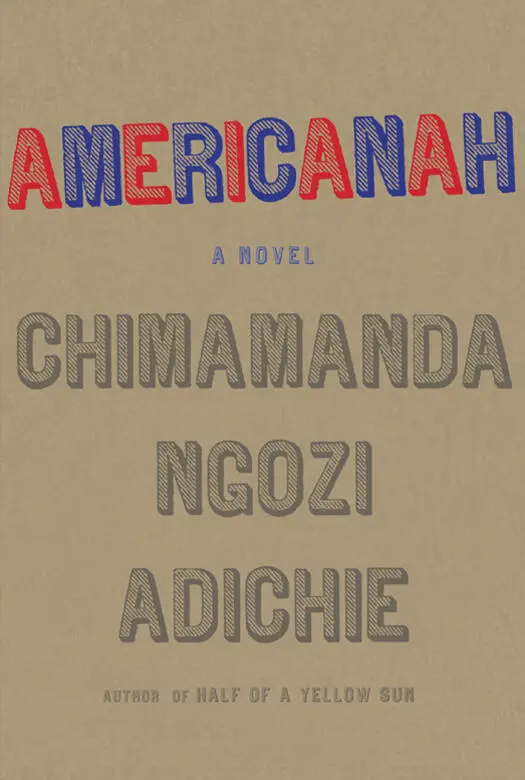
- Название:Americanah
- Автор:
- Издательство:Knopf
- Жанр:
- Год:2013
- ISBN:нет данных
- Рейтинг книги:4 / 5. Голосов: 1
-
Избранное:Добавить в избранное
- Отзывы:
-
Ваша оценка:
Americanah: краткое содержание, описание и аннотация
Предлагаем к чтению аннотацию, описание, краткое содержание или предисловие (зависит от того, что написал сам автор книги «Americanah»). Если вы не нашли необходимую информацию о книге — напишите в комментариях, мы постараемся отыскать её.
, a dazzling new novel: a story of love and race centered around a young man and woman from Nigeria who face difficult choices and challenges in the countries they come to call home.
As teenagers in a Lagos secondary school, Ifemelu and Obinze fall in love. Their Nigeria is under military dictatorship, and people are leaving the country if they can. Ifemelu — beautiful, self-assured — departs for America to study. She suffers defeats and triumphs, finds and loses relationships and friendships, all the while feeling the weight of something she never thought of back home: race. Obinze — the quiet, thoughtful son of a professor — had hoped to join her, but post-9/11 America will not let him in, and he plunges into a dangerous, undocumented life in London.
Years later, Obinze is a wealthy man in a newly democratic Nigeria, while Ifemelu has achieved success as a writer of an eye-opening blog about race in America. But when Ifemelu returns to Nigeria, and she and Obinze reignite their shared passion — for their homeland and for each other — they will face the toughest decisions of their lives.
Fearless, gripping, at once darkly funny and tender, spanning three continents and numerous lives,
is a richly told story set in today’s globalized world: Chimamanda Ngozi Adichie’s most powerful and astonishing novel yet.
Americanah — читать онлайн бесплатно полную книгу (весь текст) целиком
Ниже представлен текст книги, разбитый по страницам. Система сохранения места последней прочитанной страницы, позволяет с удобством читать онлайн бесплатно книгу «Americanah», без необходимости каждый раз заново искать на чём Вы остановились. Поставьте закладку, и сможете в любой момент перейти на страницу, на которой закончили чтение.
Интервал:
Закладка:
Ifemelu felt only a slight burning, at first, but as the hairdresser rinsed out the relaxer, Ifemelu’s head bent backwards against a plastic sink, needles of stinging pain shot up from different parts of her scalp, down to different parts of her body, back up to her head.
“Just a little burn,” the hairdresser said. “But look how pretty it is. Wow, girl, you’ve got the white-girl swing!”
Her hair was hanging down rather than standing up, straight and sleek, parted at the side and curving to a slight bob at her chin. The verve was gone. She did not recognize herself. She left the salon almost mournfully; while the hairdresser had flat-ironed the ends, the smell of burning, of something organic dying which should not have died, had made her feel a sense of loss. Curt looked uncertain when he saw her.
“Do you like it, babe?” he asked.
“I can see you don’t,” she said.
He said nothing. He reached out to stroke her hair, as though doing so might make him like it.
She pushed him away. “Ouch. Careful. I have a bit of relaxer burn.”
“What?”
“It’s not too bad. I used to get it all the time in Nigeria. Look at this.”
She showed him a keloid behind her ear, a small enraged swelling of skin, which she got after Aunty Uju straightened her hair with a hot comb in secondary school. “Pull back your ear,” Aunty Uju often said, and Ifemelu would hold her ear, tense and unbreathing, terrified that the red-hot comb fresh from the stove would burn her but also excited by the prospect of straight, swingy hair. And one day it did burn her, as she moved slightly and Aunty Uju’s hand moved slightly and the hot metal singed the skin behind her ear.
“Oh my God,” Curt said, his eyes wide. He insisted on gently looking at her scalp to see how much she had been hurt. “Oh my God.”
His horror made her more concerned than she would ordinarily have been. She had never felt so close to him as she did then, sitting still on the bed, her face sunk in his shirt, the scent of fabric softener in her nose, while he gently parted her newly straightened hair.
“Why do you have to do this? Your hair was gorgeous braided. And when you took out the braids the last time and just kind of let it be? It was even more gorgeous, so full and cool.”
“My full and cool hair would work if I were interviewing to be a backup singer in a jazz band, but I need to look professional for this interview, and professional means straight is best but if it’s going to be curly then it has to be the white kind of curly, loose curls or, at worst, spiral curls but never kinky.”
“It’s so fucking wrong that you have to do this.”
At night, she struggled to find a comfortable position on her pillow. Two days later, there were scabs on her scalp. Three days later, they oozed pus. Curt wanted her to see a doctor and she laughed at him. It would heal, she told him, and it did. Later, after she breezed through the job interview, and the woman shook her hand and said she would be a “wonderful fit” in the company, she wondered if the woman would have felt the same way had she walked into that office wearing her thick, kinky, God-given halo of hair, the Afro.
She did not tell her parents how she got the job; her father said, “I have no doubt that you will excel. America creates opportunities for people to thrive. Nigeria can indeed learn a lot from them,” while her mother began to sing when Ifemelu said that, in a few years, she could become an American citizen.
Understanding America for the Non-American Black: What Do WASPs Aspire To?
Professor Hunk has a visiting professor colleague, a Jewish guy with a thick accent from the kind of European country where most people drink a glass of antisemitism at breakfast. So Professor Hunk was talking about civil rights and Jewish guy says, “The blacks have not suffered like the Jews.” Professor Hunk replies, “Come on, is this the oppression olympics?”
Jewish guy did not know this, but “oppression olympics” is what smart liberal Americans say, to make you feel stupid and to make you shut up. But there IS an oppression olympics going on. American racial minorities — blacks, Hispanics, Asians, and Jews — all get shit from white folks, different kinds of shit, but shit still. Each secretly believes that it gets the worst shit. So, no, there is no United League of the Oppressed. However, all the others think they’re better than blacks because, well, they’re not black. Take Lili, for example, the coffee-skinned, black-haired and Spanish-speaking woman who cleaned my aunt’s house in a New England town. She had a great hauteur. She was disrespectful, cleaned poorly, made demands. My aunt believed Lili didn’t like working for black people. Before she finally fired her, my aunt said, “Stupid woman, she thinks she’s white.” So whiteness is the thing to aspire to. Not everyone does, of course (please, commenters, don’t state the obvious) but many minorities have a conflicted longing for WASP whiteness or, more accurately, for the privileges of WASP whiteness. They probably don’t really like pale skin but they certainly like walking into a store without some security dude following them. Hating Your Goy and Eating One Too, as the great Philip Roth put it. So if everyone in America aspires to be WASPs, then what do WASPs aspire to? Does anyone know?
CHAPTER 20
Ifemelu came to love Baltimore — for its scrappy charm, its streets of faded glory, its farmers market that appeared on weekends under the bridge, bursting with green vegetables and plump fruit and virtuous souls — although never as much as her first love, Philadelphia, that city that held history in its gentle clasp. But when she arrived in Baltimore knowing she was going to live there, and not merely visiting Curt, she thought it forlorn and unlovable. The buildings were joined to one another in faded slumping rows, and on shabby corners, people were hunched in puffy jackets, black and bleak people waiting for buses, the air around them hazed in gloom. Many of the drivers outside the train station were Ethiopian or Punjabi.
Her Ethiopian taxi driver said, “I can’t place your accent. Where are you from?”
“Nigeria.”
“Nigeria? You don’t look African at all.”
“Why don’t I look African?”
“Because your blouse is too tight.”
“It is not too tight.”
“I thought you were from Trinidad or one of those places.” He was looking in the rearview with disapproval and concern. “You have to be very careful or America will corrupt you.” When, years later, she wrote the blog post “On the Divisions Within the Membership of Non-American Blacks in America,” she wrote about the taxi driver, but she wrote of it as the experience of someone else, careful not to let on whether she was African or Caribbean, because her readers did not know which she was.
She told Curt about the taxi driver, how his sincerity had infuriated her and how she had gone to the station bathroom to see if her pink long-sleeved blouse was too tight. Curt laughed and laughed. It became one of the many stories he liked to tell friends. She actually went to the bathroom to look at her blouse! His friends were like him, sunny and wealthy people who existed on the glimmering surface of things. She liked them, and sensed that they liked her. To them, she was interesting, unusual in the way she bluntly spoke her mind. They expected certain things of her, and forgave certain things from her, because she was foreign. Once, sitting with them in a bar, she heard Curt talking to Brad, and Curt said “blowhard.” She was struck by the word, by the irredeemable Americanness of it. Blowhard. It was a word that would never occur to her. To understand this was to realize that Curt and his friends would, on some level, never be fully knowable to her.
Читать дальшеИнтервал:
Закладка:
Похожие книги на «Americanah»
Представляем Вашему вниманию похожие книги на «Americanah» списком для выбора. Мы отобрали схожую по названию и смыслу литературу в надежде предоставить читателям больше вариантов отыскать новые, интересные, ещё непрочитанные произведения.







Обсуждение, отзывы о книге «Americanah» и просто собственные мнения читателей. Оставьте ваши комментарии, напишите, что Вы думаете о произведении, его смысле или главных героях. Укажите что конкретно понравилось, а что нет, и почему Вы так считаете.